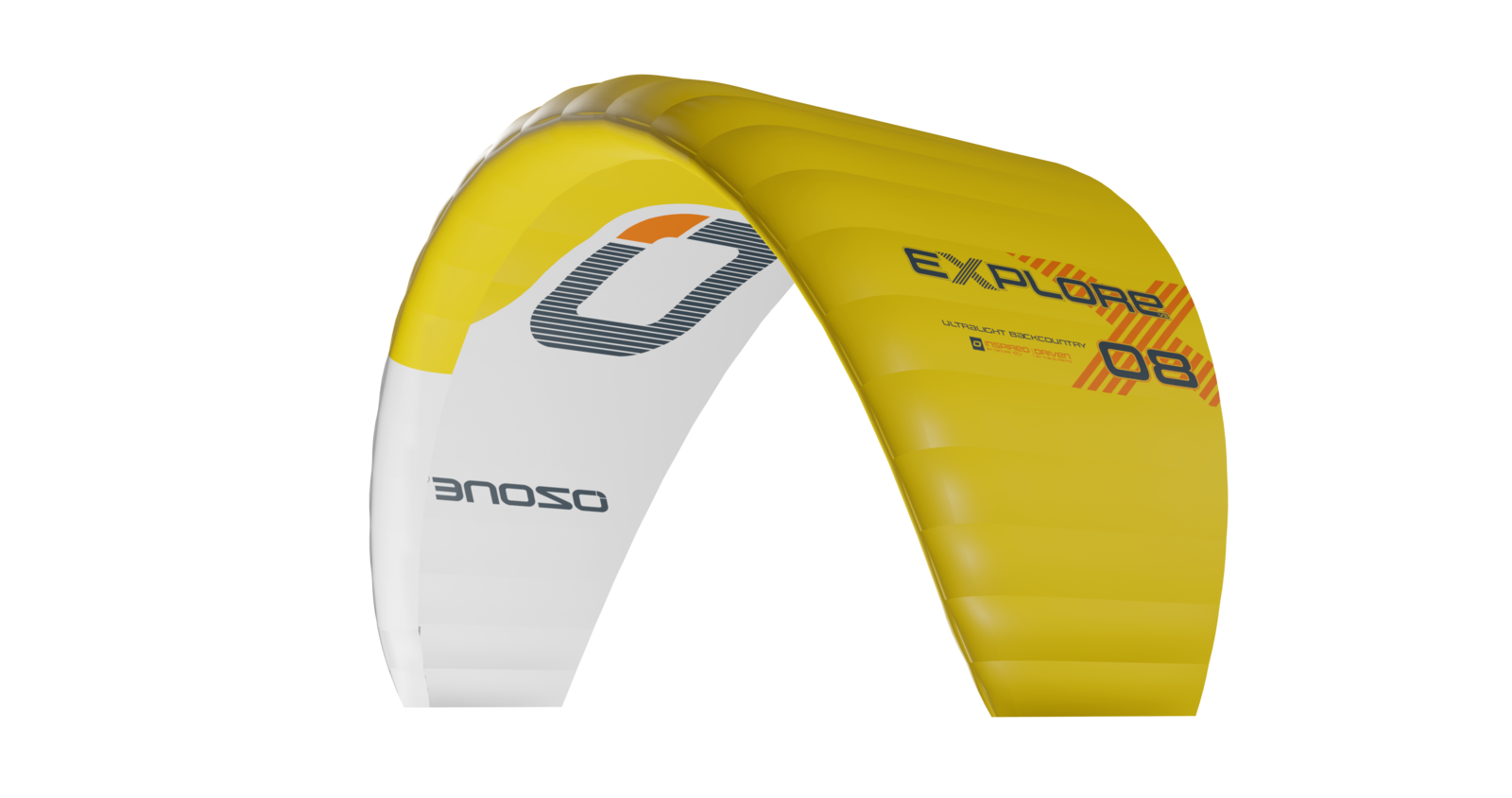
The Explore V3 is the entry point into Ozone's foil kites. Five sizes, prices from
919 €, and a note in the specification that is rare for this class: rider level, beginner and up. Here is how a foil kite manages to be simple.The short version
- Sizes: 4, 6, 8, 10 and 12 m².
- Construction: single-skin foil kite, 25 cells.
- Aspect ratio: 4.45 flat, 2.85 projected.
- Lines: 22 m on the small sizes, 25 m on the large.
- Disciplines: freeride, freestyle, backcountry, expeditions.
- Price: from
What a single-skin canopy is
A normal foil kite has two surfaces, upper and lower, with cells between them filled by incoming airflow. A single-skin has no lower surface: what remains is the upper skin and the ribs that set the shape.
Three things follow from that.
The kite weighs almost nothing. Half the material, half the mass.
It inflates instantly. There is nothing to fill gradually: the canopy opens at once.
It holds neither water nor snow. That is the key point in the mountains: a twin-skin kite dropped in deep snow can pack its cells; a single-skin has nothing to pack.
The price is efficiency. An incomplete profile means less lift per unit of area, more modest upwind performance and lower speed. An aspect ratio of 4.45 is a deliberately low number for a foil kite, and it buys simplicity rather than performance.
Why it forgives
A beginner's main fear about foil kites is the collapse. The kite loses tension, the canopy folds, and from there you need to know what to do.
A single-skin behaves more gently in that moment: it is light, it carries little inertia, and it reopens more willingly because it needs less air to fill. Add the low aspect ratio — a short wide wing is more stable than a long narrow one.
That is exactly why the spec sheet says beginner. Not because the kite is weak, but because it does not punish a pause in your reaction.
Sizes: how foil kites differ from inflatables
Note the spread: 4, 6, 8, 10, 12. Two-metre steps, and the 4 m is a working size rather than a toy.
On snow there is less resistance than on water, and the kite does not have to drag you out onto the plane. So small sizes on snow work in wind ranges where on water you would be sitting on the beach.
A typical snow-season pair is 6 and 10. An 8 m as a single kite works for a mid-weight rider on a spot with steady wind.
Who it suits
Anyone starting on snow. The main scenario: a simple profile, predictable behaviour, an accessible price.
Backcountry and touring. Weight and pack volume decide things when you are out for days.
As a second light-wind kite. A single-skin flies where an inflatable is still lying on the ground.
Anyone trying foil kites for the first time. It is the cheapest way to find out whether this is for you without committing
2 500 €.Who it does not suit
Riders who want speed and upwind. The low aspect ratio works against you here — look at the Hyperlink or the EXP.
Water use. The Explore is built for snow. A single-skin will not sink, but it is not intended for water sessions.
Racers. That is the far end of the range — the R1 V5.
What you need alongside it
A foil-kite bar: the Contact Snow V5. A snow harness: the Connect Snow V4, or the Backcountry V4 if you tour with a pack.
And separately, a snow kit backpack. On a tour that is not an accessory but part of the equipment.
Common questions
Can I ride the Explore V3 on water?
It will not sink, but it is a snow kite. For water you need a closed-cell — the Hyperlink V4.
How many lines does the Explore use?
Ozone's single-skin snow kites run a five-line setup — the standard in the mountains, where full depower matters.
Is one size enough?
On a steady spot, yes. Mountain wind varies more than coastal wind, and two sizes give noticeably more riding.
How noisy is it?
Single-skins rustle more than twin-skins. It surprises you on the first session and you stop noticing within an hour.
How does the V3 differ from the previous version?
The model evolves: profile, panel layout and finish. The job and the class are unchanged.
Where to buy
Ozone Explore V3 — from
919 €, five sizes. The whole foil range is in our range overview, and snow equipment in the snowkite section.Ozone Explore V3 Kite at K1.surf
Official Ozone dealer. From 919 €. Our IKO instructors match the size to your weight, level and wind.
Read next
AXIS offers a four-component configurator rather than a finished foil. How to choose in the right order, which…
Foil Etiquette: Why Foilers Are Unpopular and How to Fix ItA metal wing underwater is invisible, and that is the root of every conflict at a spot. The rules that formed …
Where to Start in Foiling: A Two-Year RouteFive foil disciplines, and the order of learning is not arbitrary. Which to start with, how long each stage ta…