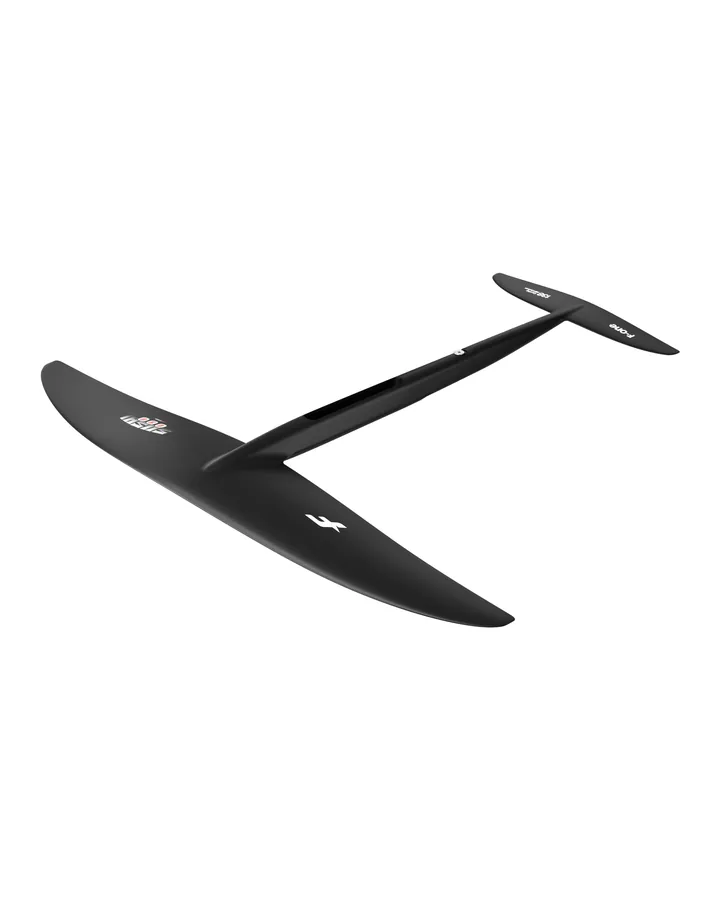
At many spots foilers are met warily, and at some they are given a separate zone outright. Here is how that came about and how to behave so there is no conflict.
The root of it: the wing is invisible
A surfer sees a board and a person. They do not see a metre-long mast with a metal wing beneath the water.
Everything else follows:
- They judge distance from the board, while the danger zone sits a metre deeper and wider.
- In a fall the foil carries on by inertia in the direction you were travelling — and it is sharp.
- A foil moves fast and almost silently. Nobody hears you.
Hence the main principle: the foiler keeps the distance, not the people around. They physically cannot assess the risk you create.
The rules that formed by themselves
1. Do not ride the main peak
The most important one. Every wave spot has a place where surfers gather. A foiler has no business there — not because anyone outranks anyone, but because you can ride where they cannot: gentle, crumbling, "junk" waves.
That is an advantage rather than a concession: prone foiling does not need a good wave, so you get empty water instead of a queue.
2. Keep three times your usual distance
A rule that seems excessive right up until the first incident. Assume a radius of several metres around you where nobody should be.
3. Fall flat and to the side
Not backwards and not onto the board. It is the first thing taught before flying, and it also protects others: a controlled fall leaves the foil beneath you rather than sending it flying.
4. Never ride between people
Even when the gap looks sufficient. The danger zone is wider than it looks.
5. Call out
You cannot be heard, so announce yourself. A short "foil!" on approach prevents more conflict than any explanation ashore.
6. Always give way
Even when the right of way is yours. The cost of error is asymmetric: you get a ruined session, the other person gets a laceration.
Separately on electric assist
A motor adds a second irritant to the invisible wing — noise and speed where they are not expected.
Practical rules:
- Do not run the motor in swimming areas or near surfers.
- Check the waterway rules: powered and unpowered craft are different categories.
- Do not approach people under power any closer than a manoeuvre requires.
On the discipline itself, see our assist article.
What a beginner should do at a busy spot
The answer is short: do not go there until you fly confidently.
Why that matters. A beginner falls every two minutes, cannot control the direction of the fall, and cannot steer the foil away from people. They are dangerous by level rather than by intent.
Where to learn:
- Empty water, at least a metre and a half deep.
- Away from swimming and surfing areas.
- Not in the impact zone: it is shallow and the foil reaches the bottom.
- Better still, with a school where a zone is set aside and someone is watching.
Safety for yourself
Half of etiquette is about others; the other half is about you.
Helmet. Not against someone else's foil but your own: in a fall you go forward and the wing follows.
Vest. It helps you surface and keeps you up when tired.
Board leash. But deliberately: in current a leash can become a problem, and there you want a quick-release version.
Depth. A 70 to 90 cm mast plus margin. In shallows you will plant the wing at speed.
Never alone. Especially in pumping and downwind, where no thrust will carry you out.
Why this is worth observing
Out of pragmatism rather than politeness.
Spots get closed. One injury incident and a beach bans foiling for everyone. Such decisions are taken quickly and reversed over years.
The discipline is young. Its reputation is being formed now, and you are forming it.
And the simplest reason: the separate zone you get pushed into usually turns out better than the main one. In prone and wing foiling you do not need a queue for a perfect wave.
Common questions
Why are foilers unpopular at spots?
A metal wing underwater is invisible, so others cannot judge the danger zone. The foiler keeps the distance.
Can I foil among surfers?
Better not. A foil rides gentle, crumbling waves a surfer cannot — empty water and no conflict.
How should I fall?
Flat and to the side, never backwards. A controlled fall leaves the foil beneath you.
Where should a beginner learn?
On empty water at least a metre and a half deep, away from swimming and surf zones, preferably with a school.
What is different with electric assist?
The motor adds noise and speed. Do not run it near people, and check the waterway rules.
What to read next
Try kitesurfing in Mui Ne
A trial hour with an IKO instructor is €55, all gear included. Then a course to independent riding or a December kite camp.
Read next
AXIS offers a four-component configurator rather than a finished foil. How to choose in the right order, which…
Where to Start in Foiling: A Two-Year RouteFive foil disciplines, and the order of learning is not arbitrary. Which to start with, how long each stage ta…
Electric Assist for Foiling: A Motor You Run for Twenty SecondsFoil Drive and Assist put a compact motor on the mast to get you up to takeoff speed. How it works, what it co…