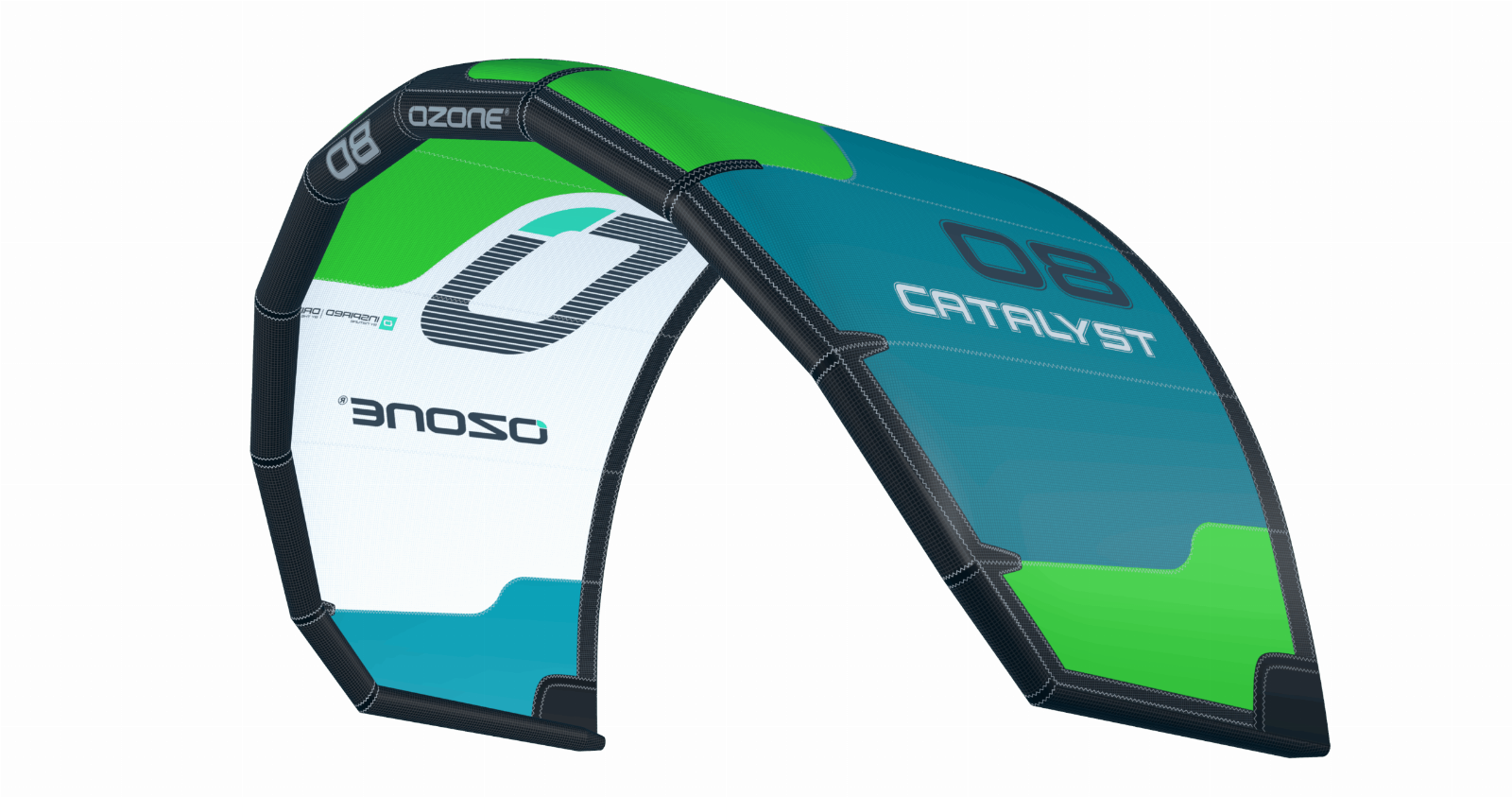
A foil kite has no inflatable frame: its shape is held by airflow entering the cells of the canopy. Ozone builds five of them, and they differ from each other far more than the inflatable models do. Here is the whole range.
The short version: who is who
- Explore V3 — single-skin, snow and backcountry, all levels. From
Single-skin, open-cell, closed-cell — three constructions
This is the main division, and the range makes no sense without it.
Single-skin means the canopy has only an upper surface, with no lower one. Hence minimal weight and near-instant inflation. Such a kite does not sink and relaunches easily: there is nowhere for water to sit. You pay for that in efficiency — the profile is incomplete, so speed and upwind performance drop. The Explore V3 and Alpha V3 are built this way.
Open-cell means a full twin-skin profile with open intakes. Efficiency is high, but a kite that lands in water takes water on. So open-cells live on snow and land. That is the EXP.
Closed-cell uses the same two skins, but the intakes have valves that hold air inside. The kite stays inflated on the water and relaunches from it. That is the Hyperlink and the R1.
The practical conclusion: construction decides where a kite can work at all, long before any specification does.
Aspect ratio: the number that defines a foil kite
Inflatable kites sit in a narrow aspect-ratio corridor. Foil kites spread widely, and the spread tells you the job directly.
- Explore V3 — 4.45 flat, 2.85 projected.
- Hyperlink V4 — 4.98 and 3.63.
- EXP — 5.31 to 6.24, rising with size.
- R1 V5 — 6.5 to 7.0 flat, 4.9 to 5.3 projected.
The higher the aspect ratio, the more efficient the wing: more lift per unit of area, better upwind, higher speed. And the more nervous it is: a long narrow wing is harder to sort out after a collapse and less tolerant of mistakes.
Seven on the R1 against four and a half on the Explore is the difference between a glider and a parachute. Both fly. They ask different things of the pilot.
Weight: where foil kites beat inflatables
The Hyperlink V4 at 5 m weighs 1 kg. The 13 m weighs 1.9 kg. For comparison, an inflatable kite of the same size weighs two to three times more.
Why that matters: lift first has to hold the kite itself up, and only the remainder reaches you. In light wind a kilogram is the difference between a session and sitting on the beach.
The second consequence is luggage. Three foil kites fit in a backpack. Three inflatables are a separate bag and an excess-weight fee.
How to pick yours
You ride snow and you are starting out. Explore V3. A simple profile, rated beginner and up, 4 to 12 m, from
919 € — the most affordable way into foil kites.You want one kite for water and snow. Hyperlink V4. It works as a closed-cell four-line kite on water and switches to open-cell five-line mode for the mountains.
You do multi-day tours. EXP. Open-cell, from 1.5 kg, with backcountry and expeditions listed among its disciplines.
You race on a foil. R1 V5. Eight sizes up to 21 m, 11 to 14 m lines, rated advanced and expert. The freeride DNA was removed on purpose.
You want minimum weight in your luggage. Alpha V3 Ultra-X — the 4 m weighs 1.1 kg. We covered it in a separate review.
What foil kites cannot do
Honestly, so there is no disappointment later.
They forgive mistakes in the air less. A collapsed foil kite does not recover by itself — you have to open it, and there is a skill to that.
The lines are longer and there are more of them. A five-line setup demands care when packing: tangled foil-kite lines take longer to sort.
Single-skins are noisy. A detail, but it surprises people on the first session.
An open-cell in the water ends the session. Do not mix the models up.
Common questions
Can I learn on a foil kite straight away?
On snow, yes — the Explore V3 is rated from beginner. On water, start on an inflatable: relaunch is simpler and schools teach on them.
Are foil kites more dangerous?
Not more dangerous, but different. The key distinction is what happens when tension is lost: an inflatable falls, a foil kite collapses. Both scenarios are covered in a course.
How long does a foil kite last?
Longer than an inflatable if handled carefully: there is no bladder to leak and no leading edge to burst. The main enemies are sand in the cells and UV.
Do I need a special bar?
For five-line models, yes. From Ozone that is the Contact Snow V5 and the Snow EXP V5.
Snow or water kite first?
Whichever you actually ride more. The all-round Hyperlink costs more than two specialised kites together at the entry end of the range.
Where to look
The full range is on the Ozone page, and the brand itself in our Ozone review. Kites in stock are in the kite section.
Not sure which is yours? Tell us where you ride and on what, and we will pick one at no charge.
Ozone at K1.surf
Official Ozone dealer. Our IKO instructors match the size to your weight, level and wind.
Read next
AXIS offers a four-component configurator rather than a finished foil. How to choose in the right order, which…
Foil Etiquette: Why Foilers Are Unpopular and How to Fix ItA metal wing underwater is invisible, and that is the root of every conflict at a spot. The rules that formed …
Where to Start in Foiling: A Two-Year RouteFive foil disciplines, and the order of learning is not arbitrary. Which to start with, how long each stage ta…