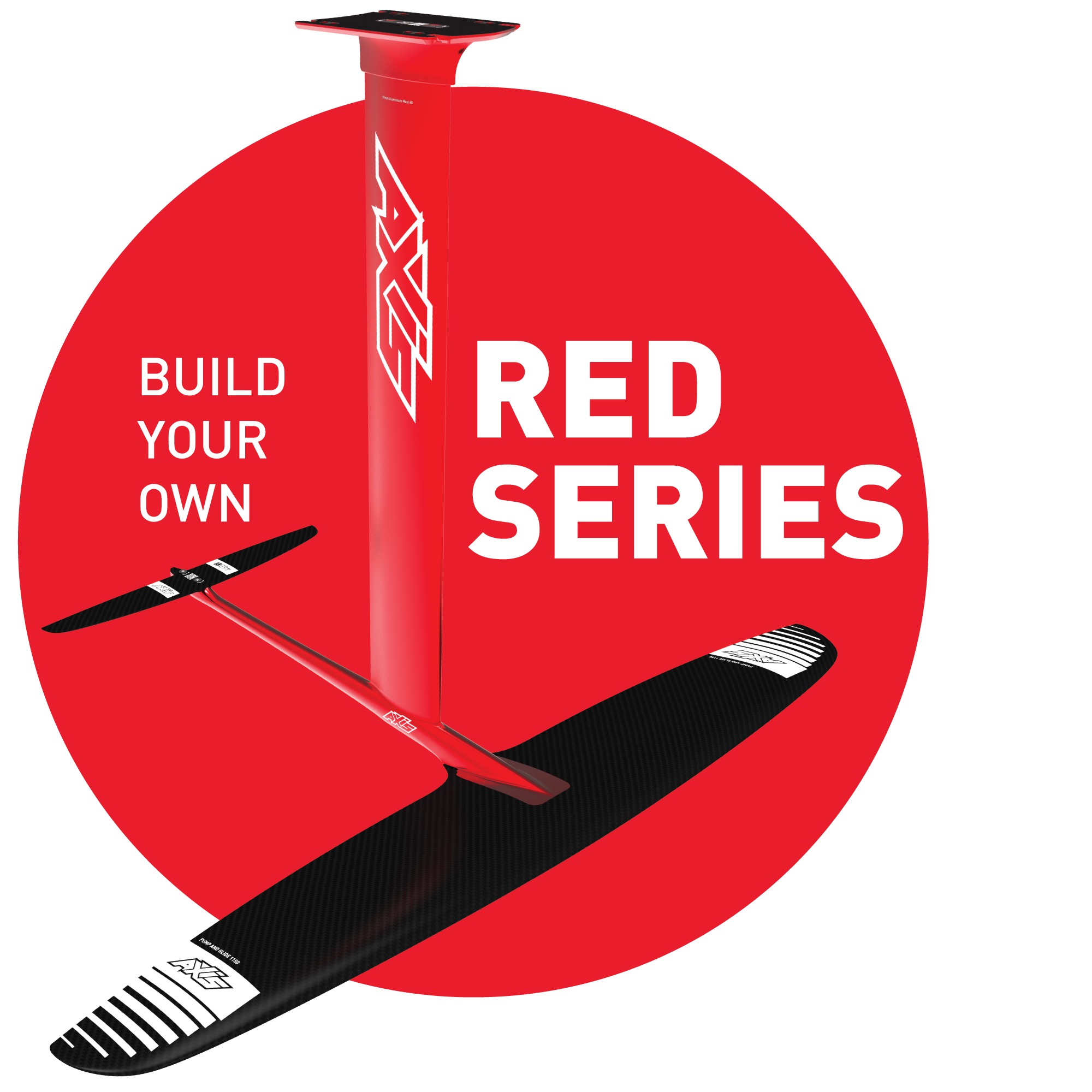
The catalogue holds items that are not products: Build Your Own Black Series, Red Series, Ti Link Package. They are configurators. Here is how to use them.
What you are choosing
Four components, and the order matters:
- Front wing — sets 80 % of the character. From
Series: Black and Red by material and price; Ti Link with a titanium fuselage at
825 €.We confirm pricing for a specific build to order: it depends on the parts chosen. Send us your discipline, weight and spot and we will put together two or three options with prices before payment.
The right order of choosing
This is where mistakes are easiest, so step by step.
Step 1: discipline
Not "foiling" but specifically: wing, prone, downwind, kite, pumping. Everything else follows, and half the catalogue drops away immediately.
Step 2: front wing area by weight
- under 70 kg: 1000 to 1300 cm²
- 70–85 kg: 1300 to 1600 cm²
- over 85 kg: 1500 to 1900 cm²
Those are learning figures; a confident rider drops 20 to 30 % below. Do not buy "to grow into" — the discipline's most expensive mistake.
Step 3: aspect ratio by job
Low for waves and learning, high for downwind and pumping. In detail: our aspect ratio guide.
Step 4: mast by spot depth
Shallow, 60 to 68 cm; universal, 75; ocean and waves, 85 to 90. Material: aluminium to start, carbon once response limits you.
Step 5: fuselage
Standard by default. Shorter only if you genuinely need wave turning.
Step 6: rear wing
20 to 30 % of front wing area. A Freeride profile as a universal start.
Three working combinations
Wing foil, first setup, 80 kg
- Front: 1400 to 1500 cm², low or medium aspect
- Rear: around 400 cm², Freeride or Progressive
- Fuselage: Standard
- Mast: aluminium 75 cm
The logic: maximum predictability, minimum money where you would not feel the difference.
Prone and waves
- Front: medium area, low aspect
- Rear: smaller area, for turning
- Fuselage: Short or Ultrashort
- Mast: 70 to 80 cm
Downwind and pumping
- Front: high aspect, large area to start
- Rear: Speed, small area
- Fuselage: Standard
- Mast: carbon 85 to 90 cm
Carbon is mandatory here: in pumping a soft mast damps the impulse directly.
Where people miss most often
1. Buying a small wing "so as not to change in a year". Result: a year without takeoff, and a second wing bought anyway.
2. Changing two parameters at once. A new wing of smaller area and different aspect, and no way to tell what actually changed. One change at a time.
3. Economising on the rear wing. It is the cheapest part and influences nearly as much as the front — covered here.
4. Not checking board compatibility. Mast-to-board mounting is its own standard and is not universal.
5. Buying a carbon mast first. A thousand euros into a part whose difference you will feel in year three.
What to confirm before payment
Mounting generation. Advance and Advance+ are different connection systems.
Board mounting. Send us your board model.
Whether a base plate is included. Some masts include one, some do not.
Bolts and their length. It depends on your board's thickness.
We verify all of this before payment — in a four-part configurator that is a necessity rather than a service.
Who does not need a configurator
Honestly, because modularity is not for everyone.
A first foil. Buy a complete package: compatibility is checked for you.
Anyone undecided on a discipline. The configurator demands an answer to that very first question.
Anyone riding twenty days a year. Fine tuning will not show.
When it is justified: from the second wing onward. That is when modularity starts returning what you put in — you change one part instead of the whole setup.
Common questions
What is Build Your Own?
A configurator of four parts: front wing, rear wing, fuselage and mast. We confirm configuration pricing to order.
Where do I start?
With the discipline, then wing area by weight, then aspect, mast, fuselage and rear wing.
Which combination for a first wing foil at 80 kg?
Front 1400 to 1500 cm², rear around 400, Standard fuselage, aluminium mast 75 cm.
The main assembly mistake?
A small wing "to grow into", and changing two parameters at once. Change one at a time.
Who does not need it?
Anyone buying a first foil or undecided on a discipline. Modularity repays from the second wing.
Where to look
The range is on the AXIS Foils page. To read: modular foils and wing families.
Try kitesurfing in Mui Ne
A trial hour with an IKO instructor is €55, all gear included. Then a course to independent riding or a December kite camp.
Read next
Five foil disciplines, and the order of learning is not arbitrary. Which to start with, how long each stage ta…
Foil Etiquette: Why Foilers Are Unpopular and How to Fix ItA metal wing underwater is invisible, and that is the root of every conflict at a spot. The rules that formed …
Foil Care: Corrosion, Bolts, and Why You Cannot Just Bag ItA foil is the one piece of kit where dissimilar metals are bolted together and left in salt water. Galvanic co…