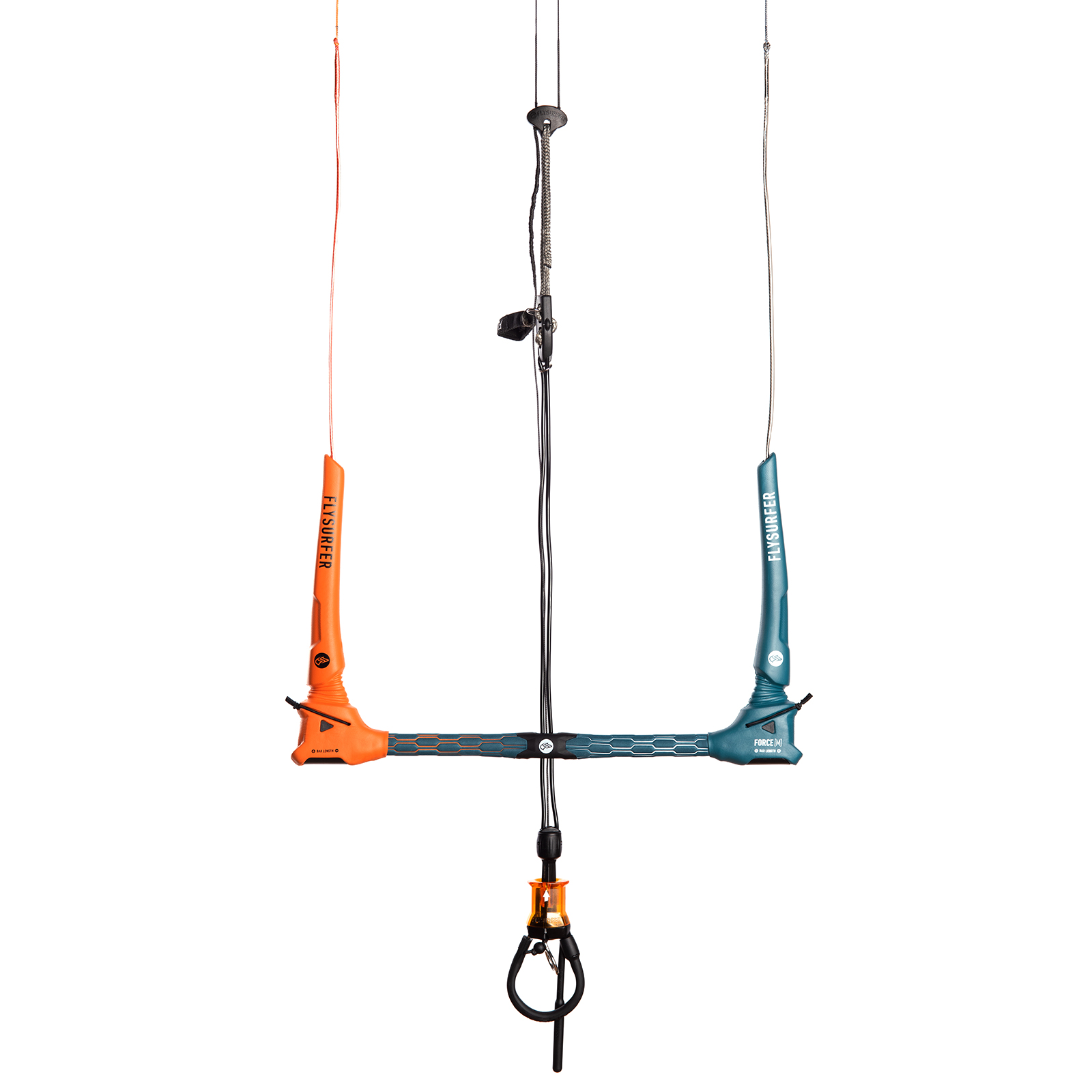
The bar is the least understood item in a kite quiver. Kites compare by size and aspect ratio, boards by length and flex, and every bar looks the same: a length of alloy, some lines, a chicken loop. And it costs
600 € and up.Here is what that money actually buys.
Two bars, two philosophies
- Ozone Contact Water V5 —
Comparable prices, different philosophies. Ozone states its own outright: "a clean and simple control system, nothing surplus — only what you need to ride confidently". Flysurfer comes from foil kites, where a bar objectively has more to do.
What actually matters in a bar
Four things, and they set the price.
One: the quick release. The critical safety component. It has to fire under load, with one hand, in a panic, wearing gloves. Ozone's is the Click-In Loop — the loop clicks in and comes out in a single movement.
This is not marketing: a cheap bar differs from an expensive one above all in how its release behaves under load and how quickly you can reassemble it on the water.
Two: the trim system. What changes the kite's base power without holding the bar. Good trim works under load and does not jam with sand.
Three: line quality. Lines stretch unevenly — rears more than fronts. After a season the geometry drifts and the kite behaves differently. Better lines hold their length longer.
Four: line twist management. When you rotate, the lines twist. The untwisting system decides how much effort getting back costs you.
Bar length: the thing people get wrong
The Contact Water V5 comes in 38 and 45 cm, and the difference matters more than it looks.
A short bar gives less leverage: the kite turns more slowly, but control is more precise and your arms work less. Right for small kites and shorter riders.
A long bar gives more leverage: a big kite turns willingly. On a small kite the same length makes steering sharp and nervous.
The rule: bar length follows kite size, not personal taste. For 5 to 8 m, short; 9 to 12 m, medium; 13 m and up, long. For small kites and shorter riders Ozone offers the separate Compact V5.
Four lines or five
The main difference between ranges sits here, and it is about environment rather than brand.
Four lines is the water standard. Simpler, lighter, less tangling.
Five lines is the mountain standard. The fifth gives complete instant depower: the kite folds along its centre and stops being a wing.
So the Contact Water V5 is a water bar, and for snow Ozone has the separate Contact Snow V5 and Snow EXP V5. More on the fifth line separately.
Why Flysurfer asks more of a bar
Flysurfer builds foil kites, and that changes the job.
A foil kite has more lines, of differing lengths, and its wing geometry is more sensitive to trim: two centimetres on a rear line change the character far more than on an inflatable. Closed-cell models also demand careful handling on relaunch.
Hence Flysurfer's greater attention to setup precision and the line system. If you ride that brand's foil kite, its bar will be matched to the kite's trim.
The compatibility rule
Bars are formally universal: a four-line kite will fly on any four-line bar.
But line lengths and factory trim differ between brands, and a kite on someone else's bar can behave differently from the design intent: a different depower range, a different neutral point.
The practical conclusion: buy the bar from the same brand as the kite. Especially with foil kites and five-line setups.
When to replace a bar
Bars are replaced less often than kites, and rightly so. But there are three signals.
Lines of differing length. Check once a season. More than a couple of centimetres out and the kite flies crooked — and it is not the kite.
Wear at loops and knots. That is almost always where a line fails.
A stiff release. The one item that means not going on the water at all.
Common questions
Can one bar serve two kites?
Yes, if they are the same brand and close in size. With a large size gap, use different bar lengths.
How does Contact Water differ from Contact Snow?
Line count: the snow bar runs five lines with complete depower, the water bar four.
Which bar length should I buy?
By kite size: 38 cm for small, 45 cm for medium and large. For small kites and shorter riders there is the Compact V5.
How often should lines be replaced?
By wear, not by calendar. Check every season; replace at signs of chafe or when lengths diverge.
Is a used bar a good idea?
You can see the lines and the covering; you cannot see the state of the release mechanism. This is a poor place to economise.
Where to look
Ozone Contact Water V5 and Flysurfer FORCE — both in stock. All bars are in the catalogue section.
Flysurfer FORCE Control bar at K1.surf
Official Flysurfer dealer. From 592 €. Our IKO instructors match the size to your weight, level and wind.
Read next
Red and White Dunes, Fairy Stream, Red Canyon, the fishing village, Cham towers and the Whale Temple — what fi…
Build Your Own: Assembling a Foil for Yourself Without Getting It WrongAXIS offers a four-component configurator rather than a finished foil. How to choose in the right order, which…
Foil Etiquette: Why Foilers Are Unpopular and How to Fix ItA metal wing underwater is invisible, and that is the root of every conflict at a spot. The rules that formed …