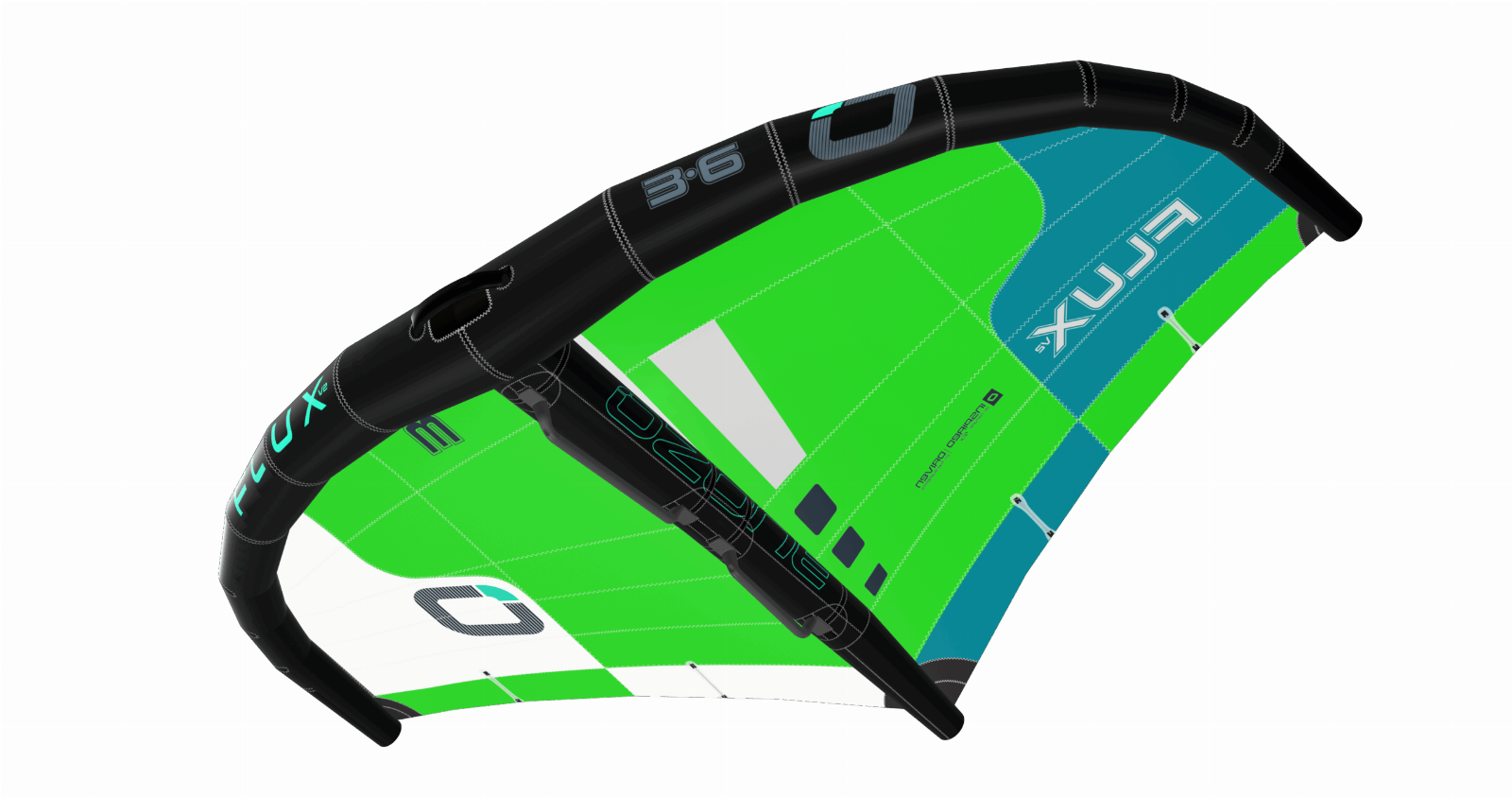
The manufacturer states the job plainly: "for riders chasing speed who are not willing to sacrifice control". In a range that also holds the all-round Flow, it is worth understanding what exactly the Flux is charged with.
The short version
- Sizes: 2.4, 3.0, 3.6, 4.3, 5.0, 5.5 and 6.0 m².
- Weight: 1.92 kg (2.4) to 3.2 kg (6.0).
- Construction: 10 battens.
- Aspect ratio: 2.47 flat, 2.55 projected.
- Level: intermediate, advanced, expert.
- Price: from
2.47 against the Flow's 2.29
The gap looks small, but wing aspect ratios live in a narrow corridor, and eight hundredths is a noticeable step here.
What higher aspect ratio gives: a longer, narrower wing with smaller tip losses and better glide efficiency. Directly: better upwind and higher speed under acceleration.
What it costs: the wing becomes more demanding about hand position and reacts more visibly to gusts. Not fussy, but precise — and precision needs attention.
Which is why the specification starts at intermediate rather than beginner as on the Flow V2. That is not marketing tiering but a description of character.
"Flies lighter in the hands than its predecessor"
The manufacturer's phrasing, worth unpacking, because on paper the Flux and Flow weigh practically the same: 1.92 kg at the smallest size for both.
So this is not about mass but about load distribution. On a higher-aspect wing the centre of pressure shifts, and with a correct grip part of the drive pulls forward rather than down onto your arms.
In practice: the Flux feels lighter under acceleration and not at low speed. The wing comes alive once you are moving, which is exactly what it was built for.
Seven sizes, and the 6 m
The Flux has one size more than the Flow, added at the top: 6.0 m² against the Flow's 5.7.
Logical: a powered wing tends to be bought by riders who want a wider range including light wind, where area decides.
- 2.4 and 3.0 — strong wind, light riders.
- 3.6, 4.3, 5.0 — the working middle.
- 5.5 and 6.0 — light wind and heavy riders.
The working pair for 75 to 85 kg is 4.3 and 6.0.
Who it suits
Riders already flying confidently. The Flux comes alive at speed, and speed has to be reached first.
Anyone short of upwind. The most common second-season complaint, and aspect ratio addresses it directly.
Riders on a small front wing. A small foil wing needs speed — the Flux supplies it.
Anyone doing long runs and downwinders. Efficiency over distance matters more than forgiveness at the start.
Who it does not suit
Beginners. The level starts at intermediate, and honestly so: the wing wants a precise grip.
Occasional riders. The gap to the Flow shows over many hours, not over ten sessions a year.
Wave riders. Waves reward compactness and quick sheeting out rather than efficiency.
On the Ultra-X version
The Flux also exists as the Flux V2 Ultra-X with an Aluula frame — from
1 819 € against 1 119 € for the standard.The manufacturer describes it as delivering "surgical steering precision together with real acceleration". Translated: the same character with a stiffer frame and less weight.
Whether it is worth it is the same question we worked through in our ALUULA article: at high hours yes, at occasional sessions the money is better spent on the foil.
Flow or Flux: deciding
Take the Flow if you are learning, ride varied conditions, and want a wing that does not demand attention.
Take the Flux if you already fly consistently and are limited by speed or upwind angle.
The price gap is
70 € at the smallest size. So the choice here is about stage, not budget.Common questions
Is the Flux suitable for a beginner?
Not the best choice: it is rated from intermediate and wants precise hand position.
How does the Flux differ from the Flow?
2.47 against 2.29 aspect ratio, and character: the Flux is faster and goes upwind better, the Flow is smoother and more forgiving.
Which sizes should I buy?
For 75 to 85 kg, 4.3 and 6.0 m². That pair covers most of a season.
Is the Ultra-X worth it?
At high hours, yes — stiffness and weight are noticeable. At occasional sessions, put the money into the foil.
Can I jump the Flux?
Yes, an efficient wing gives good lift. But dedicated freestyle wings are more compact and quicker to sheet out.
Where to buy
Ozone Flux V2 from
1 119 € and the Flux V2 Ultra-X from 1 819 €. All wings are in the wingfoil section, and the range on the Ozone page.Ozone at K1.surf
Official Ozone dealer. Our IKO instructors match the size to your weight, level and wind.
Read next
Five foil disciplines, and the order of learning is not arbitrary. Which to start with, how long each stage ta…
Foil Etiquette: Why Foilers Are Unpopular and How to Fix ItA metal wing underwater is invisible, and that is the root of every conflict at a spot. The rules that formed …
Build Your Own: Assembling a Foil for Yourself Without Getting It WrongAXIS offers a four-component configurator rather than a finished foil. How to choose in the right order, which…