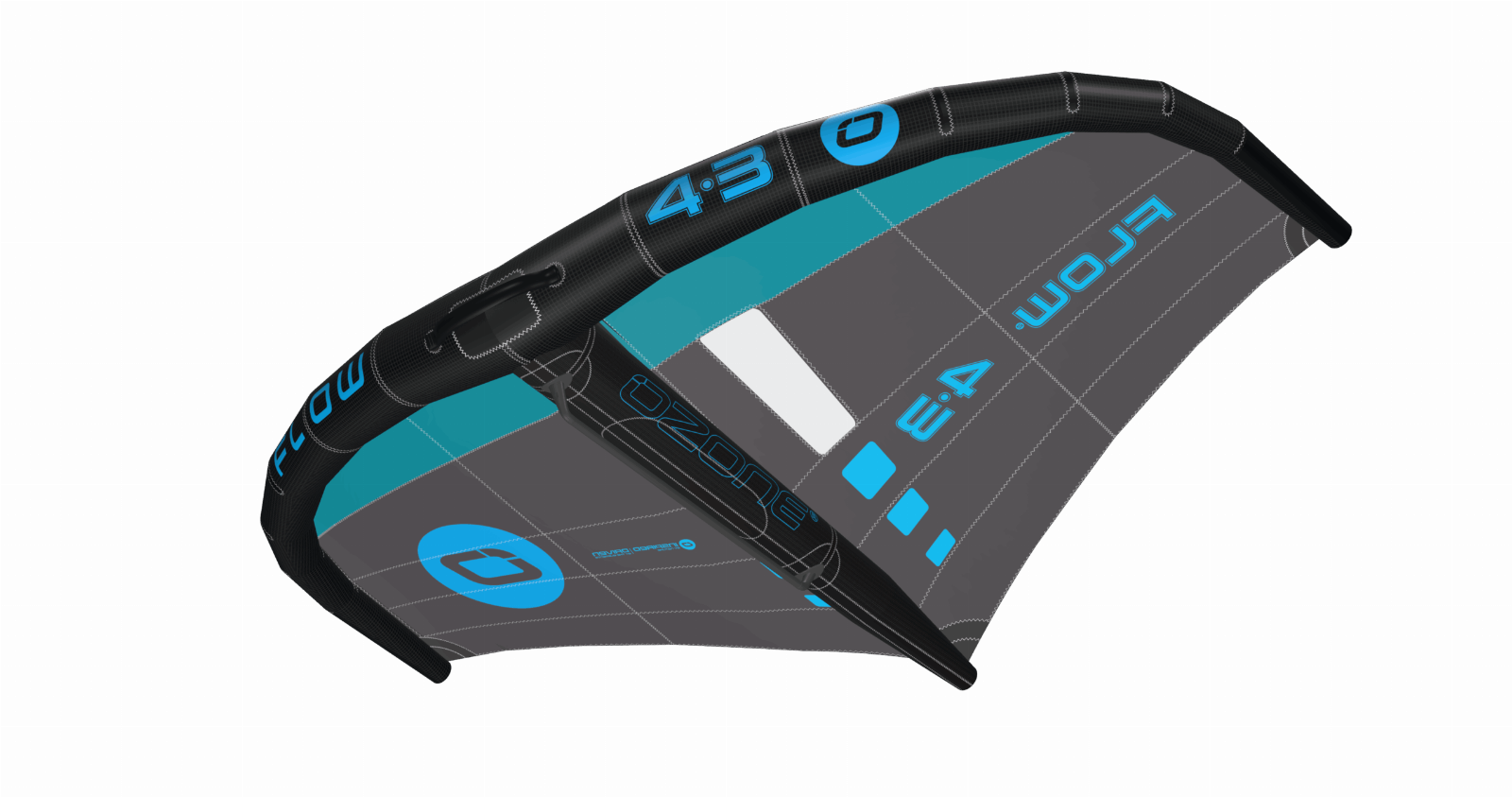
Ozone describes the Flow V2 as a one-wing quiver, and the specification backs it with a rare line: rider level, beginner through expert. Here is how.
The short version
- Sizes: 2.4, 3.0, 3.6, 4.3, 5.0, 5.7 m².
- Weight: 1.92 kg (2.4) to 3.05 kg (5.7).
- Construction: 10 battens.
- Aspect ratio: 2.29 flat, 2.38 projected.
- Level: beginner, intermediate, advanced, expert.
- Price: from
Aspect ratio 2.29: why low is good here
On kites we are used to high aspect ratio meaning efficiency. On a wing the logic differs, and that is worth understanding.
Compare within the Ozone range: Flow V2 at 2.29 flat, Flux V2 at 2.47. A small gap on paper, but the direction is telling.
A higher-aspect wing goes upwind better and accelerates faster. It is also fussier in the hands: a long narrow wing reacts more to an imprecise position and pulls harder in a gust.
A low aspect ratio gives a compact wing with even drive that forgives a rough grip and does not snatch at an imperfect angle. For someone still thinking about their feet rather than the wing, that is the decisive quality.
Weight: 1.92 kg at the smallest size
For comparison within the range: the Ozone Fly weighs 1.3 kg at 2 m, but it has 6 battens against the Flow's 10.
Battens are the internal stiffeners that hold the wing's shape under load. More of them means a stiffer, more accurate profile — and more weight. Ten against six is a choice in favour of stiffness, and it explains both the weight and the price.
In practice the Flow holds its shape through acceleration and gusts better than simpler wings and worse than ultralight ALUULA builds. Exactly in the middle, as intended.
Six sizes and how to choose
The steps are uneven, and deliberately so: finer at the bottom, coarser at the top.
- 2.4 and 3.0 — strong wind, light riders.
- 3.6 and 4.3 — the working middle for 65 to 80 kg.
- 5.0 and 5.7 — light wind and heavy riders.
The universal pair for a 75 to 85 kg rider is 4.3 and 5.7. That covers roughly 12 to 25 knots, which is most of a season on an average spot.
A reminder from choosing a first wing: a wing has no depower, so a sizing miss cannot be compensated.
Who it suits
A first wing. "Beginner" in the specification is not a formality: low aspect ratio and even drive are exactly that.
Anyone wanting one wing for everything. Freeride, first jumps, waves, light wind — the Flow copes everywhere without being best anywhere.
Schools and rental centres. A wing that forgives rough handling lasts longer in a fleet.
Who it does not suit
Anyone chasing speed. Look at the Flux V2: it is built for acceleration and upwind.
Light-wind specialists. 5.7 m² is not the market's limit, and ten knots wants wings from 6.5 m² up.
Anyone counting grams. Ultra-X and ALUULA builds are noticeably lighter, and dearer.
Flow or Fly: two ways into the range
Ozone offers two beginner wings, and the difference is useful.
Fly — from
719 €, 6 battens, 2.0 aspect ratio, beginner and intermediate. Lighter, cheaper, simpler.Flow V2 — from
1 049 €, 10 battens, 2.29 aspect ratio, rated to expert. Stiffer, more precise, relevant for longer.The rule: if you are trying wingfoiling and unsure you will stay, take the Fly. If you have decided to take it seriously, take the Flow — you will not outgrow it in a season.
Common questions
Is the Flow V2 suitable for a beginner?
Yes, it is rated from beginner. Low aspect ratio and even drive work in your favour early on.
Which two sizes should I buy?
For 75 to 85 kg, 4.3 and 5.7 m². Together they cover roughly 12 to 25 knots.
How does the Flow differ from the Flux?
Aspect ratio and character: the Flux is built for speed and upwind, the Flow is smoother and more forgiving.
How many battens, and what for?
Ten. Battens hold the wing's shape under load: more means a stiffer profile at higher weight.
Can I jump the Flow?
First jumps, certainly. For dedicated freestyle the range has other models.
Where to buy
Ozone Flow V2 — from
1 049 €, six sizes. The brand's wings are on the Ozone page, and all wings in the wingfoil section.Ozone Flow V2 Wing at K1.surf
Official Ozone dealer. From 1 119 €. Our IKO instructors match the size to your weight, level and wind.
Read next
Five foil disciplines, and the order of learning is not arbitrary. Which to start with, how long each stage ta…
Foil Etiquette: Why Foilers Are Unpopular and How to Fix ItA metal wing underwater is invisible, and that is the root of every conflict at a spot. The rules that formed …
Build Your Own: Assembling a Foil for Yourself Without Getting It WrongAXIS offers a four-component configurator rather than a finished foil. How to choose in the right order, which…