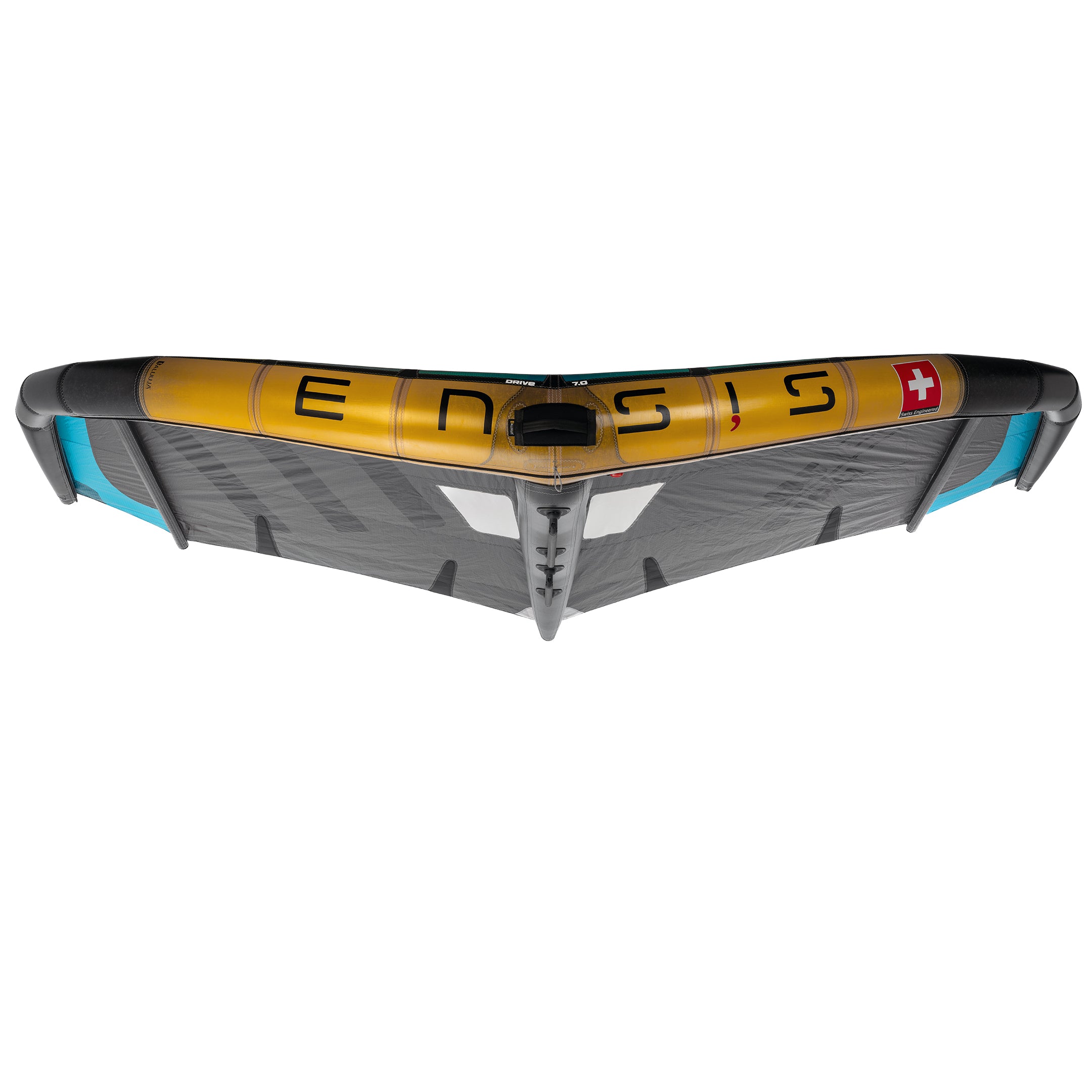
Two versions of one wing at nearly double the price is a rare case where the comparison comes out clean: the construction is identical and only the material differs. Here is what it delivers.
The short version
- DRIVE — two sizes, 7.0 and 8.0 m². From
What ALUULA is
A composite delivering the same strength at markedly lower weight. It is also behind Ocean Rodeo's ultralight kites and other brands' Ultra-X ranges — the idea is the same everywhere.
In practice: an ALUULA wing is roughly a quarter lighter at the same frame stiffness.
Why weight matters more on a wing than on a kite
The key point of the whole article, and not an obvious one.
A kite hangs on lines, and its weight is carried by your harness. You feel the mass indirectly — through response and light-wind behaviour — but not in your hands.
A wing you hold in your hands for the entire session. Here weight is not a specification but a physical load on shoulders and forearms, accumulating linearly with time.
Hence: two or three hundred grams barely register on a kite, and on a wing they decide how long you last. People come off the water not because the wind stopped but because their arms did.
The second effect: light wind
The DRIVE is positioned for light wind — and here the material works twice.
The obvious part: a light wing is easier to hold up when there is little drive and it will not stay aloft on its own.
The less obvious part: in light wind you hold the wing longer per unit of distance covered. Getting going takes longer, runs stretch out, there are fewer pauses. Light wind is exactly where weight hits hardest.
The logic mirrors foil kites: lift first holds the wing itself up, and only the remainder reaches you. We covered it in our foil versus inflatable comparison.
The 9 m — a size the standard DRIVE does not have
A detail worth noticing: the ALUULA version has a 9.0 m², the standard one only 7.0 and 8.0.
That is not accidental. Nine square metres in the standard build would weigh enough that holding it in light wind became punishing — and light wind is precisely where that size is needed.
ALUULA here does not improve an existing wing; it makes possible a size that would otherwise make no sense. That is the most honest argument for the material anywhere in the range.
Who it pays back for
Anyone riding a lot. A hundred days a season, and the difference in arm fatigue becomes a difference in hours on the water.
Light-wind riders. If your spot regularly gives 10 to 14 knots, ALUULA earns its keep every session.
Heavy riders. You need the larger sizes, and weight is critical exactly there.
Anyone with shoulder trouble. A plain, non-sporting reason, and a real one.
Who it does not pay back for — honestly
Anyone riding twenty days a year. Arm fatigue will not accumulate over that, and
1 350 € is a board or a foil.Anyone still learning. At that stage you spend more time in the water than in flight, and wing weight is not what limits you.
Anyone on a windy spot. In twenty knots you take a smaller size, and at small areas the weight gap is less noticeable.
A word of caution about ALUULA
The material is strong, but it is not about abrasion resistance. Sand and dragging across a beach harm it as much as ordinary cloth, and the repair costs noticeably more.
The practice is simple: do not drag the wing across sand, do not drop it on shingle, and rinse it in fresh water. The same as we say about foil kite care.
Common questions
How much lighter is an ALUULA wing?
Around a quarter, at comparable stiffness. Exact figures depend on size and construction.
Is ALUULA worth double?
It depends on hours. At a hundred days a season, yes. At twenty, that money is better spent on a board or foil.
Is ALUULA more durable than ordinary cloth?
It gives the same strength at lower weight, but it is no better against sand and abrasion. Handle it the same way.
Which size for light wind?
For 75 to 85 kg in 10 to 14 knots, 8.0 or 9.0 m². The 9 exists only in the ALUULA version.
How does the DRIVE differ from the SCORE?
The SCORE is a universal freeride wing with seven sizes from 2.8 m². The DRIVE is specialised for light wind and starts at 7.0 m².
Where to buy
Ensis DRIVE ALUULA from
2 974 € and the DRIVE from 1 621 €. The range is on the Ensis page, and the brand in our review.Ensis DRIVE ALUULA Wing at K1.surf
Genuine Ensis gear. From 2 974 €. Our IKO instructors match the size to your weight, level and wind.
Read next
AXIS offers a four-component configurator rather than a finished foil. How to choose in the right order, which…
Foil Etiquette: Why Foilers Are Unpopular and How to Fix ItA metal wing underwater is invisible, and that is the root of every conflict at a spot. The rules that formed …
Where to Start in Foiling: A Two-Year RouteFive foil disciplines, and the order of learning is not arbitrary. Which to start with, how long each stage ta…