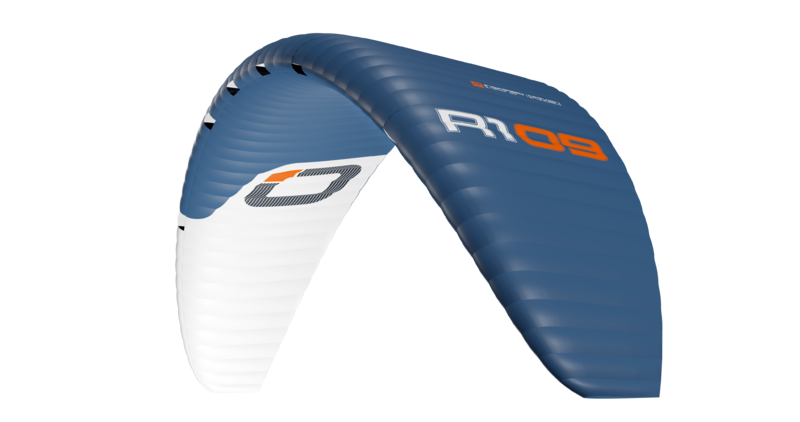
The R1 V5 is the result of a full four-year development cycle and more than fifty prototypes. The manufacturer puts the outcome bluntly: the model has shed every trace of freeride DNA. Here is what that means in numbers.
The short version
- Sizes: 8, 9, 10, 11, 14, 15, 19 and 21 m².
- Weight: 1.7 kg at 8 m up to 3.3 kg at 21 m.
- Cells: 51 on the small sizes, 65 on the large.
- Aspect ratio: 6.5–7.0 flat, 4.9–5.3 projected.
- Lines: 11–14 m. Bar size at the rider's preference.
- Level: advanced and expert. Disciplines: hydrofoil and racing.
- Price: from
Aspect ratio 7.0: what that really is
For comparison within the Ozone range: the Explore V3 runs 4.45, the Hyperlink V4 4.98, the inflatable Edge VT 5.41. Seven on the R1 is a different class of aircraft.
The physics is simple: the longer and narrower the wing, the smaller the losses at the tips and the higher the glide efficiency. That translates directly into speed and upwind angle — the two things a race result is made of.
The cost is equally direct. A long narrow wing responds more slowly, recovers from a collapse less readily and does not forgive a loss of tension. Which is why there is no intermediate level in the specification: that is not caution on the manufacturer's part, it is a description of the physics.
11 to 14 metre lines: the biggest difference of all
An ordinary kite flies on 20 to 25 metres. The R1 flies on 11 to 14. That is half, and it is a deliberate racing decision.
Short lines give instant response: bar input reaches the canopy with almost no delay. In a race, where the line you sail is measured in metres, that decides things.
The second effect is that the kite flies lower and closer, and is easier to hold in a narrow sector of the window without letting it drop into the power zone. A racer works with precision rather than power.
The third, less obvious one: short lines reduce the lag between your input and the foil's reaction. On a foil, where everything happens quickly, that changes the feel completely.
65 cells: why so many
The Explore V3 has 25 cells, the Hyperlink 33. The R1 has 65 on its larger sizes.
More cells means a more accurate aerodynamic profile: the canopy sits closer to its designed shape and wanders less between ribs. The cost is construction complexity, rib weight and line count.
It is exactly the logic by which competition paragliders carry three times the cells of training wings.
A range that reaches 21 metres
Look at the top of the range: 19 and 21 m. For a water kite those are enormous sizes, and on a twintip they make no sense.
But the R1 is a foil kite. On a hydrofoil, water resistance is a fraction of what a board faces, and the kite does not have to drag you onto the plane. It only has to pull — and in light wind area decides everything. These are the sizes on which racers go out in wind where everyone else stays ashore.
Who it is for
Course racers and formula kite racers. That is its stated purpose.
Experienced foilers racing their friends. An official regatta is not required: if you foil for speed and angle, the R1 gives you what no freeride kite will.
Anyone chasing very light wind. Large sizes plus a foil is the most efficient combination on the market.
Who it does not suit — and this matters
Anyone not on a foil. The disciplines are explicitly limited to hydrofoil and racing. On a twintip this kite will be awkward and unsafe.
Intermediate riders. Not out of snobbery: an aspect ratio of 7.0 on short lines requires you to know what to do about a collapse before it happens.
Anyone wanting one kite for everything. The R1 is the opposite of an all-rounder, and that is the point of it.
Honestly about the price
An interesting detail: the R1 is cheaper than the all-round Hyperlink V4. The 8 m costs
1 359 € against 2 299 € for a 5 m Hyperlink.The reason is construction rather than quality: the R1 has no dual-mode mechanics and is not built for snow. Specialisation costing less than versatility is rare, but logical.
Common questions
Can I ride the R1 on a twintip?
It will fly, but it is a poor idea: short lines and high aspect ratio are designed around a foil, where speed and tension are different.
Does it relaunch from water?
It is a closed-cell foil kite, so relaunch is possible. On a high-aspect wing it takes technique, and in a race people simply try not to drop it.
Which bar does it need?
The specification says rider's preference — racers set it up to suit themselves. From Ozone there is the Foil Race V5.
Which size first?
It depends on your typical wind. For a mid-weight rider the usual entry point is a 10 or an 11.
How does the R1 differ from the Flysurfer Sonic?
Both are closed-cell racing foil kites. The Sonic is presented as race-and-freestyle and accepts big air; the R1 is pure foil racing.
Where to buy
Ozone R1 V5 — from
1 359 €, eight sizes. The other foil kites are in our range overview, and foils in the hydrofoil section.Ozone R1 V5 Kite at K1.surf
Official Ozone dealer. From 1 359 €. Our IKO instructors match the size to your weight, level and wind.
Read next
Five foil disciplines, and the order of learning is not arbitrary. Which to start with, how long each stage ta…
Foil Etiquette: Why Foilers Are Unpopular and How to Fix ItA metal wing underwater is invisible, and that is the root of every conflict at a spot. The rules that formed …
Build Your Own: Assembling a Foil for Yourself Without Getting It WrongAXIS offers a four-component configurator rather than a finished foil. How to choose in the right order, which…