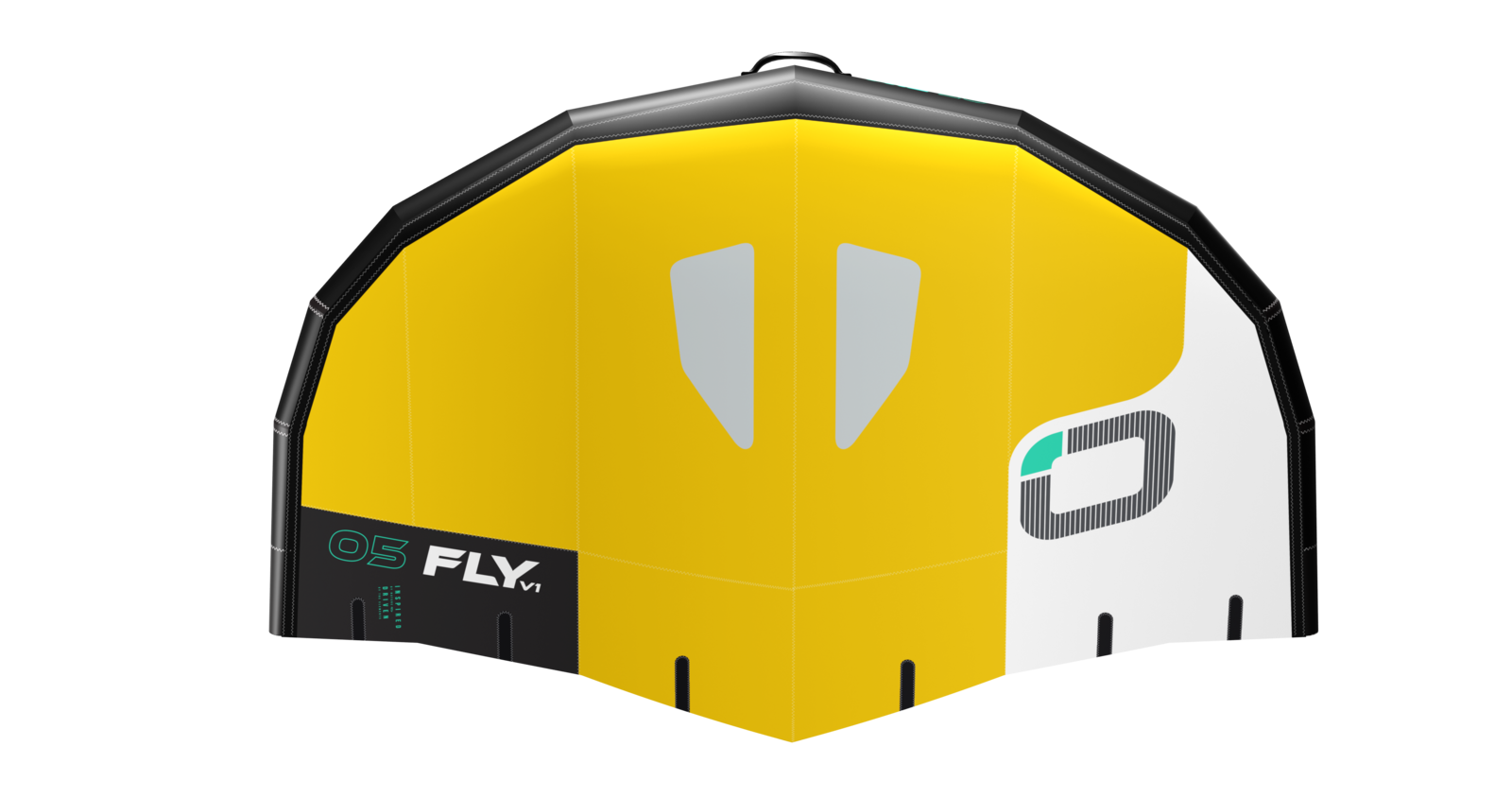
Wingfoil wings start at a thousand euros and climb, which puts off people who simply want to try. The Fly starts at
719 € — and that changes the conversation.The short version
- Sizes: 2, 3, 4, 5, 6 and 7 m².
- Weight: 1.3 kg (2 m) to 2.7 kg (7 m).
- Construction: 6 battens.
- Aspect ratio: 2.0 flat, 2.2 projected.
- Level: beginner and intermediate.
- Price: from
Six battens instead of ten
The main structural difference from the Flow V2, and it sets both price and character.
Battens are the internal stiffeners holding the wing's profile under load. Fewer means a lighter, cheaper wing, but under heavy load the profile starts to deform: part of your effort goes into the flex instead of drive.
Where you notice it: under acceleration, in strong wind and at the top of a size's range. Where you do not: in everything that happens during the first months of learning.
Hence the honest boundary in the specification: beginner and intermediate, with no advanced or expert.
1.3 kg — and that is not much
A two-metre wing at 1.3 kg is a good figure, and it follows directly from the simple construction.
Fewer battens means less material and fewer seams. What senior models achieve with expensive composites, this achieves by simplification. Different routes to the same number, and at the start you will not feel the difference.
What you will feel is your shoulders at the end of a session. On why wing weight matters more than kite weight, see our ALUULA review.
Aspect ratio 2.0 — the lowest in the range
For comparison: the Flow V2 runs 2.29, the Flux V2 2.47.
Two is a very compact wing. It is slower and goes upwind less well, but it is exceptionally calm in the hands: it does not snatch in a gust and forgives an imprecise angle.
For someone whose early sessions are about their feet rather than the wing, that is exactly right. The wing should stay out of the way — the rest follows.
Six sizes up to seven metres
A pleasant surprise in a budget model: the range runs to 7 m², a genuine light-wind size.
- 2 and 3 m — strong wind, children and light riders.
- 4 and 5 m — the working middle.
- 6 and 7 m — light wind and heavy riders.
For 75 to 85 kg the working pair is 5 and 7 m². Note the arithmetic:
889 € and 1 059 € — two Fly wings cost about the same as one mid-range wing.Who it suits
Anyone trying the sport. The main scenario. Wingfoiling is not for everyone, and finding that out for
2 000 € is expensive research.Occasional riders. Twenty sessions a year do not demand a stiff wing: you will not reach the regimes where the difference shows.
As a second wing for the edge of the range. A 7 m Fly for rare light days beats an expensive wing sitting in a bag.
Children and teenagers. A two-metre size and a low price is clear logic.
Who it does not suit
Riders who already go well. Six battens start limiting you as soon as you reach speed.
Anyone who wants to jump. A softer profile returns less at takeoff.
Racers and serious upwind riders. An aspect ratio of 2.0 works against you.
Honestly about the savings
We always say where the money was saved, and here it is transparent: on batten count and materials.
What was not saved is capability. The Fly is not a toy or a showroom simplification: it flies and it teaches. Ozone simply placed it honestly at beginner and intermediate and promised nothing more.
The sensible route: take a Fly, ride a season, work out whether this is for you, and only then invest in a Flow, Flux or ALUULA build knowingly.
Common questions
Is the Fly enough for a first season?
Yes, comfortably. Limits appear when you reach speed and strong wind.
How does the Fly differ from the Flow V2?
Batten count (6 against 10), aspect ratio (2.0 against 2.29) and level: the Fly to intermediate, the Flow to expert.
Which size first?
For 75 to 85 kg, 5 m². A 7 m makes the better second wing for light days.
Will the Fly work for wingsurfing without a foil?
Yes, and at the start that is easier: an ordinary board is more stable than a foil.
Can I use it in strong wind?
On the small sizes, yes, but the profile is softer and will deform at the top of the range.
Where to buy
Ozone Fly — from
719 €, six sizes. The other wings are on the Ozone page, and sizing in our first wing guide.Ozone Fly Wing at K1.surf
Official Ozone dealer. From 719 €. Our IKO instructors match the size to your weight, level and wind.
Read next
Five foil disciplines, and the order of learning is not arbitrary. Which to start with, how long each stage ta…
Foil Etiquette: Why Foilers Are Unpopular and How to Fix ItA metal wing underwater is invisible, and that is the root of every conflict at a spot. The rules that formed …
Build Your Own: Assembling a Foil for Yourself Without Getting It WrongAXIS offers a four-component configurator rather than a finished foil. How to choose in the right order, which…