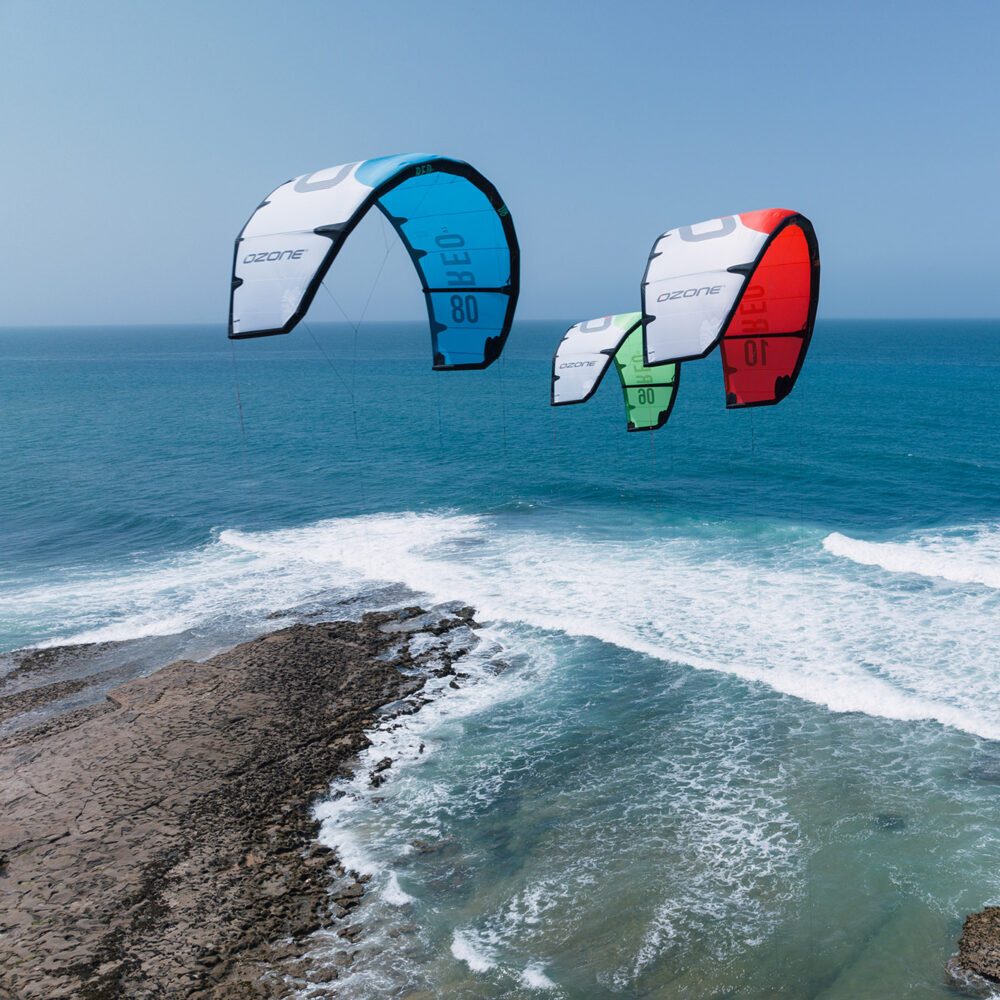
Reo is Ozone's wave kite, and the seventh version arrived two years after the sixth. That is the rare case where a gap between versions means there was nothing worth changing until there was — not that the model was forgotten.
The short version
- Sizes: 4, 5, 6, 7, 8, 9, 10, 11 and 12 m².
- Construction: 14 leading-edge segments, flat aspect ratio 4.2, projected 2.2 — a low-aspect profile.
- Weight: from 1.6 kg in the 4 m to 2.9 kg in the 12 m.
- Lines: 23 m, bar 38–50 cm depending on size.
- Level: beginner through expert — an unusually wide span for a wave kite.
- Price: from
Why low aspect ratio is the point
Aspect ratio 4.2 against 5.41 on the race-oriented Edge. On paper that reads as "worse". On the water it means something else.
Drift. A low-aspect kite with small projected area does not drag you off the wave when you sheet out. It drifts with you and stays in the air even when line tension disappears. For riding waves that is the property that matters: the kite stops interfering.
Instant relaunch. Fourteen segments and a compact arc get the kite off the water quickly and without ceremony. In waves that happens more often than you would like.
Manoeuvrability. A short-span kite pivots rather than sweeping an arc across half the sky. In the impact zone that is the difference between making it and not.
What the manufacturer claims
Ozone describes the Reo V7 as tuned tighter than ever: speed, power control, drift and instant relaunch. The listed disciplines are freeride, big air, foil and waves; the listed strengths are low-end power, manoeuvrability, upwind, drift on the wave and performance in both light and strong wind.
Our note on that list: big air belongs at the bottom of it. The Reo jumps, but buying one for altitude is a mistake — Vortex and Edge exist for that.
What the Ultra-X version changes
Reo V7 Ultra-X has identical geometry and sizes with a lightweight canopy: the 4 m weighs 1.4 kg against 1.6, the 12 m 2.5 against 2.9. Nearly half a kilo on the large size.
On a wave kite that lightness is particularly useful: the less mass, the better the kite holds position on depower while you work the board. Ozone describes the feel as close to pure surfing — the kite leaves your field of vision and stops competing for attention with the wave.
Ultra-X starts at
1 429 €.Not only for waves
The Reo is often filed as a specialist kite, which is a mistake. The specification lists it from beginner level, and its calm behaviour and easy relaunch make it a reasonable freeride kite for shallow water and for anyone who values predictability.
In Mui Ne that is doubly relevant: November to April is wind and chop, and from May the swell arrives. A Reo covers both, provided you are not chasing altitude.
Choosing a size
For a 75 kg rider: 7 m² for 22–28 knots, 9 m² for 18–24, 11 m² for 14–20. In waves it is normal to go one size smaller than in freeride: the wave adds apparent wind, and an overpowered kite in the impact zone is dangerous.
The small sizes — 4 and 5 m² — are for strong wind and light riders, and they double as useful foil kites.
Who should not buy it
Anyone who wants to jump high. Low aspect ratio is a deliberate trade: drift and manoeuvrability in exchange for lift. Want big air? Vortex or Edge.
Racers and long-distance riders. The Reo goes upwind well; the Edge goes better.
Anyone without waves. If your spot is flat water and you are not planning surf trips, you would pay for properties you never use. Take a Catalyst or an Enduro.
Frequently asked questions
Is the Reo suitable for a beginner?
Ozone lists it from beginner level, and it is calm and relaunches easily. That said, if you are learning and have no wave ambitions, a Catalyst gives you more for the same money.
How does the Reo differ from the Vortex?
By purpose. Reo is drift and wave work; Vortex is altitude and hang time. Different tools, not different levels.
Is Ultra-X worth it here?
On a wave kite, more often yes: half a kilo on a large size directly affects how the kite holds position on depower. In steady strong wind the standard version copes.
Which board goes with it?
A directional surfboard if you mean waves. On flat water the Reo works perfectly well with a twin-tip.
How many sizes do I need?
Usually two for waves: a working size and a strong-wind size. The depower range is broad enough that a third is rarely needed.
Where to buy
All sizes: Ozone Reo V7 from
1 249 €, lightweight version Reo V7 Ultra-X from 1 429 €. The brand in full is in our Ozone review.Coming to ride waves in Mui Ne? The surf season runs May to September — details in the Mui Ne guide. Sizing advice is free: write to us.
Want advice from an instructor?
Our IKO instructors will help you choose gear or plan a kite trip to Mui Ne — free of charge.
Read next
Starboard came out of windsurfing and became the leading name in SUP. The range: inflatable and hard boards, p…
Inflatable SUP vs Hard Board: What to Choose and the Real DifferenceAn inflatable fits in a boot; a hard board goes faster. Eight differences you feel on the water, and when payi…
How to Read a SUP Board Size: 10'8" x 33", Litres and What MattersThree numbers — length, width and volume — decide whether you paddle or fall. What each one means and how to m…