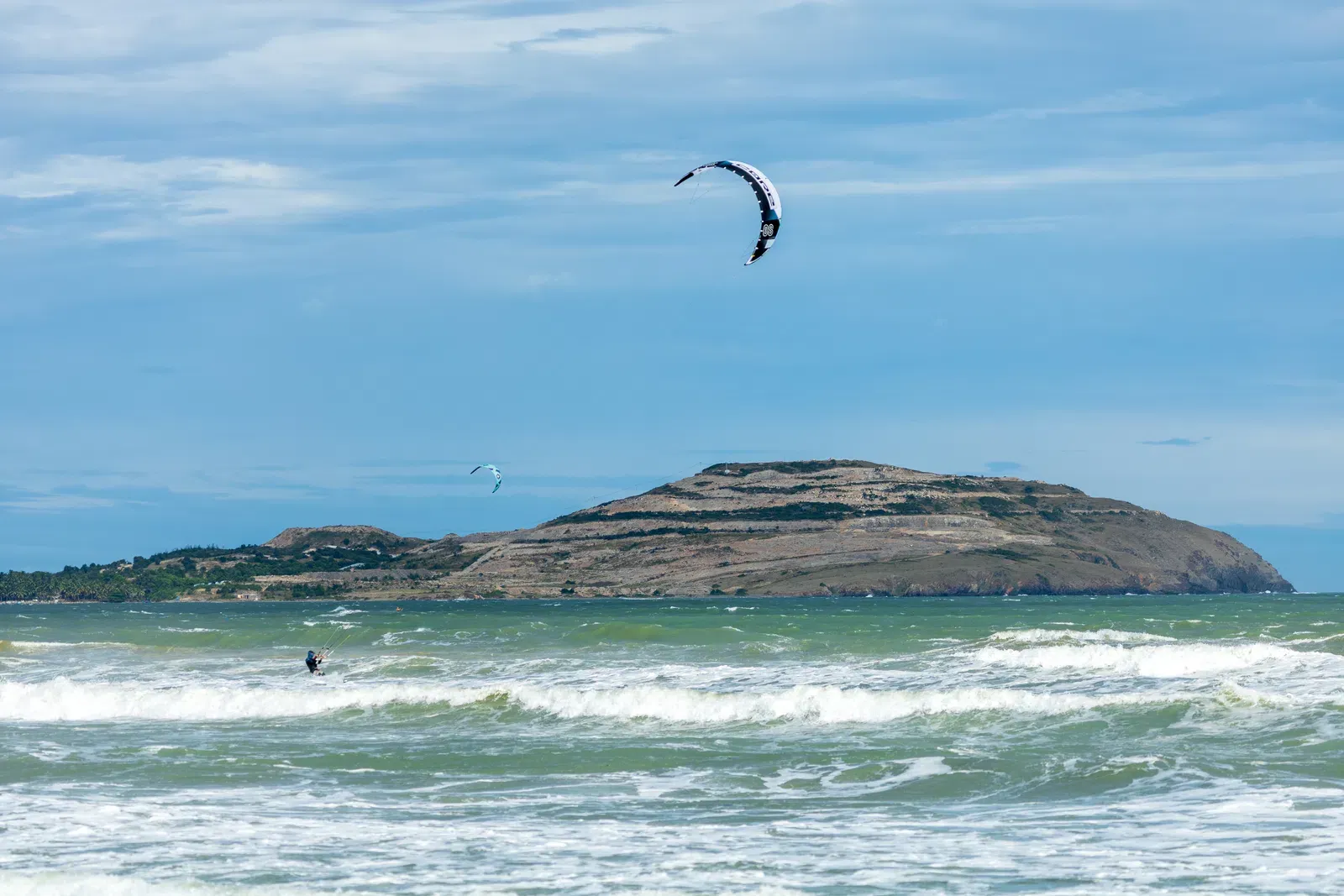
This is a detailed answer to one question: is Mui Ne, Vietnam a good place to learn kitesurfing — and what actually waits for you there. We run a kite school and a beach station on this exact stretch of sand, so this guide is written from what we see every day, not from other people's articles.
One disclaimer up front, because it will save you time. Mui Ne is not the best kitesurfing spot on the planet. There are places with flatter water, places with more reliable wind, places that cost less. What Mui Ne gives you is a long run of windy days in season, a gently shelving sandy beach, short flights from most of Asia and Eastern Europe, and prices that keep a two-week trip from becoming the expense of the year. For someone learning, that combination matters more than records.
The short version: kitesurfing in Mui Ne at a glance
For readers in a hurry and for voice assistants — one-line answers.
- When to come: the kite season in Mui Ne runs from November to April, peaking December through March. From May to September there is little wind for kiting, but the swell arrives and surfing starts.
- How long it takes: plan on somewhere between eight and fifteen hours on the water with a teacher before you ride away alone. Spread over the days the wind gives you, that is most of a week.
- What lessons cost: one hour one-to-one costs
Who Mui Ne suits — and who it does not
It suits you if you are starting from zero and want warm water, a sandy bottom you can stand on, and wind that blows day after day rather than once a week. It suits you if you have two weeks and want to come home riding rather than come home with a story about one good session.
It suits you less if you are chasing glassy flat-water freestyle conditions or big clean waves. Mui Ne in season is choppy — a side-shore wind over open sea builds a short, messy swell. You can learn in it perfectly well, and thousands do, but a rider looking for a mirror-flat lagoon will be happier elsewhere.
It does not suit you at all in June through August if kiting is the only reason you are coming. The wind in high summer is thin and unreliable. Read the season section below before you book anything.
Where Mui Ne is and how the spot works
Mui Ne is a fishing village turned resort strip on Vietnam's south-eastern coast, in Binh Thuan province, about 200 km east of Ho Chi Minh City. The kite beaches run for several kilometres along one bay, with red sand dunes behind them — the ones you see in every photograph of the place.
The important part for a beginner is the shape of the water. The bottom is sand, the entry is shallow and gradual, and for the first tens of metres you can stand. That single fact removes most of the fear from the first days: when the kite drops, you plant your feet and sort it out instead of treading water.
The wind is side-shore or side-onshore, coming down the beach with a slight lean towards or away from the land depending on the section and the hour. In practice it means you are not blown out to open sea and not pinned against the beach — you drift along it. That is the friendliest arrangement there is for learning.
Kitesurfing season in Vietnam: when to come and when not to
The Mui Ne season is driven by the north-east monsoon. From November to April it blows almost daily; December, January, February and March are the peak, when a fortnight typically gives you ten to thirteen rideable days. Wind usually fills in around late morning and holds through the afternoon.
From May to September the monsoon reverses and weakens. There are windy days, but they are scattered, and planning a kite trip around them is gambling. What arrives instead is swell: this is the surf season, and the same beaches that were full of kites in January have surf lessons running in July.
October is the turn: swell fading, wind starting, both possible in the same week.
The Mui Ne kite spots and how they differ
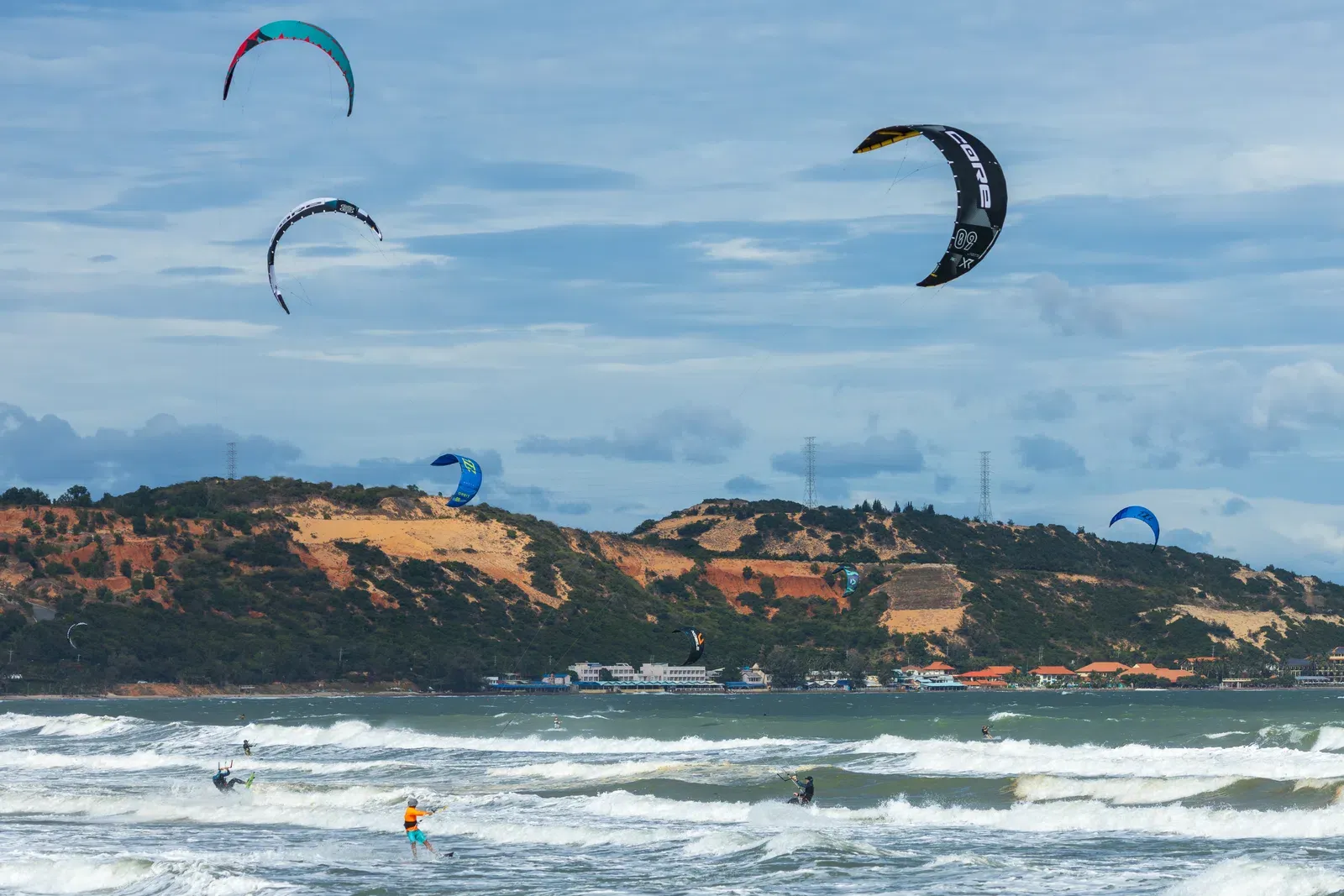
Malibu is where we teach. It is the widest beach section with the most room downwind, a sandy bottom and a long shallow shelf. Beginners belong here, and so does anyone who wants space rather than a crowd.
The central beach in the village works too, and locals ride it all season, but it is narrower, busier, and there are hazards to know about — see the currents section.
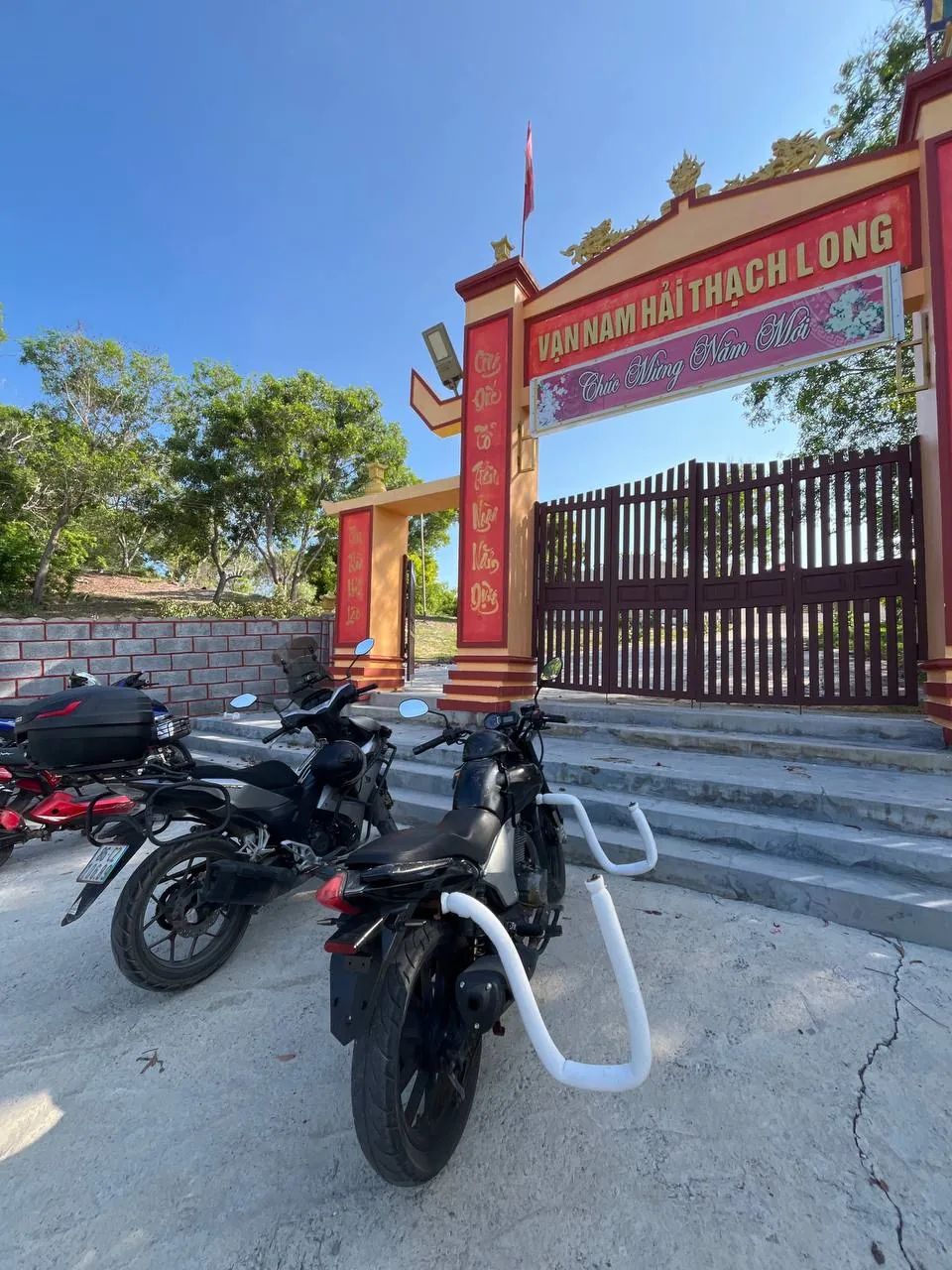
The Cape, near the temple gate at the eastern end, is the summer spot. The wind holds there more evenly and for longer than in the village, so from June to August what life there is moves to that end of the bay.
How kitesurfing lessons work: five steps
Every reputable school teaches the same sequence, because the sequence is what keeps you safe. The names come from the IKO syllabus.
Step one: theory and the wind window
On the sand: how wind direction defines what you can and cannot do, what the wind window is, how the safety systems on the bar work, and how to release them without thinking. It sounds dull. It is the part that decides whether your first week is calm or frightening.
Step two: flying the kite
A trainer kite first, then the real one, on land and then in shallow water. You learn to park the kite, move it through the window, generate power on purpose and take it away on purpose. Most people spend more time here than they expect, and that is fine — everything later is built on it.
Step three: body dragging
You go in the water without a board and let the kite pull you: downwind, then across the wind, then upwind, then dragging one-handed to recover a board. This is the step that makes you self-sufficient, because a board you cannot retrieve is a board you have lost.
Step four: the water start
Board on the feet, kite dropped and driven back up through the power zone, and you stand. The first ones are short and ugly for everybody. Then something clicks, usually within a session or two.
Step five: tacking and coming back
Riding upwind so that you finish where you started rather than a kilometre downwind, turning, controlling speed. This is where a rider stops needing a school.
How many hours it really takes
These figures come from our own logbooks rather than from a brochure. Somewhere between eight and fifteen hours on the water is what it takes most guests to leave riding in both directions. At the four-hour mark the kite stops being frightening and body dragging works. By hour eight the board is under your feet. Between twelve and fifteen you stop walking back up the beach, because you can hold your line against the wind.
Age, weight and fitness change this less than people fear. What changes it a lot: how much water time you actually get (wind decides), whether you are willing to spend the boring hours on kite control, and whether you panic when something goes wrong.
IKO kite school: courses and prices
We are an IKO school — the International Kiteboarding Organization, whose levels are recognised at kite centres worldwide. The certificate is not wall decoration: without it many stations simply will not rent you equipment.
| Course | What it covers | Price |
|---|---|---|
| 1 hour | A single private hour. Gear, radio helmet and insurance included; the hour is credited if you then buy a course. | 55 € |
| Discovery, levels 1A–1E | First contact: assessing conditions, setting up and parking the kite, safety systems, first flying and the wind window. IKO certificate. | 100 € |
| Intermediate, levels 2F–2I | Water start and relaunching the kite from the water, body dragging both ways and upwind, self-rescue. 6 hours plus a free rental hour. | 300 € |
| 8+1 hour course | Discovery and Intermediate together: from zero to a confident water start. Full kit including helmet and impact vest. | 400 € |
| Independent, levels 3J–3N | Riding upwind and controlling speed, transitions, toeside, self-launching and self-rescue. | 500 € |
| 15-hour course — the popular one | The whole path: Discovery + Intermediate + Independent, from zero to independent rider. Radio in the helmet, in-water supervision, IKO certificate, rental included. | 600 € |
| Group lesson 2:1 | Per person, per hour. | 45 € |
Full programme, dates and instructor bios are on the kitesurfing lessons in Mui Ne page.
Rental: when you are ready and what it costs
You are ready to rent when you can launch, land, ride upwind and rescue yourself. Before that, an instructor is not an expense — it is the cheaper option, because self-taught mistakes are paid for in equipment and occasionally in hospital bills.
The full set
| Period | Kite, bar, board, harness |
|---|---|
| 1 hour | 30 € |
| 1 day | 80 € |
| 1 week | 330 € |
Sizes, deposits and conditions are set out on the kite equipment rental page. If you bring your own gear, we store it, repair it and pump it — storage and repair are separate services and are cheaper than shipping a kite home mid-trip.
What a two-week trip costs in total
Counted honestly, not "from": two weeks, learning from zero to independent, mid-range accommodation.
| Item | Guide price | Comment |
|---|---|---|
| Flights | depends on origin and dates | Cam Ranh and Ho Chi Minh City are the two useful airports. |
| Visa | 25–50 USD | 90-day e-visa, or free if your nationality is exempt. |
| Full 15-hour course | 600 € | The main expense and the point of the trip. Rental included. |
| Another week of rental after the course | 330 € | Worth it if you want the skill to stick. |
| Accommodation, 14 nights | guesthouse to resort | Enormous range; ask us and we will point you at places near the station. |
| Food | local food is far cheaper than European | Vietnam remains an inexpensive country to eat in. |
| Local transport | scooter or taxi | Distances are short; the station and your room are usually minutes apart. |
| Insurance | must cover action sports | A standard travel policy does not cover kitesurfing. Check the wording. |
We deliberately do not quote flight and hotel numbers: they change monthly, and any figure printed here would be stale before you read it. Our own prices are the ones we stand behind.
Visas, flights and getting to Mui Ne
Do you need a visa for Vietnam
Vietnam's e-visa is open to citizens of every country and gives up to 90 days — 25 USD for single entry, 50 USD for multiple. It is applied for online, usually takes about three working days, and your passport must be valid for at least six months from the date you arrive. A number of nationalities, including several European countries, enter visa-free for 45 days.
One practical detail people get caught by: your first entry must be through the checkpoint written on the e-visa. Later entries can be through any of the country's international border points, but the first one is fixed. Choose it to match your ticket.
Getting to Mui Ne from Ho Chi Minh City or Nha Trang
There is no airport in Mui Ne itself. Two routes work:
- From Ho Chi Minh City (Tan Son Nhat) — roughly four to five hours by road. Sleeper and "limousine" minibuses run all day; a private car costs more and saves nerves if you arrive at night with board bags.
- From Nha Trang / Cam Ranh — about four hours by road, or the train to Phan Thiet and a short taxi from there.
Tell us your flight when you book a course and we will arrange the transfer rather than leave you negotiating at the terminal.
What to bring
Sun protection first: a long-sleeve rash guard beats sunscreen, because you will be in the water for hours and the reflected sun is brutal. Then: reef shoes if your feet are tender, a dry bag, a spare pair of sunglasses with a leash, and any medication you rely on. You do not need a wetsuit — see the FAQ.
Safety: what is actually dangerous and what is not
Kitesurfing has a reputation for danger that mostly belongs to the sport as it was twenty years ago. Modern kites depower and can be released in a second. Still, some things deserve respect, and this is the honest list.
- Getting tangled in the lines in the water. This is the real one. If you end up wrapped in lines with a kite pulling and you have no hook knife, you are in serious trouble. Carry a knife on your harness, always, and know where it is by feel.
- Riding in offshore wind. Wind blowing off the land takes you away from it, and if your kite dies you are drifting out to sea. Side-offshore, as it sometimes is at Malibu, is workable and people ride it every day. Straight offshore is not, and no school will send you out in it.
- Cloud fronts. Watch the horizon. A dark cloud line coming in can double the wind in minutes. When the beach starts landing kites, land yours — do not be the last one out there deciding for yourself.
- Hard objects downwind. Piers, rocks, boats, other people. Always know what is downwind of you before you launch, because that is where you will end up if things go wrong.
- Being overpowered. Riding a kite that is too big for the wind is the most common cause of beginner injuries. Smaller is safer, and slower is faster in the long run.
What is not especially dangerous: the water temperature, the sea life, and the sport itself when taught in the right order with a helmet, an impact vest and someone watching from the beach.
Currents: the thing the listicles leave out
Every guide describes the wind. Almost none describe the water moving under it, which is the part that actually catches people.
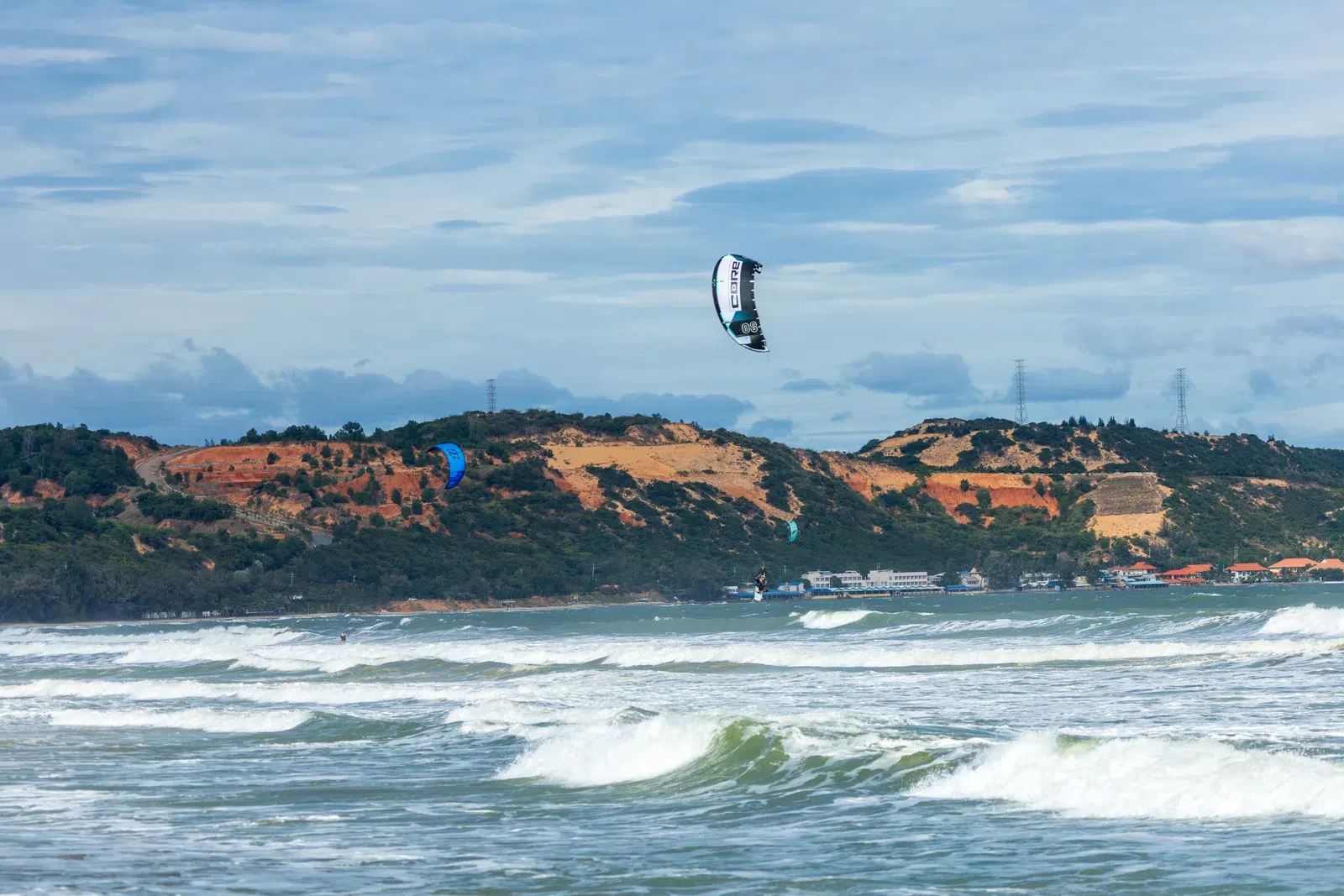
Malibu
The current here runs along the shore, and there are modest rip channels flowing back out. Neither is dramatic, but both will move you further than you think while you are busy with the kite. The saving grace of the geometry: on a port tack the wind pushes you back towards the beach, so a lost board tends to come to you rather than leave.
The central beach
Stronger, less predictable currents, and specific hazards near the Caty area. It is a fine spot for someone who knows it and a poor place to learn on your own.
The simple rule that works
If you find yourself caught in a rip, do not fight it and do not swim straight back at the beach — you will exhaust yourself. Swim along the shore, sideways out of the flow, and only then turn in. Rips are narrow; a few dozen metres of sideways swimming is usually all it takes.
Not only kitesurfing: surf, wingfoil and SUP in Mui Ne
If the wind does not show up, or if kiting turns out not to be your thing, the bay has other days in it.
Wingfoiling
The fastest-growing discipline on this beach. A wing needs less space and less wind than a kite, and there is nothing above your head to drop on anyone. Both existing kiters and complete beginners learn it. We run a separate wingfoil course, and wing-and-foil rental is
20 € per hour.Surfing
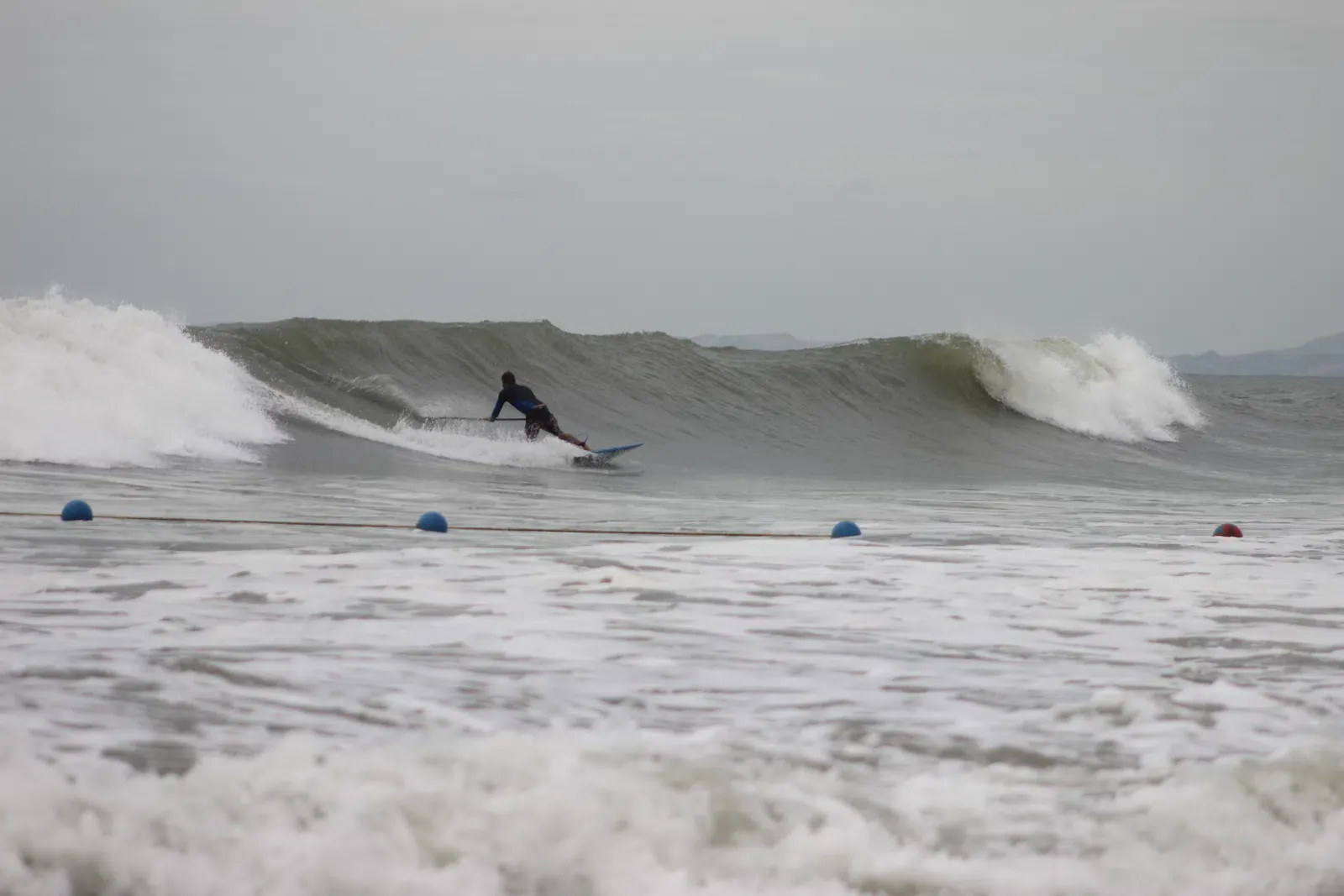
From May the swell arrives and the season changes rather than ends. The waves here are beginner-friendly for most of the summer — long, soft and forgiving, which is exactly what a first surf lesson wants. See surfing lessons in Mui Ne.
SUP
Calm mornings, sunset paddles and tours along the coast. It is also the best cross-training there is for board balance. Details on the SUP tours page.
Hydrofoil
For kiters who already ride: a foil turns a weak-wind day into a session. It is a genuinely different skill with its own learning curve, and it is worth taking two or three hours with an instructor rather than discovering the mast the hard way.
Mui Ne versus other kite destinations: the honest comparison
People ask how Mui Ne compares to Egypt, Sri Lanka, Brazil, Zanzibar or the Philippines. Fairly:
- Egypt has flatter, shallower lagoons and is the better place to learn if you are coming from Europe. It is also more expensive and, in winter, colder.
- Brazil has the most reliable wind on earth and better conditions in almost every respect. It also costs more to reach from anywhere in Asia and needs three weeks to be worth it.
- Sri Lanka has a shorter, sharper season and lagoons that are superb when the wind is on.
- Mui Ne wins on the boring practical stuff: many windy days in a row, a beach you can stand up in, food and rooms that do not empty your account, and short flights from Asian hubs.
If someone tells you Mui Ne is the best spot in the world, they are selling you something. It is a very good place to learn, and that is a different claim.
When to buy your own gear
Not in your first week. Rent until you know what you actually ride: your weight, the wind you will use it in, and whether you are heading for freeride, waves or foiling all point at different kites. Buying before that means buying twice.
Buy when you are riding upwind consistently and going out more than a few times a season. At that point rental costs overtake ownership fast, and gear you know behaves predictably. We are a dealer for Ozone, Flysurfer, F-One and others — the catalogue is here, and we would rather size you correctly than sell you the expensive option.
Frequently asked questions
I am not sporty at all. Can I do this?
Yes. The kite provides the power; you provide the steering and the patience. We have taught people in their sixties and children of ten. Fitness helps a little on long days; it decides nothing.
I am a weak swimmer. Is that a problem?
You must be comfortable in water over your head with a flotation vest on. You do not need to swim well, because you wear an impact vest and you are rarely far from where you can stand. Tell your instructor honestly and the lesson plan will account for it.
Do I need a wetsuit?
No. The water sits around 25–28 °C all season. A long-sleeve rash guard for the sun is far more useful than neoprene.
How many days should I plan for?
Ten days minimum, two weeks ideally. Wind takes days off, and you want spare ones. A week is enough to get standing, not enough to leave riding.
Can two of us learn together to save money?
Yes — a 2:1 group lesson is
45 € per person per hour. You get less individual water time, so it is slower, but for two people learning at similar pace it works well.What if there is no wind during my dates?
In peak season that is unlikely for a whole fortnight, but it happens for a day or two. Unused lesson hours do not burn — we move them, and there is surf, SUP and foil in the meantime.
Do I need special insurance?
Yes. Standard travel policies exclude kitesurfing as an extreme sport. Buy one that names it, and read the exclusions rather than the headline.
Is kitesurfing an expensive sport?
The entry is expensive: a course and a first set of gear. After that it is cheaper than skiing — there are no lift passes, equipment lasts several seasons, and wind is free.
A normal day at the kite station
Mornings are usually calm. That is when theory happens, when kite control on the sand happens, and when people have breakfast slowly. Wind fills in late morning to early afternoon, and the beach comes alive: pumping, launching, two hours on the water, then sitting in the shade watching everyone else and pretending to analyse their technique. By sunset the wind eases and the surfers get their turn.
You will hear a specific vocabulary. The window is the arc of sky the kite can fly in. Body dragging is being pulled through the water without a board. Depower is pushing the bar away to kill the pull. Chicken loop is the release you can hit with one hand. Downwind is where you end up if you stop paying attention.
Where to stay, eat and get around
Accommodation runs from guesthouses to beach resorts, and most of it sits within a few minutes of the water. We keep a list of places near the station and are happy to point you at one that fits your budget — see where to stay.
Getting around is by scooter or taxi, distances are small, and the food is one of the good reasons to come: local seafood and Vietnamese cooking cost a fraction of European prices. Mobile data is cheap and fast; buy a local SIM at the airport.
What to know before your first lesson
Come with realistic expectations: your first hours are about the kite, not the board, and that is not a delay — it is the sport. Bring water and sun cover. Ask your instructor to explain the safety release until you can find it blindfolded. And book more days than you think you need, because the wind, not the schedule, decides when you learn.
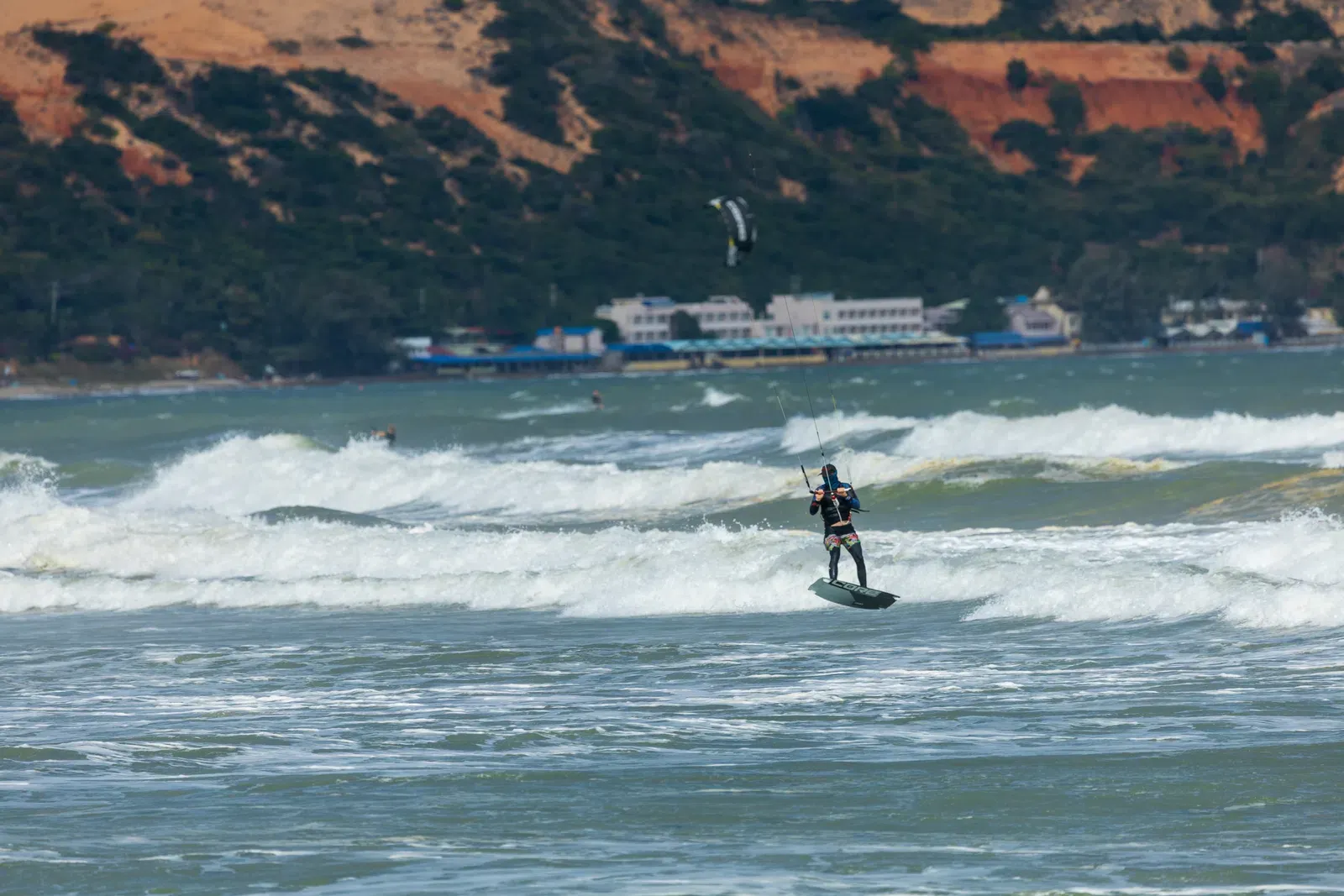
Questions about dates, conditions or which course fits you? Write to us — we answer the same day, and we will tell you honestly if your dates are a bad idea. Ready to book? The kitesurfing course page has the details, and the live wind and webcam shows you the beach as it is right now.
Want advice from an instructor?
Our IKO instructors will help you choose gear or plan a kite trip to Mui Ne — free of charge.
Read next
Starboard came out of windsurfing and became the leading name in SUP. The range: inflatable and hard boards, p…
Inflatable SUP vs Hard Board: What to Choose and the Real DifferenceAn inflatable fits in a boot; a hard board goes faster. Eight differences you feel on the water, and when payi…
How to Read a SUP Board Size: 10'8" x 33", Litres and What MattersThree numbers — length, width and volume — decide whether you paddle or fall. What each one means and how to m…