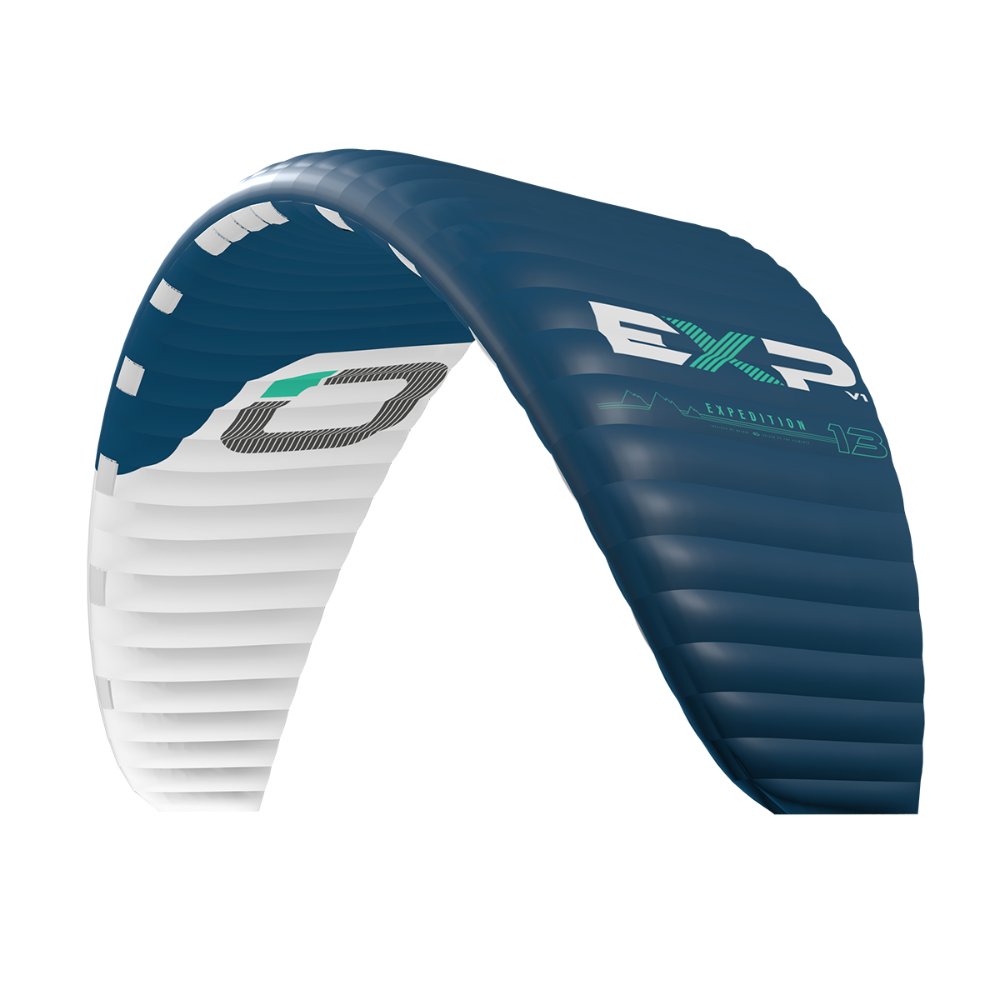
The EXP is built for a scenario that is rare in kiting: long-distance travel, high altitude and full self-sufficiency. Not a session, but a means of transport. Every decision in it follows from that.
The short version
- Sizes: 7, 9, 11, 13, 15 and 18 m².
- Weight: 1.5 kg at 7 m up to 2.8 kg at 18 m.
- Construction: open-cell foil kite, 38 to 44 cells.
- Aspect ratio: 5.31 to 6.24 flat, 3.66 to 4.05 projected — rising with size.
- Level: intermediate, advanced, expert.
- Disciplines: freeride, freestyle, racing, backcountry, expeditions.
- Price: from
Open-cell: why the mountains want exactly this
Open-cell means a full twin-skin profile with open intakes — no valves holding air inside.
The drawback is obvious: in water such a kite takes water on and the session ends. So open-cells live on snow and land.
In the mountains the advantages outweigh that. A full profile is more efficient than a single-skin: more lift, better upwind, higher speed — everything you need when you are not out to play but to cover ground. And the absence of valves simplifies the build and lowers the weight.
Above all, the five-line setup gives complete depower. On a slope, where a fall costs more than it does on water, the ability to zero the pull instantly outweighs any specification.
Aspect ratio rises with size — an unusual decision
A kite's aspect ratio is normally constant across the range. On the EXP it changes: 5.31 at 7 m, 6.24 at 15 and 18 m.
The logic is clear, and it differs sharply from water-kite logic. Small sizes are for strong wind, where handling matters more — a lower aspect ratio makes the wing calmer. Large sizes are for light wind, where efficiency matters more — a higher aspect ratio extracts the maximum from every knot.
We looked at the same trick on the Ozone Reflex. Here the spread is wider: almost a full point of aspect ratio between the ends of the range.
Weight: 1.5 kg at 7 m
For comparison, an inflatable of similar area weighs about two and a half. The difference is a kilogram you carry for the whole route.
On a day session a kilogram is irrelevant. On a five-day tour with overnights it adds to a tent, a sleeping bag, food and avalanche equipment — and there every item is literally weighed.
Expedition equipment is judged not on specification but on usefulness per gram. The EXP is built to that principle.
Who it is for
People who travel routes. The disciplines explicitly include backcountry and expeditions — rare wording in a kite specification.
High altitude. Thin air means less lift, and profile efficiency becomes critical.
Experienced snow riders. The level starts at intermediate, and on the large sizes at 6.24 aspect ratio that is not a formality.
Who it does not suit
Anyone riding water. Categorically: open-cell and water do not mix.
Beginners on snow. Starting on the Explore V3 makes more sense: half the price and far more forgiving.
Anyone riding one field near home. You pay for self-sufficiency, and self-sufficiency is used on a route.
EXP or Explore: how to choose
A practical question, since both are snow kites and both are Ozone.
Explore V3 — single-skin, from
919 €, beginner and up, aspect ratio 4.45. Simpler, cheaper, calmer. For riding and first trips.EXP — open-cell, from
2 389 €, intermediate and up, aspect ratio to 6.24. Faster, more efficient, more demanding. For routes and kilometres.The rule: if your question is "how do I ride", buy the Explore. If it is "how do I get there", buy the EXP.
Common questions
What happens if the EXP lands in water?
It takes on water through the open cells and becomes very heavy. That is not only the end of the session but potentially a dangerous situation — which is why it does not go on the water.
How many lines?
A five-line setup, the mountain standard. You need a bar with a fifth line, such as the Snow EXP V5.
Which sizes should I take on a route?
Usually two: a working size and a light-wind backup. One kite on a self-supported trip risks leaving you unable to move.
Is it fine for ordinary field riding?
Yes, and it will be excellent. You will simply have paid for self-sufficiency you never use.
Does it pull better than an inflatable?
In light wind, noticeably. In strong wind the gap narrows, but the weight and profile efficiency always work in its favour.
Where to buy
Ozone EXP — from
2 389 €. Snow equipment is in the snowkite section, and the whole foil range in our overview.Ozone EXP Kite at K1.surf
Official Ozone dealer. From 2 389 €. Our IKO instructors match the size to your weight, level and wind.
Read next
Red and White Dunes, Fairy Stream, Red Canyon, the fishing village, Cham towers and the Whale Temple — what fi…
Build Your Own: Assembling a Foil for Yourself Without Getting It WrongAXIS offers a four-component configurator rather than a finished foil. How to choose in the right order, which…
Foil Etiquette: Why Foilers Are Unpopular and How to Fix ItA metal wing underwater is invisible, and that is the root of every conflict at a spot. The rules that formed …