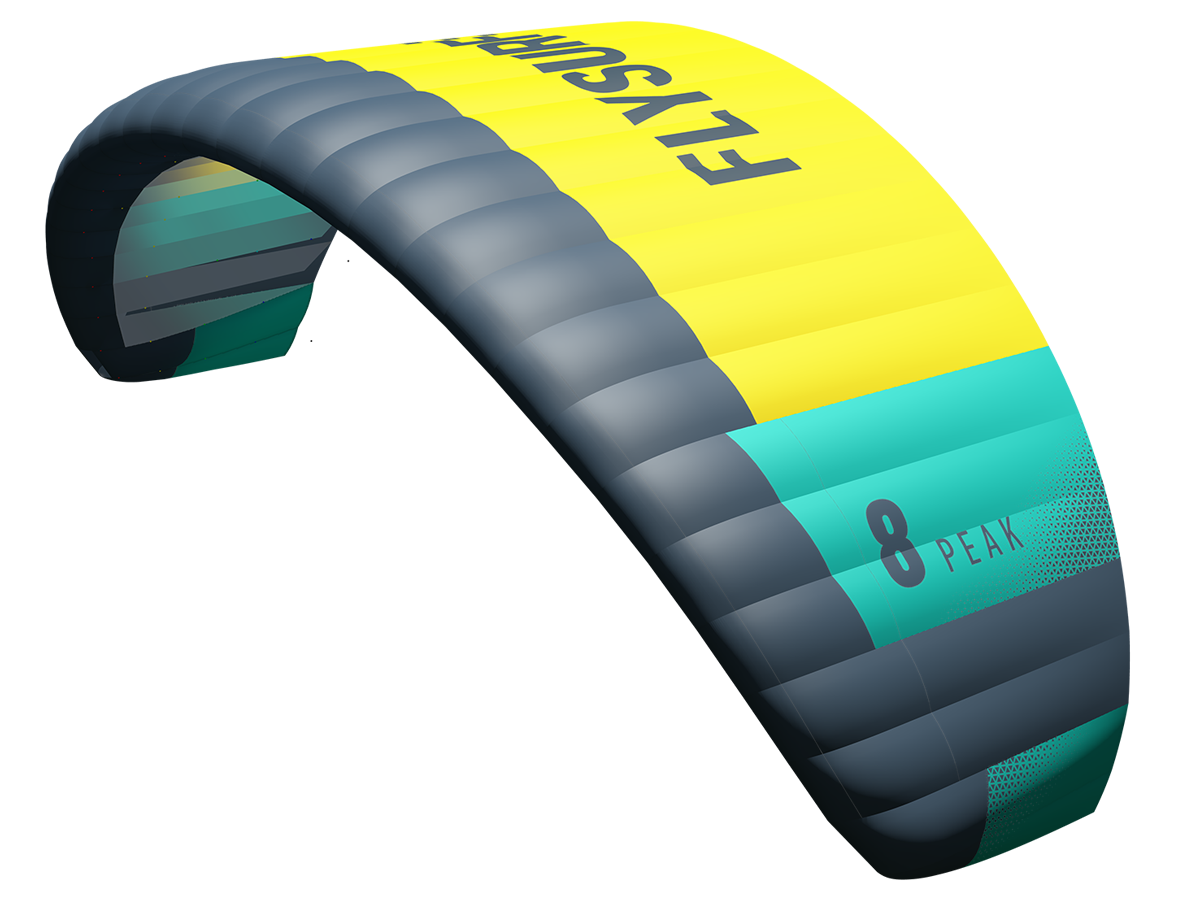
The PEAK is the model that brought single-skin kites out of their niche. A sixth generation, and a range spanning 2.5 to 11 m² — a spread almost nobody else offers. Here is what that range delivers.
The short version
- Sizes: 2.5 / 4 / 5 / 6 / 8 / 11 m².
- Construction: single-skin foil kite.
- Level: beginner and up.
- Purpose: snowkiting, mountains, backcountry.
- Brand: Flysurfer, Germany.
- Price: from
Why a 2.5 metre size exists
The first thing that surprises people about the range. On water a kite that size is a toy. On snow it is a working tool, and here is why.
Snow resistance is a fraction of water resistance. The kite does not have to drag you onto the plane — you are already sliding. It only has to pull.
Which means in strong mountain wind a small area stays controllable where an ordinary kite is already dangerous. The 2.5 is for thirty-plus knots on a col, where an 8 m simply cannot come out of the bag.
The second scenario is learning. A small single-skin barely pulls and lets you develop your hands on snow without the risk of being yanked off your feet.
Eleven metres that weigh almost nothing
The other end of the range. A single-skin is half the fabric of an ordinary foil kite and has no frame at all.
As a result the large Peaks stay light and pack into a volume unthinkable for an inflatable of the same area. An eleven-metre kite that fits in a backpack alongside avalanche equipment is exactly what single-skins exist for.
The price is efficiency. An incomplete profile means less lift per unit of area and modest upwind performance. An eleven-metre single-skin corresponds roughly to an eight or nine metre twin-skin in pull.
Why it forgives
"Beginner and up" on a foil kite's spec sheet is rare, and here it is honest.
A single-skin canopy fills instantly: there is nowhere for air to lag. A collapsed kite reopens more readily than a twin-skin because it needs less air to recover its shape. There is little inertia and the response is soft.
And the point that matters most in the mountains — it does not pack with snow. A twin-skin dropped in deep snow can fill its cells, and you will spend half an hour shaking it out. A single-skin has nothing to fill.
Choosing a size
Snow logic differs from water logic, and the steps between sizes mean more here.
- 2.5 and 4 m — strong wind, learning, children and light riders.
- 5 and 6 m — the working middle for a mid-weight rider in 15 to 25 knots.
- 8 m — the most universal single size if you buy only one kite.
- 11 m — light wind, flat ground, heavy riders.
A working season pair is a 6 and an 11, or an 8 as a single kite on a steady spot.
Peak or Ozone Explore
The two leading single-skins on the market, so the question always comes up. In brief: the Explore V3 runs five sizes from 4 to 12 m at an aspect ratio of 4.45; the Peak6 runs six from 2.5 to 11 m.
The key difference is at the edges: the Peak has a 2.5 the Explore lacks, and the Explore has a 12 the Peak lacks. A full comparison is in a separate article.
Who it does not suit
Water riders. A single-skin will not sink, but it is a snow kite.
Anyone who wants speed and upwind. Look at twin-skins — the SOUL3 or SONIC5.
Anyone chasing height. A single-skin gives modest lift.
What you need alongside it
A bar with a fifth line — the Flysurfer CONNECT or the Ozone Contact Snow V5. Snow harnesses and protection are in the snowkite section.
Common questions
Can I ride the PEAK6 on water?
It will not sink, but it is designed for snow. For water you want a closed-cell — the SOUL3.
How many lines?
Single-skin snow kites run five lines: the fifth gives complete depower.
Which size if I only buy one?
The 8 m for a mid-weight rider. It covers the most common range.
Is it noisy?
Single-skins rustle more than twin-skins. It surprises you on the first session and then you stop noticing.
Is it suitable for a child?
The 2.5 and 4 m sizes suit a light rider, but teaching a child should only happen with an instructor.
Where to buy
Flysurfer PEAK6 — from
639 €, six sizes. The full range is on the Flysurfer page, and the brand in our Flysurfer review.Flysurfer PEAK6 Kite at K1.surf
Official Flysurfer dealer. From 639 €. Our IKO instructors match the size to your weight, level and wind.
Read next
AXIS offers a four-component configurator rather than a finished foil. How to choose in the right order, which…
Foil Etiquette: Why Foilers Are Unpopular and How to Fix ItA metal wing underwater is invisible, and that is the root of every conflict at a spot. The rules that formed …
Where to Start in Foiling: A Two-Year RouteFive foil disciplines, and the order of learning is not arbitrary. Which to start with, how long each stage ta…