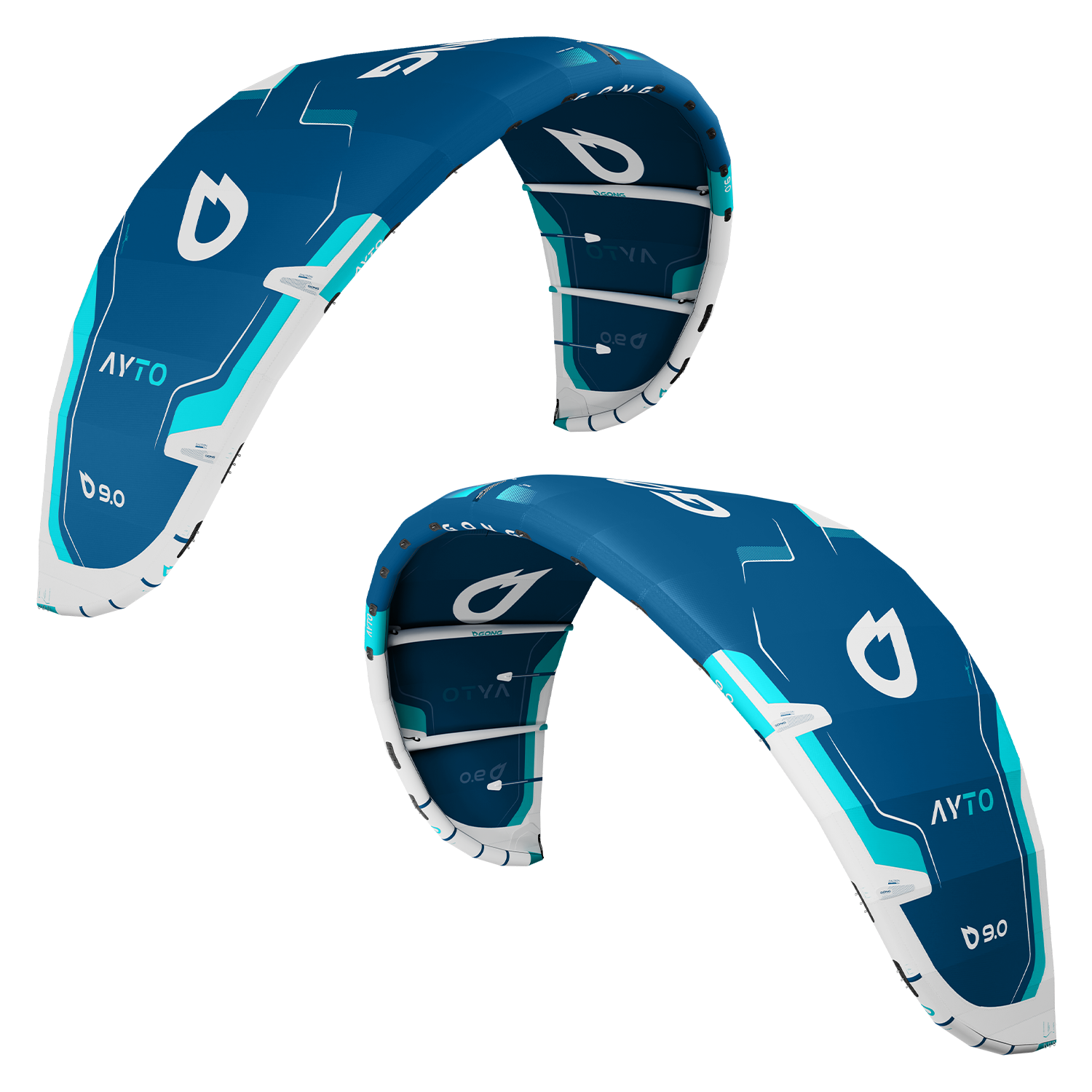
Six models form an almost even price ladder: 469, 519, 589, 599, 629, 649 euros. Here is what sits behind each step.
The ladder
- Strutless —
All share one size grid — 10, 11, 12 m² and onward, in identical colourways. A sign of a shared platform: the brand separates models by canopy shape rather than by size ladder.
What to grasp before picking a model
The base price is not the whole price. Each model also exists in two further materials:
- Dacron — the base, at the prices above.
- Aramid — Elips
The practical consequence: the gap between models (180 € end to end) is smaller than the gap between materials within one model (340 € on the Ayto).
So choose the model by job first and the material by hours second — not the other way round. On materials, see our canopy material guide.
Strutless: what "no struts" means
The cheapest item and the most unusual structurally.
A normal kite has a leading edge tube plus cross struts holding the canopy's shape.
A strutless kite has only the leading edge. The cloth between sections is held by line tension and airflow.
What that gives:
- Less weight. No struts, no strut mass. Hence better drift and an earlier start in light wind.
- Faster setup. One bladder instead of five or six.
- Smaller packed size.
What it costs:
- Less stiffness. The canopy deforms more in strong wind.
- A weaker top end. Storm sessions are not its territory.
- Harder water relaunch in some positions.
Who it suits: riders in light to medium wind, wave riders, and anyone who values low weight. The same logic that makes strutless kites popular with foilers.
How to choose a model when descriptions are thin
An honest method for when a brand does not spell out each model's purpose.
One: read price as an indicator of structural complexity. Within a range, a dearer model almost always has a more complex canopy shape aimed at a more demanding rider.
Two: ask us. We check the brand's stated purpose and wind range against your weight and spot before payment — a normal part of the job rather than a favour.
Three: do not chase the top. In a range spanning 180 € the temptation is real. But the suffix rule applies here too: while learning, technique is your limit.
Sizes: what to buy
The grid is standard and the rules are the usual ones:
- under 70 kg: 8 and 11 m²
- 70–85 kg: 9 and 12 m²
- 85–95 kg: 10 and 13 m²
- over 95 kg: 12 and 15 m²
The full table is in our weight and wind guide.
A separate thought on price: at
519 € a kite, a pair of sizes costs roughly one mid-brand kite. That changes strategy: instead of one all-rounder you can buy two sizes outright and cover the range honestly.What else a kite needs
A bar. Check whether it is included — in a modular range it is often separate.
A harness. If you lack one: fitting one to your back.
A board. Separate.
A pump. Usually included, but confirm.
The rule: budget the whole setup. A cheap canopy does not mean cheap entry into the discipline.
Common questions
How does a strutless kite differ?
It has no cross struts: less weight and better drift, but less stiffness in strong wind.
Model or material first?
Model by job first, material by hours second. The material gap within a model exceeds the gap between models.
Which two sizes at 80 kg?
9 and 12 m². At these prices a pair costs about one mid-brand kite.
Is a bar included?
Check per item — in a modular range it is often separate. We confirm contents before payment.
Should a first kite be the top model?
No. While learning, technique limits you rather than canopy design.
Where to buy
469 €, Unik 519 €, Ayto 649 €. The section: kites.Want advice from an instructor?
Our IKO instructors will help you choose gear or plan a kite trip to Mui Ne — free of charge.
Read next
The cheapest SUP in our catalogue costs 99 euros, the cheapest adult one 199. Where that price comes from, wha…
GONG I-SUP: Nine Models for Nine JobsAllround, Cruising, Race, Family, Explorer, Adventure, Hybrid, Longboard, Shortboard — a range split by purpos…
Assembling a Setup Without Forgetting Anything: Five ChecklistsIn modular ranges half the parts are sold separately, and it is easy to reach the water without a pad or a lea…