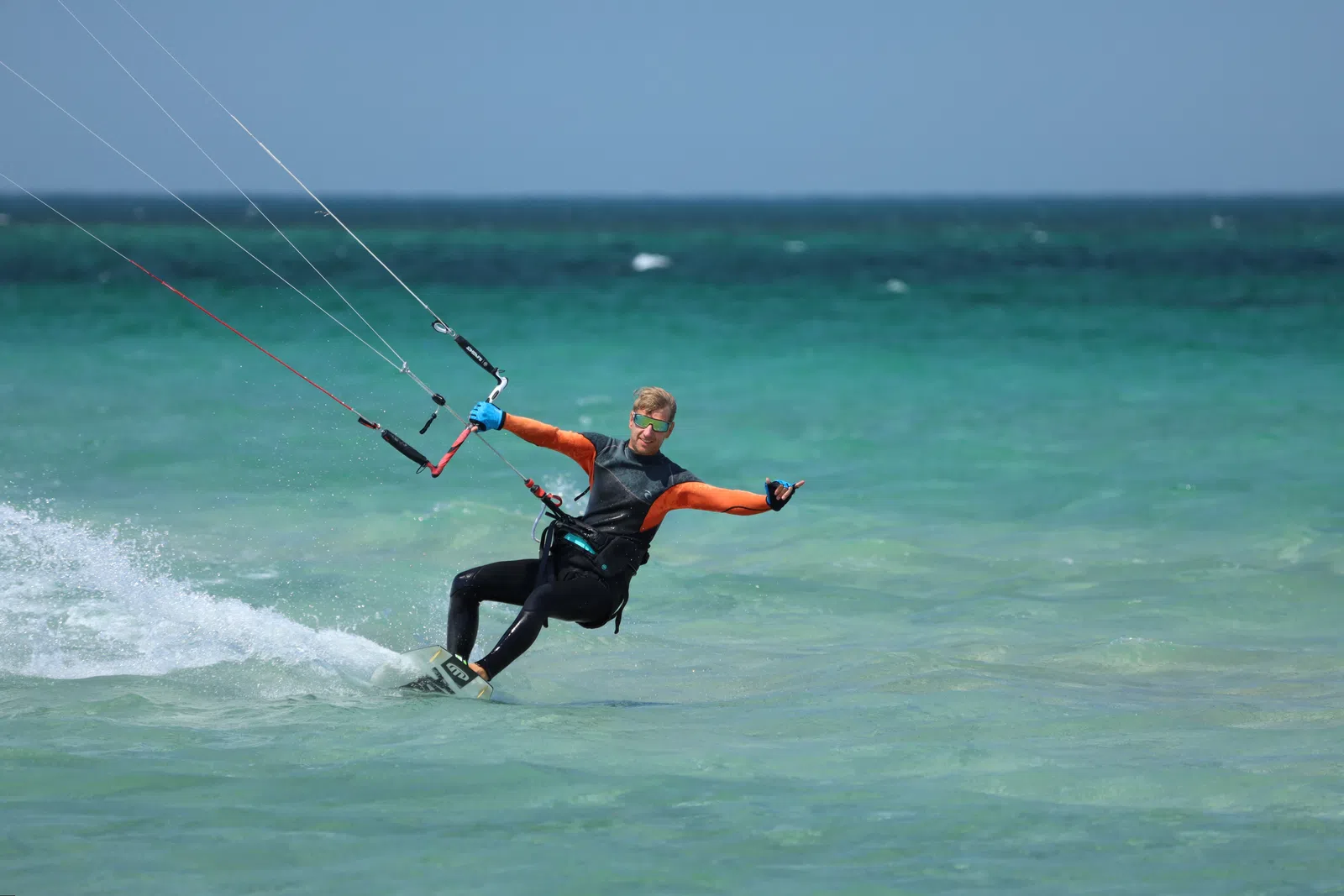
Everyone writes about harness size: measure your waist, and when in doubt go smaller. True, but that is half of it. The other half is shell height relative to your back, and it is why people ride for years in a harness that pinches them.
Where a harness should sit
Not on the waist in the clothing sense, and not on the hips. The correct position is just above the hip bones, at the narrowest part of your torso. Below, the harness rests on the pelvis; above, it stops short of the lower ribs.
That position is the only one where load goes into your skeleton rather than into soft tissue. Everything else is a question of how long before it hurts.
Measurement one: circumference
Measure where the harness will sit, not at your trouser line. And over your wetsuit if you ride in one: neoprene adds two or three centimetres, and that is exactly the margin behind a harness that "suddenly" stopped fastening in May.
Brands overlap their ranges deliberately. On a boundary, take the smaller size: a harness stretches under load, and a loose one rides up.
Measurement two: torso height
Here is the part almost nobody discusses.
The distance from pelvis to lower ribs varies between people, and it has almost nothing to do with waist circumference. Someone with a short back can have five or six centimetres less of it than a tall person of the same girth.
If the harness shell is taller than that gap, it has nowhere to go: it will hit your ribs. No amount of tightening fixes that, because the problem is geometry rather than size.
Which is why modern brands added a second figure. The Ozone Connect Waist V4 comes in seven sizes, and Manera states waist girth and waist width separately — that is exactly what it is about.
The rule: with a short back, look for a narrow harness even if a taller one matches your girth.
Three signs the harness is not yours
One: it rides up. The classic. Three causes — too big, not tight enough, or you ride with straight legs and your chest forward. The first two are fixable; the third is technique, and the harness is innocent.
Two: breathing gets hard on a long tack. The shell is pressing on your diaphragm: either it is too big and has ridden up, or it is too tall for your back.
Three: it rubs your lower back. Usually a stiff thick shell that will not bend when you do. The answer is a more flexible model, not a tighter one.
Waist or seat
A question to settle before size, because these are different objects.
A waist harness leaves the hips free and does not interfere with jumps and rotations. The standard for freeride, freestyle and big air. The downside: with a weak stance it rides up.
A seat harness is fixed with leg straps and does not move at all. The choice for learning, for foiling and for anyone with back problems. The downside: less freedom of movement.
A full comparison is in a separate article.
What is not the harness's fault
Worth being able to tell apart, because plenty of people change equipment instead of technique.
Tired arms. Not the harness — you are hanging off the bar instead of sitting in the harness. The harness should carry the pull; your arms only steer.
A sore lower back the next day. Usually your stance: straight legs and an arched back instead of bent knees.
The hook drifting sideways. That is the spreader line or slider, not the harness.
Measuring at home in two minutes
- Stand upright and find the top of your hip bones with your hands.
- Two or three fingers above that is the seating line. Measure your girth there.
- Measure the distance from that line to your lowest rib. Under 12 to 14 cm means you want a narrow harness.
- If you ride in a wetsuit, add 2 to 3 cm to the girth.
Common questions
What if I fall between two sizes?
Take the smaller. A harness stretches, and a loose one rides up into the ribs.
Can I go by clothing size?
No. A harness fits by waist circumference, and the correlation with T-shirt size is coincidental.
Why has my harness started pinching this season?
Three usual causes: a different wetsuit thickness, a change in weight, or a covering that shrank after drying in the sun.
How long does a harness last?
Three to four seasons with regular riding. The covering and spreader line fail first — check both every season.
Do I need a separate harness for winging?
Not necessarily: universal models work with both. But many wingers prefer a softer belt.
What to read next
Specific models: the Ozone Connect Waist V4 and the Prolimit VECTOR BLACK. All harnesses are in the catalogue section.
Try kitesurfing in Mui Ne
A trial hour with an IKO instructor is €55, all gear included. Then a course to independent riding or a December kite camp.
Read next
Red and White Dunes, Fairy Stream, Red Canyon, the fishing village, Cham towers and the Whale Temple — what fi…
Build Your Own: Assembling a Foil for Yourself Without Getting It WrongAXIS offers a four-component configurator rather than a finished foil. How to choose in the right order, which…
Foil Etiquette: Why Foilers Are Unpopular and How to Fix ItA metal wing underwater is invisible, and that is the root of every conflict at a spot. The rules that formed …