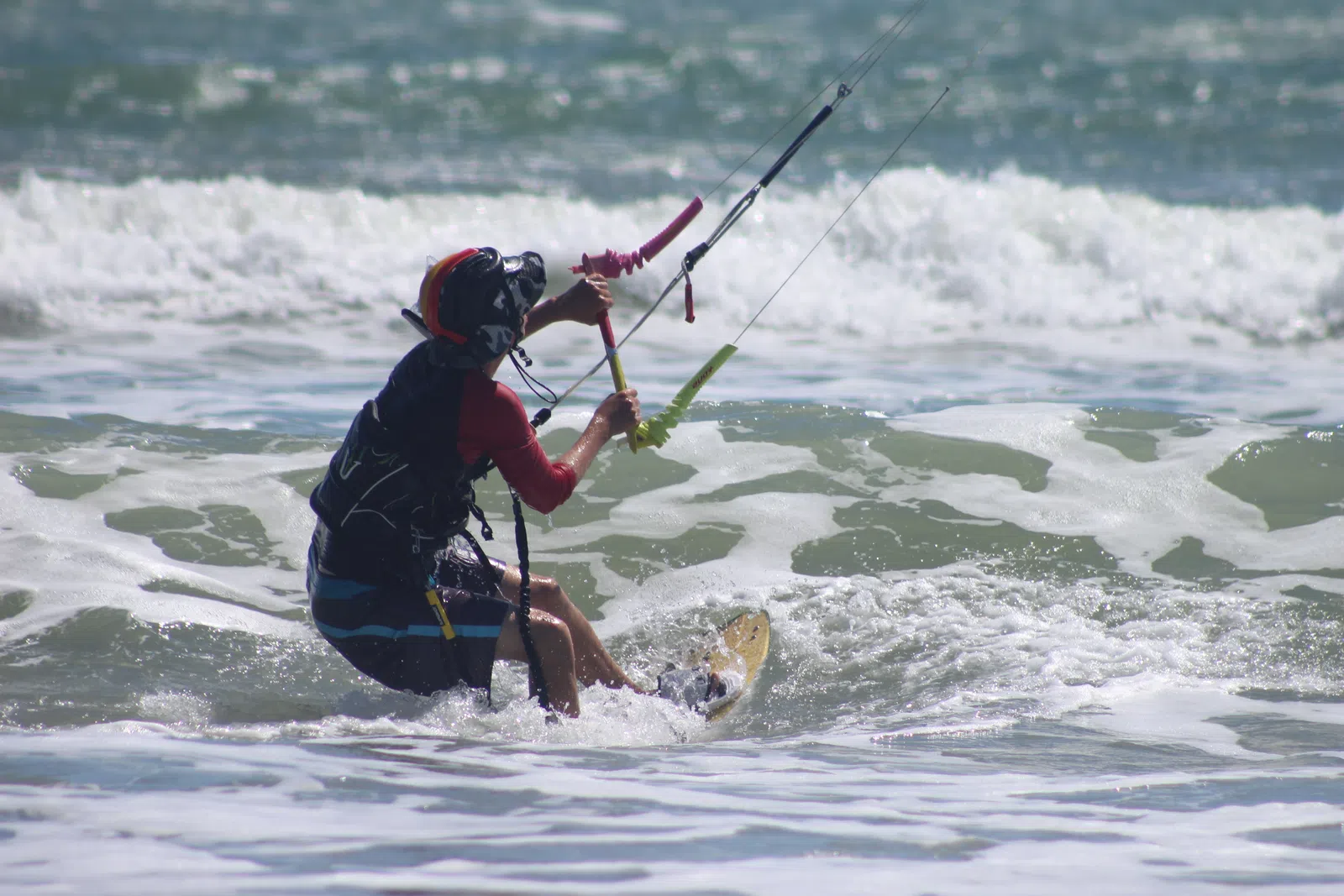
The first question in surfing, and the answer decides whether you enjoy it at all.
Six differences
1. Safety — the decisive one for a beginner
A hard board means a solid nose, sharp fins and weight. In your first weeks it will hit you regularly: in falls, surfacing, in the impact zone.
A softboard softens all of that. Not eliminates — softens: a bruise instead of a gash.
And the other side: you stop being afraid. Fear of taking a board to the face is a real brake on learning, and it holds people back more than a lack of technique.
2. Volume and area
Softboards are thicker at the same length. More volume means more flotation, easier paddling and easier wave catching.
That decides everything early: the first task in surfing is not standing up but paddling into a wave and catching it. Volume does exactly that.
3. Speed and precision
Here the hard board wins.
Thin rails bite the water and hold a line on a steep wave. A thick soft rail skids.
Response is faster: a rigid construction transmits input instantly.
When that starts to matter: when waves become steep and fast. On gentle small surf there is barely any difference — and that is exactly what you will ride in your first year.
4. Durability
A softboard survives what kills a hard board: hitting the bottom, a pontoon, someone else's board, or a flight in the hold.
A hard board demands care: any ding gets sealed immediately or the core takes on water. Mechanics in our construction article.
5. Price
Softboards: Catch Surf from
35 € for a WOMPER to 547 € for a ten-foot LOG; Softech boards at 394 € to 451 €.A hard board of comparable level usually costs more, and a used one is a lottery on condition.
6. Weight and feel
A softboard is heavier at equal size. On a wave that is not critical, but carrying and paddling are slightly harder.
When to switch to a hard board
A four-point test. Switch if you can answer yes to all:
- You stand up reliably on most waves you catch.
- You ride along the wave rather than straight into the whitewater.
- You turn and paddle back to the peak yourself.
- You lack speed and precision — and can say so specifically.
Any single no means it is early. A hard board will not make you better; it will add fear and bruises.
The middle option people forget
You need not replace the board — start with the fins.
Some softboards come with soft fins, and hard ones can be fitted instead: Softech sells FCS II sets from
47 €.What that gives: the board holds a line noticeably better while the deck stays as safe as before. The cheapest upgrade in surfing.
The same logic as SUP fins — covered in our fin guide: a part costing a couple of dozen euros changes board behaviour more than you would expect.
Choosing in under a minute
First board, adult 70 to 90 kg → an 8 to 9 foot softboard such as the Easy Rider.
First board, over 95 kg → 9 to 10 feet, a LOG or Plank.
A child → a 6 to 7 foot softboard, and nothing else.
Small weak waves at your spot → a softboard permanently, not just to start.
Already surfing confidently → a hard board matched to your wave.
Flying with the board → a softboard survives more flights.
What else you need beyond the board
A leash. Mandatory — from
32 €. A loose board in the impact zone endangers everyone around.Fins and screws. Check whether they are included.
Wax — for a hard board. A softboard needs none.
A wetsuit or rash guard to suit the water and sun — how to choose.
Common questions
Is a softboard worse than a hard board?
Not worse, different: safer, more voluminous and cheaper, but slower and less precise on a steep wave.
When should I switch to hard?
When you stand reliably, ride along the wave, turn and return to the peak yourself, and can articulate what is missing.
What softboard length for an adult?
8 to 9 feet at 70 to 90 kg, 9 to 10 feet above 95.
Can I improve a softboard without replacing it?
Yes: fit hard fins instead of soft ones. The cheapest upgrade in surfing.
Does a softboard need wax?
No, the soft deck grips by itself. Wax is for hard boards.
Where to look
Surfboards. To read: Catch Surf and Softech.
Try before you buy
Rent at the K1 station in Mui Ne and ride the model before buying. Our instructors match the size to your weight and wind.
Read next
A sevenfold price gap between outwardly similar boards. What actually changes, point by point, and the three c…
Red Paddle Co Brand Review: Premium Inflatable SUP and What You Pay For31 boards from 1,000 to 1,751 euros, paddles to 175, and a pump with its own spare hose. What sits behind a pr…
Surfskates: Training for Surfing When the Water Is Far AwayA skate with a pivoting front truck reproduces the body movement of a wave turn. How it differs from an ordina…