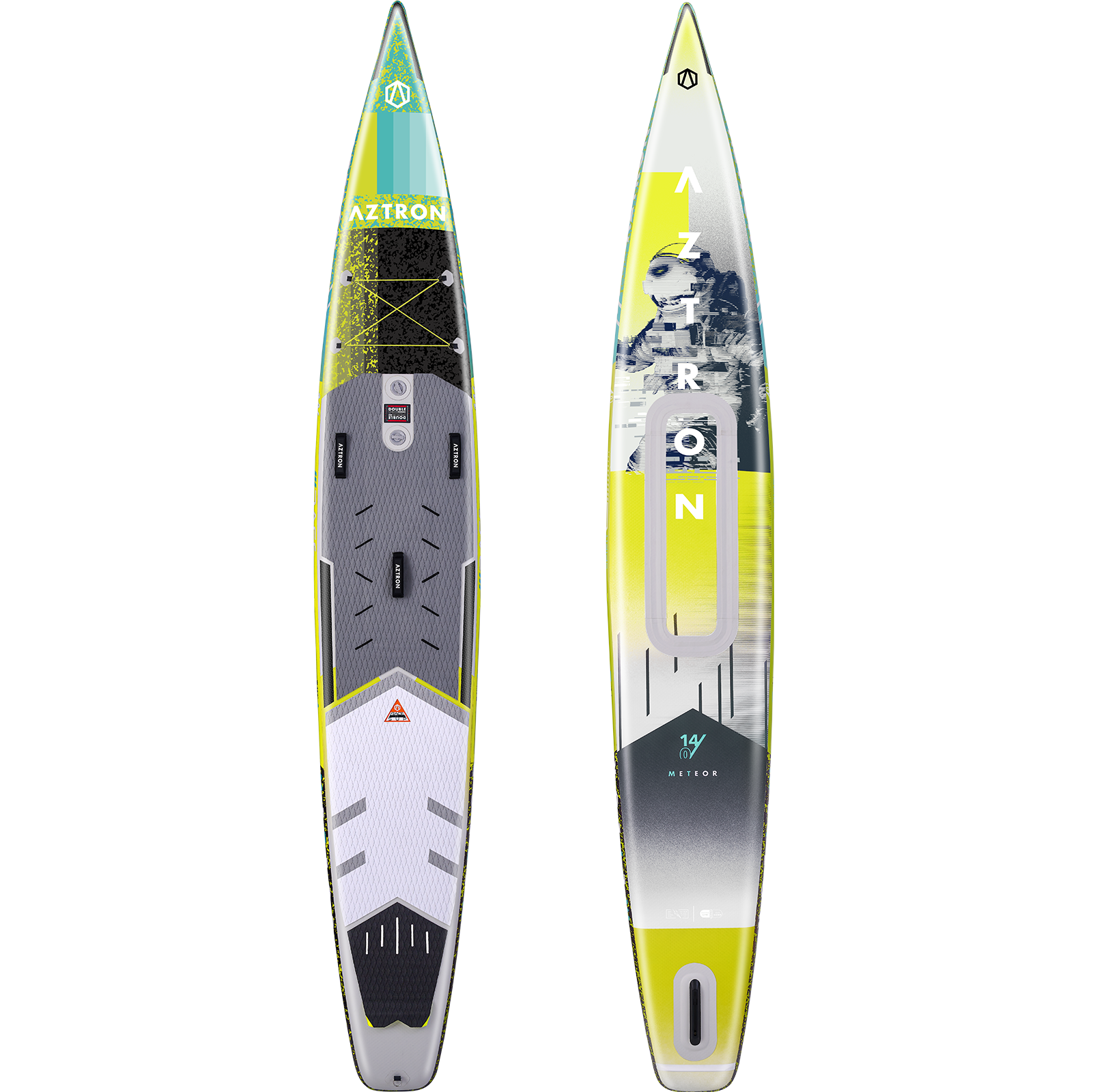
Two eleven-foot inflatables. One costs
199 €, the other 1 444 €. Here is what sits behind that.First, honestly about comparing
Board prices cannot be compared directly, and that is the first trap.
Budget boards are sold as kits: the GONG Pack First at
199 € includes board, paddle, pump, leash and bag.Premium ones too: a Red Paddle Package is the same list a class higher.
But Starboard at
649 € is often a board alone, needing a paddle from 79 €.The rule: budget the whole kit, or the gap looks larger or smaller than it is.
What actually changes with price
1. Stiffness — the main thing
The one parameter worth paying for.
An inflatable works as a beam: you stand in the middle and the ends float up. The softer the construction, the more it folds beneath you.
What a soft board feels like: the nose lifts, the board ploughs, glide disappears, and you paddle twice as hard for the same speed.
When it is critical: above 90 kg and beyond five kilometres. Below that the difference is barely visible — and that is the honest position.
How it is achieved: layer count, the bond between top and bottom, working pressure, and rail battens.
2. Weight
An expensive board is lighter at equal stiffness. You notice not on the water but on the way to it — board plus backpack is 10 to 15 kg.
3. What is in the kit
The paddle. Budget kits include aluminium or basic fibreglass; premium ones carbon.
That matters more than it seems: an hour of paddling is around two thousand strokes, and paddle weight multiplies by that. Upgrading the paddle often delivers more than upgrading the board — covered here.
The pump. Double action against single is half the strokes.
The backpack. With wheels or without.
4. Durability
Seams, valve, material. A cheap board more often leaks after a season or two of heavy use.
5. Spare parts
A point people miss: premium brands sell a hose at
9 € or a batten at 17 €. On budget boards a broken part means a new board.When the premium returns
1. A rider above 90 kg. The most honest criterion. A heavy rider folds a soft board in the middle, visible from the first session.
2. Distance and touring. Over five to ten kilometres the glide difference accumulates into fatigue.
3. Frequency. A hundred outings a season against five, and durability becomes a real factor.
When it does not
Sampling the discipline. At
199 € the cost of being wrong equals one day's rental.An hour or two on a lake. On calm water over short distances you will not notice the glide difference.
A board for guests and children. It takes more impacts than kilometres.
Under 75 kg. A light rider does not load the board enough to deflect it.
The strategy that works best
Do not buy an expensive board first.
The right order:
- A budget kit — to learn whether it is for you and what you will actually do: cruising, distance, waves, yoga.
- A paddle upgrade — the best-value investment of all: carbon from
Why: a first board almost always turns out wrong. Not in quality but in purpose. Someone buys an all-rounder and a season later realises they paddle distance and need a touring board.
On pressure — the great leveller
An under-inflated expensive board is worse than a properly inflated cheap one.
Not an exaggeration: the felt difference between 12 and 15 psi exceeds the difference between constructions.
What to do: inflate to the stated maximum and check with a gauge rather than by hand. Mechanics in our construction comparison.
Common questions
The main difference between a cheap and an expensive board?
Stiffness. A soft board folds beneath you, loses glide, and you paddle harder for the same speed.
At what weight does it show?
From 90 kg, immediately. Under 75 kg a light rider does not load the board enough to deflect it.
Upgrade the board or the paddle first?
The paddle. An hour is around two thousand strokes, so its weight matters more than the board's.
Should a first board be expensive?
No. A first board almost always turns out wrong in purpose rather than quality.
Can a cheap board beat an expensive one?
Yes — if the expensive one is under-inflated. The gap between 12 and 15 psi is felt more than the gap between constructions.
Where to look
Inflatable SUP from
99 € to 1 751 €. To read: how to read a size and our paddle guide.SUP tour in Mui Ne
Guided SUP tours from €35 per person, planned around wind and tide.
Read next
Inflatable kayaks for one, two or three, a SUP-kayak hybrid, and floating platforms up to twenty feet. A branc…
Red Paddle Co Brand Review: Premium Inflatable SUP and What You Pay For31 boards from 1,000 to 1,751 euros, paddles to 175, and a pump with its own spare hose. What sits behind a pr…
Surfskates: Training for Surfing When the Water Is Far AwayA skate with a pivoting front truck reproduces the body movement of a wave turn. How it differs from an ordina…