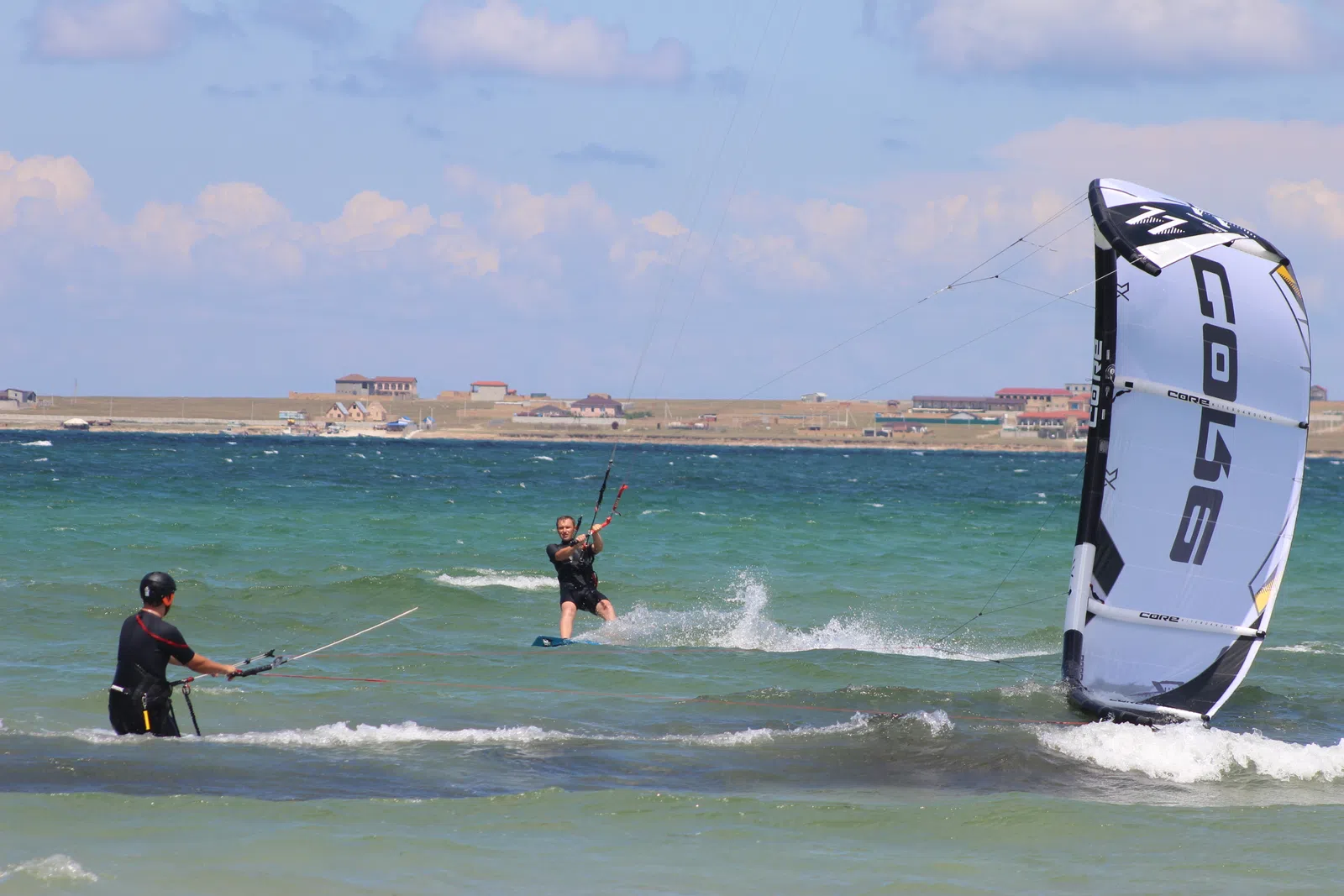
A wetsuit is the one piece of kit that sets the length of your session directly. You can ride the wrong kite and still have a session. In the wrong wetsuit you will be out in forty minutes whatever the wind is doing.
What the numbers mean
3/2, 4/3, 5/4 is neoprene thickness in millimetres: the first figure for the torso, the second for arms and legs.
Why two figures: the torso needs warmth, the limbs need movement. Thick neoprene on the arms turns working the bar into a wrestling match, so it is thinner there.
A shorty has short arms and legs. A steamer is full length.
A table by water temperature
The key word is water. Air matters secondarily: you are in water, not in air, and water conducts heat more than twenty times better.
- Above 26 °C — a rash vest or nothing. A suit is for sun and jellyfish, not cold.
- 22–26 °C — a shorty or a 2 mm suit.
- 19–22 °C — a 3/2 steamer.
- 16–19 °C — a 4/3 steamer.
- 12–16 °C — 5/4 plus hood, gloves and boots.
- Below 12 °C — 5/4 or 6/5 with a hood, and now it is a safety question rather than a comfort one.
The kiting correction. A kiter spends most of the time above the water rather than in it, with wind blowing across them. A wet suit in wind chills harder than one underwater. So a kiter often needs one step warmer than a surfer in the same water.
Why a wetsuit must fit tight
The commonest buying mistake is choosing one that does not pinch.
Neoprene does not warm you by itself. It lets a thin layer of water inside, your body heats it, and that layer then works like a flask. If the suit is loose, the water inside keeps changing, and your body heats a fresh batch of cold water each time. The suit does not work at all.
So a correctly fitted suit feels tight on land. It should sit without folds at the lower back and under the arms — that is exactly where water tends to circulate.
Second point: neoprene stretches after a few sessions. A suit that fits perfectly in the shop will be loose in a month.
Seams: what the money buys
The difference between a
121 € suit and a 324 € one is not thickness — that is comparable. It is three things, and seams are the main one.Flatlock stitching — the thread passes right through. Cheap, strong, lets water in. Fine for warm water.
Glued and blind-stitched seams (GBS) — glued first, then stitched without piercing through. Almost watertight. The standard for cool water.
Internally taped seams — the top level, fully sealed.
The second item is neoprene stretch. Better neoprene moves more and does not fight your shoulders, and working the bar is shoulders. The third is an inner lining that holds warmth and dries faster.
Three buying mistakes
One: going by air temperature. "It is 25 out, why would I need a 4/3" — while the water is 17 °C and you are blue in half an hour.
Two: sizing up for comfort. A loose suit does not warm you. Between sizes, take the smaller; neoprene will stretch.
Three: saving on the suit after buying an expensive kite. The kite decides how you ride. The suit decides how long. In cool water the second number matters more.
Making a wetsuit last
Two things kill neoprene, and neither happens while riding.
UV. Dry it in the shade. A suit that spent a summer on a sunny balcony loses stretch faster than in two seasons of use.
Creases on hangers. Thin hangers fold neoprene along one line, and it cracks there. Dry it on a wide hanger or folded over a rail.
And rinse it in fresh water after every session. Salt does not destroy neoprene itself, but it holds moisture, and moisture means smell and mould.
Common questions
What wetsuit do I need in Vietnam?
The water in Mui Ne is warm, and for most of the season a rash vest or shorty is enough. A full suit there is more about sun than cold.
And in Crimea?
In summer a shorty or 3/2. In spring and autumn a 4/3, and at the edges of the season a 5/4.
Is there a real difference between men's and women's suits?
Yes, and a significant one: the cut follows different proportions. A suit that does not match your shape will not seal and will not warm you.
Do I need boots and gloves?
Below 16 °C water, yes. Hands and feet get cold first, and they are what ends the session.
Can I wear something under a wetsuit?
A thin rash vest, yes — it also makes the suit easier to pull on. Cotton, no: it holds water and chills you.
What to read next
The suit and protection range is in our Prolimit review. All suits are in the catalogue section, vests in the vest section.
Try before you buy
Rent at the K1 station in Mui Ne and ride the model before buying. Our instructors match the size to your weight and wind.
Read next
WKT boards are built for towing behind a boat or a cable park. How it works, why the boards are so small, and …
Kites Above Two Thousand Euros: What You Pay For and When It Pays BackThe Harlem PEAK at 2,144, the Thrive LiteX at 2,794, the Ozone Edge Ultra-X at 2,819. What really sits behind …
The Control Bar: What It Is Made Of and What to Check When BuyingA bar costs 167 to 734 euros and carries your safety entirely. Chicken loop, quick release, depower, line leng…