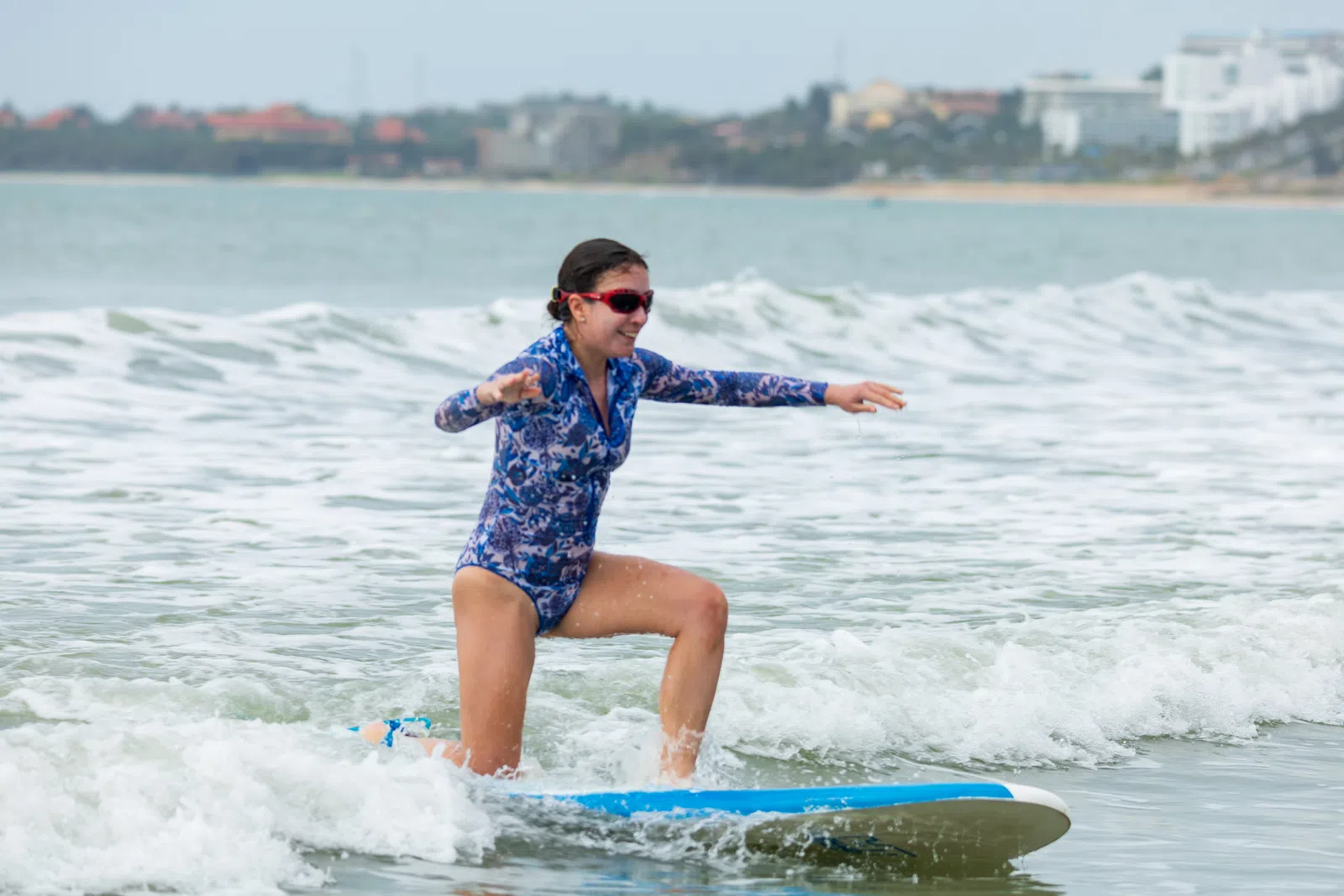
Waves do not arrive every day, but tarmac always does. Here is the trainer surfers, wingers and kiters use out of season.
How a surfskate differs from an ordinary skateboard
The difference is the front truck. An ordinary skateboard turns on a fixed axis. A surfskate uses a pivoting joint with far more travel.
What that changes: the board starts to move underfoot as it would on a wave. And crucially, you can generate speed without pushing with a foot, purely by rocking your body.
That is the essence of the trainer. The movement that accelerates you on a surfskate nearly matches the movement a surfer uses to build speed on a wave: body rotation, weight transfer, pressure on the front foot.
What actually transfers to water
Honestly, because a trainer does not replace water.
Transfers:
- Stance. Shoulder position, body rotation, where your head looks.
- Turning through the body rather than the feet. The commonest beginner error is twisting the board with the feet; a surfskate cures it fast, because otherwise it simply will not go.
- Pressure on the front foot. The basis of acceleration on both wave and skate.
- A feel for line. You learn to draw an arc rather than travel straight.
Does not transfer:
- Paddling and catching a wave. Half of surfing, and no dry-land substitute exists.
- Reading a wave.
- The take-off. Partly — you can drill the pop, but without water it is a different movement.
Who else benefits besides surfers
Wingers and kiters on directional boards. The same stance, the same body-led turn.
Twintip kiters — partly. The stance differs, but weight transfer and edge work are common ground.
Snowboarders. An off-season alternative with close mechanics.
Children. A lower barrier than surfing, with visible progress sooner.
What is in the catalogue
Aztron carries twenty-five items in this branch:
- The surfskates themselves.
- Wheels — from
Wheels deserve a note: surfskates use soft, large wheels. Soft ones grip rough tarmac and do not throw the board off a pebble; large ones roll longer.
Hard, small trick-skate wheels are useless here: you will bounce over every crack instead of holding an arc.
Choosing a first one
Deck length: 30 to 33 inches is the adult all-rounder. Shorter turns better but is less stable.
Wheelbase: longer is steadier and more predictable, shorter is sharper in a turn.
Truck tension: adjustable matters more than you would think. Tighten it and the board is calmer at the start; loosen it later.
Practical advice: tighten the truck for the first week. A surfskate out of the box on a loose setting slides away underfoot, and that puts people off.
Safety — not a formality
Plainly: you fall more often on a surfskate than on an ordinary skateboard. A pivoting truck is unpredictable over bumps.
Mandatory:
- A helmet. A skate one specifically — the HS9 at
Where to ride: smooth tarmac, no traffic, a gentle slope or flat ground. A steep hill on a surfskate is a bad idea: it is not built for speed.
How to structure practice
Weeks 1 to 2: simply ride and generate speed by rocking, without pushing. Until that is reliable there is no point going further.
Weeks 3 to 4: draw arcs — left, right, varying radius. Look where you are going rather than at your feet.
After that: sharp turns, body-led movement, imitating top and bottom turns on a wave.
Twenty minutes every other day beats two hours once a week — this is coordination training, and coordination is built by repetition.
Common questions
How does a surfskate differ from a skateboard?
A pivoting front truck: the board moves underfoot and you generate speed by rocking rather than pushing.
What transfers to water?
Stance, body-led turning, front-foot pressure and a feel for line. Paddling and wave reading do not.
What wheels do I need?
Soft and large: they grip rough tarmac and roll longer. Hard trick wheels do not suit.
Do I need a helmet?
Yes, a skate one. Falls are more frequent than on an ordinary skateboard, and a water helmet is not built for tarmac.
How much should I practise?
Twenty minutes every other day beats two hours weekly: coordination is built by repetition.
Where to look
The surfskate section. To read: our Aztron review and softboard versus hard board.
Catch a wave in Mui Ne
A private surf lesson is €50, a 3+2 course €100. In December — a surf camp with stay and transfer.
Read next
Inflatable kayaks for one, two or three, a SUP-kayak hybrid, and floating platforms up to twenty feet. A branc…
A SUP at 200 and at 1,400 Euros: What Differs on the WaterA sevenfold price gap between outwardly similar boards. What actually changes, point by point, and the three c…
Red Paddle Co Brand Review: Premium Inflatable SUP and What You Pay For31 boards from 1,000 to 1,751 euros, paddles to 175, and a pump with its own spare hose. What sits behind a pr…