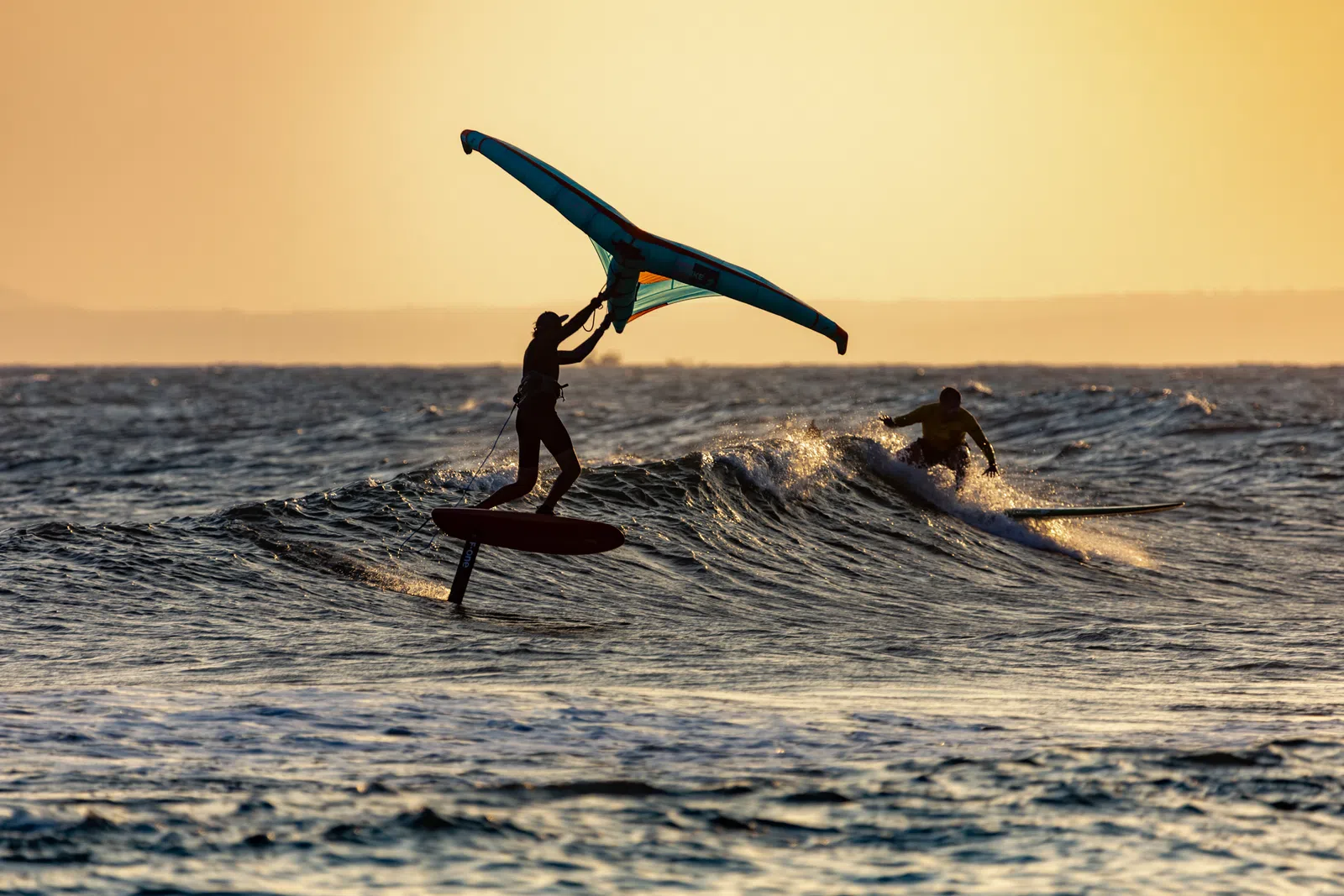
Wingfoiling is a young sport and its vocabulary arrived wholesale from English. Product descriptions and beach conversations use words that are not in any dictionary. Here are the twenty-five most common.
Parts of a foil
Mast — the vertical strut joining board to wing. Typically 60 to 90 cm and up. A long mast gives height in reserve and forgives mistakes; a short one is easier at the start and in shallow water.
Fuselage — the horizontal beam carrying the front wing and stabiliser. Long means more stable, short means more manoeuvrable.
Front wing — what generates lift. The main part of a foil: it defines how the foil flies.
Stabiliser (stab, tail wing) — the rear wing that damps pitching. Bigger stab, calmer foil and less manoeuvrability.
Shim — a thin wedge that changes the stabiliser's angle by fractions of a degree. The cheapest way to retune a foil's character.
Top plate — the mounting platform joining mast to board. Either track-mounted (adjustable) or plate-mounted.
About foil wings
HA (High Aspect) — a long, narrow front wing. More efficient, faster, glides further. Less forgiving and needs speed.
LA (Low Aspect) — short and wide. Lift arrives earlier, behaviour is calmer, speed is lower. Where people start.
Area — in square centimetres. A beginner wants 1500 cm² and up; experienced riders use 700 to 1000.
Glide — a foil's ability to carry you without drive, on momentum. The key quality for downwinders and pumping.
About riding
Pumping — generating drive by rocking the foil vertically with your legs, without wind. It is how you get going and how you stay up between swells. A skill in its own right, and the most spectacular in the sport.
Breach — the wing exiting the water when the foil rises too high. Lift stalls and you fall forward. The beginner's main fear.
Touch-and-go — the board's hull kissing the water and returning to flight without stopping.
Downwinder — travelling downwind from A to B, often without returning. On a foil, using swells and pumping.
Pump foiling — riding a foil with no wing and no wind at all, on pumping alone. A discipline of its own with its own equipment.
Carve — a banked turn on foil. On a foil you carve with your whole body, not with the board.
Tack and gybe — turns through the wind and away from it. On a foil both are done in flight, and they are the first serious goal after getting up.
About the wing
Boom — a rigid tube along the wing that you hold. Gives a freely chosen grip point.
Handles — soft grips in fixed positions. Lighter and more compact than a boom. Comparison separately.
Leading edge (LE) — the inflatable front tube of the wing.
Strut — the inflatable spine along the centre of the wing, holding its shape.
Flagging out — releasing the wing so it hangs on its leash and loses drive. The primary way to dump power.
Window — the transparent panel in a wing so you can see where you are going.
About boards
Volume — in litres, the board's main parameter. At the start, take your weight in kilograms plus 20 to 30 litres.
Midlength — a longer board for downwinders: easier to get going without wind.
Downwind board — narrow and long, designed for a water start by pumping.
Three terms people mix up most
Wingfoil and wingsurf. Wingfoil uses a foil; wingsurf uses an ordinary board. Different sports, same wing.
Parawing and wing. A parawing is a frameless canopy on lines, closer to a foil kite; a wing is an inflatable frame held in your hands.
Pumping and pump foiling. Pumping is a technique; pump foiling is a discipline where that technique is the only source of drive.
Common questions
What are HA and LA wings?
High Aspect is long and narrow, efficient and fast. Low Aspect is short and wide, calm with early lift. Beginners want the second.
What does "pumping the foil" mean?
Generating drive by rocking vertically with your legs. It is how you get going without wind and stay up between swells.
What is a breach?
The wing exiting the water when you fly too high. Lift stalls and you go over the front.
What is a shim for?
It changes the stabiliser's angle and with it the foil's character — the cheapest adjustment in the system.
How does a wing differ from a parawing?
A wing is an inflatable frame held in your hands. A parawing is a soft canopy on lines, conceptually closer to a foil kite.
What to read next
Choosing your first wing, wing versus kite, and our Ensis review — the brand that builds the whole system.
Wingfoil in Mui Ne
Wingfoil lessons with an instructor at the K1 station, and a December wing camp with stay and transfer.
Read next
AXIS offers a four-component configurator rather than a finished foil. How to choose in the right order, which…
Foil Etiquette: Why Foilers Are Unpopular and How to Fix ItA metal wing underwater is invisible, and that is the root of every conflict at a spot. The rules that formed …
Where to Start in Foiling: A Two-Year RouteFive foil disciplines, and the order of learning is not arbitrary. Which to start with, how long each stage ta…