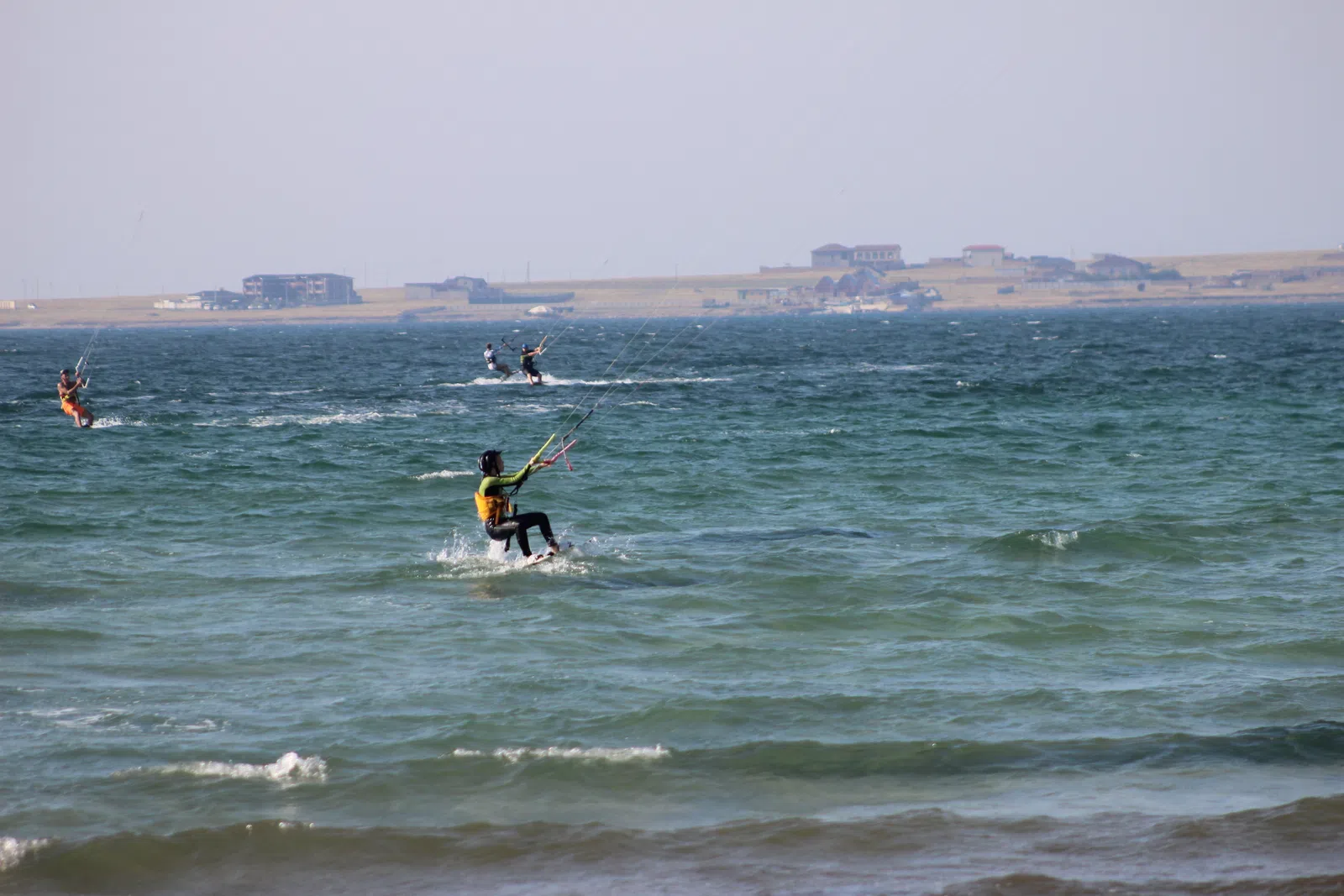
The question comes up on the beach every season, and the usual answer — "winging is easier" — is exactly half right. The wing itself is genuinely easier than a kite. The foil is harder than a board. Let us be honest about both.
Wing versus kite: the wing wins here
The difference is not in control difficulty but in the cost of a mistake.
A kite flies on lines twenty-five metres away. It is airborne constantly, it has a power zone, and you can enter that zone accidentally. A mistake on a kite means being dragged — across water, across the beach, upward.
A wing you hold in your hands. Let go and it becomes fabric hanging on a leash. That is all. No power zone, no lines, no scenario where the kite drags you into the dunes.
Practical consequences follow: a wing needs no launch assistant, no clean wind corridor as wide as a beach, and no protection against a line wrap. You can start where launching a kite is impossible.
Foil versus board: the kite wins here
Now the side people leave out.
A twintip is stable. It floats, it has area, and it forgives weight shifts. Learning to water start on one takes a few lessons.
A foil is non-linear. While it is submerged you ride as if on a board. The moment the wing generates lift, behaviour changes entirely: the board leaves the water and you balance on an underwater wing that responds to centimetres of weight shift.
And crucially: a foil has no intermediate mode. You are either on the water or flying, and the transition between them is the hardest part of learning. It is also where most falls onto the mast happen.
By stage: how long each takes
Kite: flying the kite on land → body dragging → water start → going upwind. A first independent run usually comes on day three to five of lessons.
Wing: handling the wing on the beach → getting going on a board without a foil or on high volume → first touches of flight → stable flight. A first confident flight usually comes later than a first kite run.
The honest conclusion: on a kite you start riding sooner. On a wing you start going out unsupervised sooner, because the equipment forgives more.
Money
Starter kits from our catalogue, lessons excluded.
Kite: kite from
1 489 €, bar from 619 €, board from 349 €, harness from 154 €.Wing: wing from
719 €, foil board, the foil itself, leashes. The wing is cheaper than a kite plus bar, but the foil and board eat the difference and then some.Net: wingfoiling costs more to start. And that is rarely said out loud.
Spot requirements — and here the wing wins big
The point that often decides the choice more than anything else.
A kite needs: a wide beach clear of obstacles upwind, a clean launch corridor, nobody standing in the line of your lines, and preferably shallow water.
A wing needs: water and wind. You can start from a narrow bank, from a boat, off rocks, among swimmers.
If your nearest water is not a beach but a lake fringed with trees, wingfoiling may be the only realistic option.
Wind
The received wisdom that winging needs more wind is not true in general.
On a foil, water resistance is a fraction of a twintip's. An experienced wingfoiler rides in 10 to 12 knots where a kiter on a twintip is sitting on the beach.
But while learning a wing demands more: you are not flying yet, you are pushing water, and that takes drive. The entry threshold is higher for a wing; the ceiling is lower.
Choosing in under a minute
Want to be riding sooner → kite.
Tight, crowded or beachless spot → wing.
Afraid of being dragged → wing; the fear is reasonable and the construction removes it.
Light wind most of the season → wing on a foil, but expect a longer learning curve.
Want big jumps → kite, no contest.
Limited budget → kite, the starter kit costs less.
Flying with your equipment → complicated: a wing packs smaller, but a foil is a metal structure with sharp wings. See our separate article.
On switching from kite to wing
A common separate scenario, and an easier one than starting from zero.
A kiter already reads wind, understands tacks and is comfortable in water. All that remains is the foil, which is one task instead of three.
The trap in reverse: a kiter habitually sizes the wing up. A wing has no depower, and headroom turns into fatigue. In detail: choosing your first wing.
Common questions
Which is safer, wing or kite?
The wing is safer than the kite: no lines, no power zone. But a foil is a hard structure under the water, so a helmet and impact vest are no less mandatory in wingfoiling.
Which is faster to learn?
You will be riding sooner on a kite. You will be going out unsupervised sooner on a wing.
Which is cheaper to start?
The kite. The wing undercuts a kite plus bar, but the foil board and foil outweigh that.
Is a foil compulsory?
No, you can start on an ordinary board — that is wingsurfing. Simpler and cheaper, with a lower ceiling.
Can I do both?
Yes, and many do: kite in strong wind, wing in light. The harness and helmet are shared.
What to read next
Choosing your first wing, a wingfoiler's glossary, and IKO levels for kiting.
Try before you buy
Rent at the K1 station in Mui Ne and ride the model before buying. Our instructors match the size to your weight and wind.
Read next
Red and White Dunes, Fairy Stream, Red Canyon, the fishing village, Cham towers and the Whale Temple — what fi…
Where to Start in Foiling: A Two-Year RouteFive foil disciplines, and the order of learning is not arbitrary. Which to start with, how long each stage ta…
Foil Etiquette: Why Foilers Are Unpopular and How to Fix ItA metal wing underwater is invisible, and that is the root of every conflict at a spot. The rules that formed …