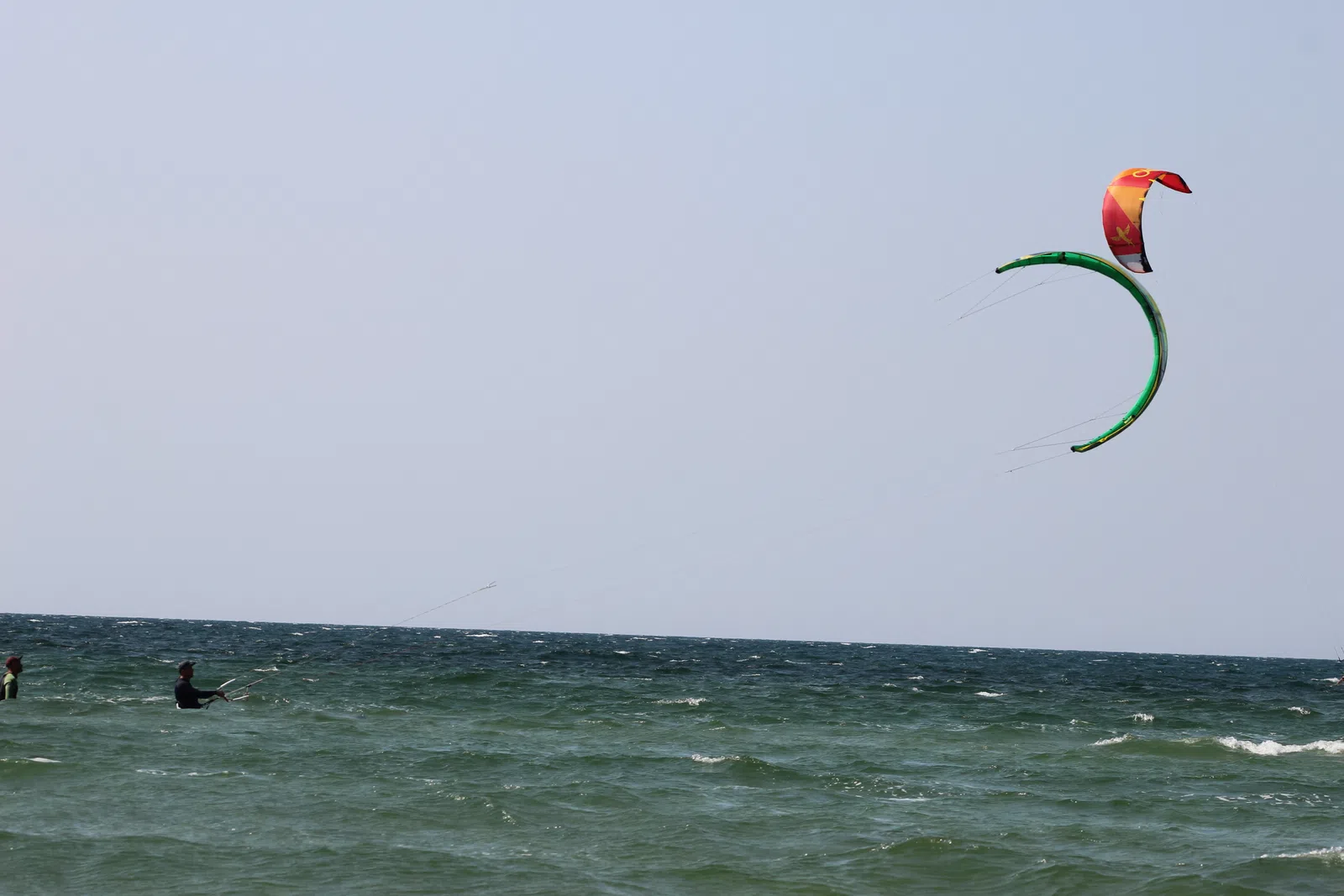
An old argument, and usually a useless one, because the two sides compare different things. The inflatable rider talks about water relaunch, the foil rider about light wind, and both are right. Let us take it parameter by parameter.
At a glance: seven parameters side by side
| Parameter | Inflatable | Foil kite | Edge |
|---|---|---|---|
| Weight (13 m) | 2.7–3.7 kg | 1.9 kg | Foil |
| Light wind | Needs a bigger size | A 9 m pulls where a 12 m inflatable still lies on the sand | Foil |
| Water relaunch | Floats, comes back up on one side | Slower with closed cells, none with open cells | Inflatable |
| Safety | Fails by losing pressure | Collapses when tension is lost; five lines give full depower | Draw |
| Repair | Standard bladders and patches | Ribs, load tapes, dozens of lines | Inflatable |
| Luggage | Separate bag plus a pump | Three kites in a backpack, no pump | Foil |
| Entry price | From 1 489 € (Sculp 2026) | From 2 299 € (Hyperlink V4) | Inflatable |
The details, and the reasoning behind each line, are below.
What we are actually comparing
An inflatable kite holds its shape with bladders inflated by a pump: a leading edge and struts. That is a rigid frame, and it works whether there is wind or not.
A foil kite has no shape without airflow. Cells fill with incoming air, and the canopy becomes a wing only in flight. On the ground it is fabric.
Almost everything else follows from that difference.
1. Weight — a clear win for the foil kite
The Ozone Hyperlink V4 weighs 1 kg at 5 m and 1.9 kg at 13 m. The inflatable Ozone Vortex V2 Ultra-X weighs 2.7 kg at 13 m, and the standard Edge VT 3.7 kg.
Close to double. The reason is simple: a foil kite has no bladders, valves or struts, and therefore none of their mass.
2. Light wind — the foil kite again
A direct consequence of weight. Lift first raises the kite itself, and only the remainder reaches the rider. A kite half the weight starts working noticeably earlier.
On top of that, a twin-skin foil profile is more efficient than an inflatable one: on an inflatable the leading edge is a thick tube that creates drag and spoils the aerodynamics. A foil kite has a clean profile.
In practice: where an inflatable 12 m is still lying on the sand, a 9 m foil kite is already pulling.
3. Water relaunch — a clear win for the inflatable
Here it reverses. An inflatable floats because its bladders keep it up. It does not sink and comes back up on one side under tension.
A foil kite loses its shape in water. Closed-cell models do relaunch, but more slowly and with more technique required. An open-cell does not relaunch at all — it takes on water, and the session is over.
This is the main reason schools teach on inflatables. A beginner drops the kite constantly, and easy relaunch outweighs any specification.
4. Safety — a draw, but in different ways
On an inflatable, failure usually means loss of pressure: a punctured bladder, a blown valve. The kite folds and stops pulling, generally predictably.
On a foil kite, failure is a canopy collapse when tension is lost. Nothing tears, but the kite stops being a wing and becomes fabric on lines. Reopening it is a skill.
In exchange, a foil kite's five-line setup gives complete and instant depower — in the mountains that is the decisive argument, and it is why almost all snow kites are foil kites.
5. Repair — the inflatable is simpler
A torn bladder is replaced, a hole in the canopy is patched. The materials are standard, repair kits are everywhere, and any school can do it.
Foil-kite repair is finer work: ribs, load tapes and dozens of lines of differing lengths. A canopy tear is fixable, but a mixed-up or incorrectly replaced line changes the geometry of the whole wing.
6. Luggage — the foil kite, no contest
Three foil kites fit in a backpack. Three inflatables are a separate bag, and that bag flies at a surcharge.
A foil kite also needs no pump, which is another half-kilo and another chunk of bag space.
7. Price — the inflatable is cheaper to enter
The Explore V3 at
919 € is the exception, not the rule: it is a simple single-skin. A full foil kite like the Hyperlink V4 starts at 2 299 €, whereas the inflatable Sculp 2026 starts at 1 489 €.On the other hand a foil kite lasts longer: there is nothing to leak and nothing to burst. Handled carefully, part of the price difference comes back over several seasons.
The conclusion: each owns its territory
The inflatable is water. Learning, freeride, big air, waves, strong wind, rental. Everything where the kite lands in water and has to come back up.
The foil kite is snow, light wind, foiling and travel. Everything where weight, efficiency and pack volume decide.
There is exactly one all-rounder — the Hyperlink V4 — and it honestly costs as much as two specialised purchases.
Which one to bring to Mui Ne
Mui Ne's kite season is the northeast monsoon from October to April: 12–18 m/s (about 23–35 knots) almost every day, building towards midday, with warm water and a gentle sandy entry. That is strong, steady wind over water — exactly the territory where an inflatable wins on relaunch and easy repair. Leave the foil kite at home unless you foil or want it for the lighter days at the edges of the season.
The size matters more than the type. Our kite size chart by weight and wind gives the ranges we use when matching rental gear on the beach.
Try before you choose
The fastest way to settle the argument for yourself is to fly one. At the K1 station on the beach of Sandunes Beach Resort a full kite set rents from
30 € an hour or 80 € a day — see rental in Mui Ne. New to kiting? A trial hour with an IKO instructor is 55 €, all gear included: kitesurfing lessons in Mui Ne.Common questions
Where should a beginner start?
On water, an inflatable, without question. On snow, a single-skin foil kite like the Explore V3 — that is what it is built for.
Are foil kites really more dangerous?
No. They demand a different skill and a different reaction to failure. What is dangerous is not the type but not knowing what to do in a collapse.
Can you ride a foil kite in strong wind?
Yes, with a caveat: high-aspect models at the top of the range need experience. Low-aspect ones behave more calmly.
How long does a foil kite last?
Longer than an inflatable with equal care. What kills it is sand in the cells and UV, not punctures.
Does a foil kite need a pump?
No. It fills with airflow as it launches.
What to read next
All of Ozone's foil kites are in our range overview. Inflatables are in the catalogue section.
Try before you buy
Rent at the K1 station in Mui Ne and ride the model before buying. Our instructors match the size to your weight and wind.
Read next
AXIS offers a four-component configurator rather than a finished foil. How to choose in the right order, which…
Foil Etiquette: Why Foilers Are Unpopular and How to Fix ItA metal wing underwater is invisible, and that is the root of every conflict at a spot. The rules that formed …
Where to Start in Foiling: A Two-Year RouteFive foil disciplines, and the order of learning is not arbitrary. Which to start with, how long each stage ta…