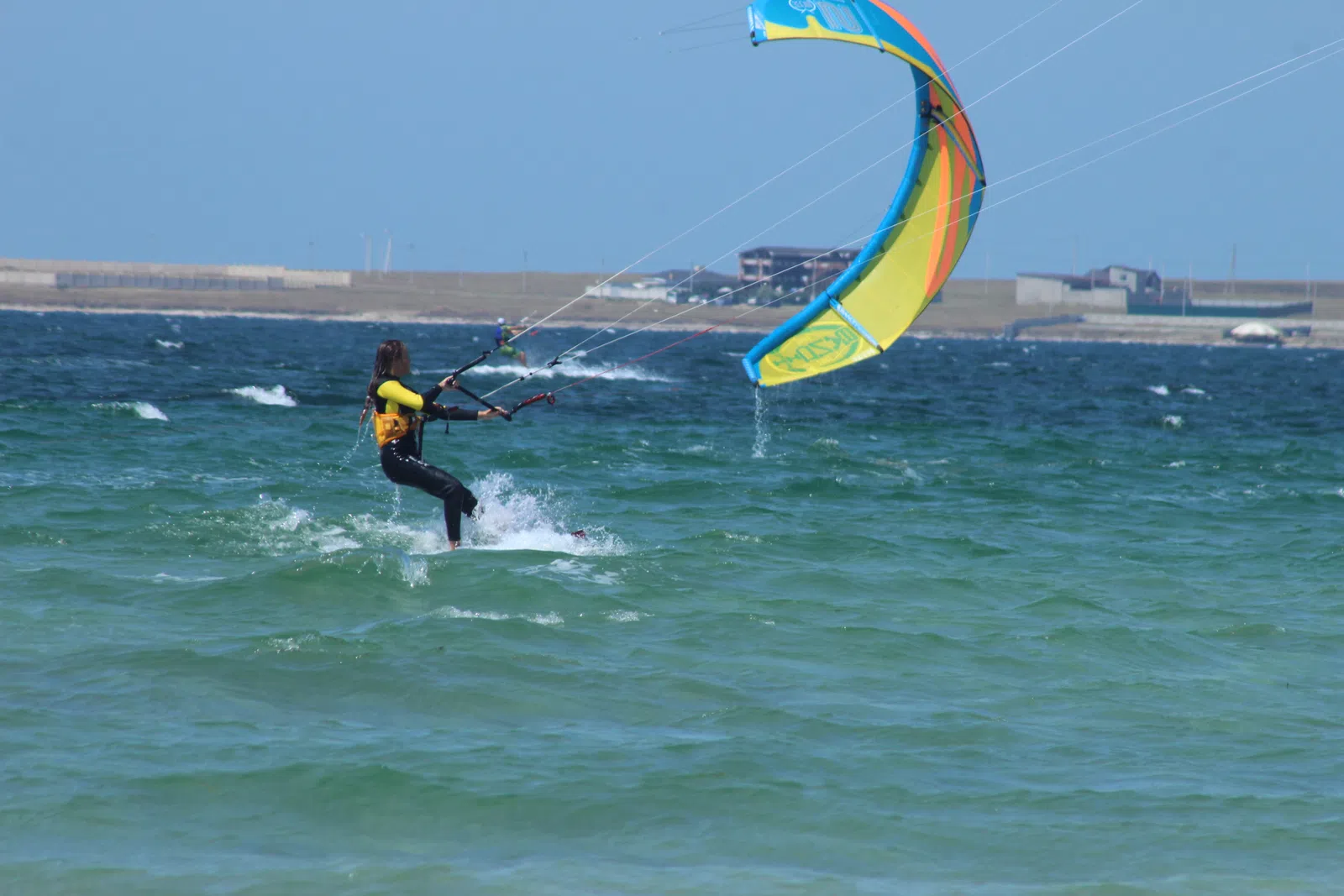
Handled carefully, a foil kite outlives an inflatable: there is no bladder to leak and no leading edge to burst. But other things kill it, and almost all of them happen after the session rather than during it.
Rule one: sand is the main enemy
On an inflatable, sand stays on the outside. On a foil kite it gets inside the cells and stays there.
What follows is this: the grains rub against the fabric from within on every flight, gradually wearing the coating away. You never see it, because it happens inside the canopy. After a season the fabric in the lower part of the cells is noticeably softer and starts letting air through.
What to do: lay the kite out on grass, on a tarp or on packed snow, not on dry loose sand. If sand does get in, turn the kite intakes-down and shake it out gently, working the sand towards the opening with your palm from the outside.
Do not try to flush the cells with a hose: you will drive the sand deeper and soak something that then takes three days to dry.
Rule two: salt water is dried off, not rinsed off
Salt does not destroy fabric by itself — what destroys it is that salt holds moisture. Salt crystals are hygroscopic: even in a dry room a salted canopy stays slightly damp.
Damp fabric folded away means mould, and mould is irreversible. The stains do not wash out and the smell does not leave.
What to do: let the kite dry completely before packing after a water session. If it has been in salt water and you are storing it for a while, rinse it in fresh water and dry it completely again.
Rule three: dry it in the shade
The most common mistake is laying the kite in the sun to speed things up.
UV is the second biggest killer after sand. It breaks down the polymer coating on the fabric: the canopy loses its air-tightness and goes soft and rag-like. On a foil kite that matters more than on an inflatable: a cell holds its shape through internal pressure, and a canopy that has lost its tightness simply stops filling properly.
What to do: dry in shade, in moving air, laid out or hung. An hour in direct tropical sun does more harm than a day in the shade.
Rule four: fold without sharp creases
A foil kite has ribs and load tapes inside. Folding in the same place every time creates a crease line along which the fabric starts to fray.
What to do: fold the kite concertina-style along the cells rather than at random, and shift the fold lines slightly each time. Do not compress it into a stuff sack harder than necessary — tight compression is useful in transit and harmful in long storage.
For transport and storage, dedicated bags such as the Closed Cell Compressor Bag help: they apply even pressure instead of random creases.
Rule five: lines matter more than the canopy
A foil kite has many times more lines than an inflatable, and they differ in length. A line mixed up during packing changes the geometry of the wing.
What to do: wind the lines the same way every time. Before storage, check for wear at knots and loops: that is almost always where a line fails.
Once a season it is worth checking the trim: line lengths change unevenly over time, the rear lines stretch more than the front, and the kite starts behaving differently. Many people put that down to the kite being worn out when it is two centimetres on a rear line.
Between seasons
- Completely dry. Not almost dry — completely.
- Shaded and dark. A cupboard beats a balcony.
- Not in a car or a loft. Temperature swings and 60 °C in summer destroy the coating.
- Not under weight. A kite bag at the bottom of a pile is a year-long crease.
- Loose, not compressed. Compression is for travel, not for winter.
Common questions
Can I wash a foil kite?
In a machine, never. Rinsing the outside with fresh water and drying it is fine and sometimes necessary.
How do I get sand out of the cells?
Turn the kite intakes-down and work the sand towards the opening with your palm from outside. Patiently, without sharp movements.
How long does a wet foil kite take to dry?
An hour or two outside in moving air. Inside the cells, considerably longer — and internal moisture is the dangerous kind.
Is an unheated garage bad for a foil kite over winter?
Cold itself is not the problem. Condensation from temperature swings and damp are.
How do I know the canopy is tired?
The fabric feels softer, the kite takes longer to fill and holds its shape less well at the top of its wind range.
What to read next
How foil kites differ from inflatables is in our comparison. Ozone's foil range is in the overview. Bags and covers are in the accessories section.
Try kitesurfing in Mui Ne
A trial hour with an IKO instructor is €55, all gear included. Then a course to independent riding or a December kite camp.
Read next
AXIS offers a four-component configurator rather than a finished foil. How to choose in the right order, which…
Foil Etiquette: Why Foilers Are Unpopular and How to Fix ItA metal wing underwater is invisible, and that is the root of every conflict at a spot. The rules that formed …
Where to Start in Foiling: A Two-Year RouteFive foil disciplines, and the order of learning is not arbitrary. Which to start with, how long each stage ta…