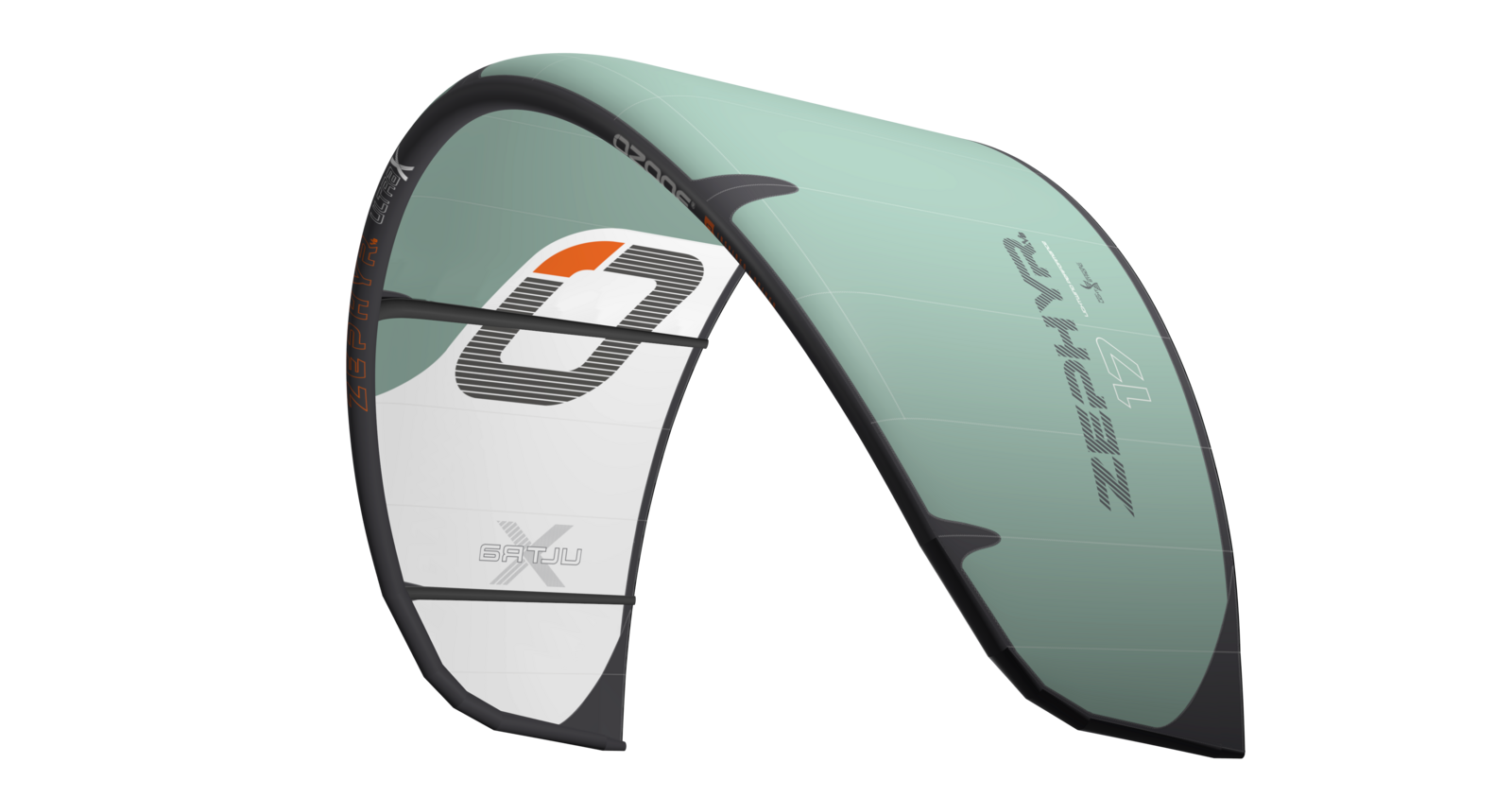
The Zephyr V8 Ultra-X exists in a single size — 17 metres. That is unusual: a model normally spans a range, whereas here the whole model is reduced to one job. The job is riding when riding is not possible.
The short version
- Size: 17 m², the only one.
- Weight: 3.5 kg.
- Construction: inflatable, 18 cells, Ultra-X material.
- Aspect ratio: 4.9 flat, 2.6 projected.
- Lines: 25 m plus 2 m extensions, 55 cm bar.
- Level: beginner through expert.
- Price:
Why only one size
A light-wind kite solves one problem: not enough power. Anything under fifteen metres solves it less well, and anything larger becomes unmanageable for most riders.
Seventeen is the upper limit at which a kite still turns like a kite rather than a sail. Building a range out of sizes that do not do the model's job makes no sense — so there is no range.
Projected aspect ratio 2.6: why so low
Compare: the big-air Edge VT runs 3.04 projected, the racing R1 V5 up to 5.3. The Zephyr runs 2.6. For a kite of this area that is a pointedly low figure, and it is deliberate.
High aspect ratio brings efficiency, but the wing becomes long, narrow and slow to turn. Multiply that by seventeen square metres and you get a kite that cannot complete an arc before you lose speed.
Low aspect ratio at large area is a compromise in favour of handling. The kite stays alive on the bar instead of becoming a tugboat. The manufacturer explicitly lists a livelier steering feel among the V8 changes.
3.5 kg: a lot or a little
For seventeen metres, very little. A conventional inflatable of that area approaches five kilograms.
Ultra-X material is what delivers it. And on a light-wind kite low weight matters more than anywhere else: in weak wind a kite fights its own mass first. Every half-kilo is a knot of wind at which you either ride or do not.
The 25 m lines, extendable to 27, serve the same purpose: longer lines put the kite into stronger air higher above the water and lengthen its path through the power zone.
Who needs a light-wind kite
A fair question, because a
2 699 € kite for a handful of days per season is a doubtful purchase. It earns its place in three cases.Your spot is light. If typical wind is 10 to 14 knots, a light-wind kite is not an addition to your quiver but the basis of it.
You foil. Hydrofoil is among the stated disciplines, and a big light kite plus a foil works in wind where a twintip is useless.
You are a heavy rider. Over 95 kg the lower limit shifts up by several knots, and seventeen metres covers what twelve covers for a light rider.
Who does not need it
Riders on consistently windy spots. The kite will live in its bag.
Anyone buying a first kite. The level formally starts at beginner, but seventeen metres is a lot of area, and mistakes on that area cost more.
Anyone open to a foil kite. In light wind a foil kite is more efficient at less area — see our foil versus inflatable comparison.
Why inflatable rather than foil, then
A logical question: if the job is light wind, a foil kite does it better. The answer has two parts.
Relaunch. In light wind the kite hits the water more often, because there is not enough power to hold it up through a mistake. An inflatable comes back up; a foil kite is harder.
Familiarity. The Zephyr behaves like an ordinary kite, just a big one. A foil kite demands different technique, and light wind is an awkward place to learn it.
Common questions
From what wind does it work?
It depends on rider weight and craft. On a foil the lower limit is markedly lower than on a twintip — the gap can reach several knots.
Can you jump it?
Big air is listed among the disciplines. But seventeen metres is a slow kite, and the jumps are different: high and drawn out rather than sharp.
Do I need a special bar?
A 55 cm bar, standard for large sizes. The Contact Water V5 fits.
How does the V8 differ from the previous version?
The manufacturer claims a wider working range, higher flying speed and livelier steering.
Should I buy it instead of two mid-size kites?
No. The Zephyr covers the edge of the range, not the middle. It is an addition to a quiver, not a replacement for one.
Where to buy
2 699 €. The full range is on the Ozone page.Not sure whether you need light wind? Send your weight and typical spot wind and we will work it out.
Ozone Zephyr V8 Ultra-X Kite at K1.surf
Official Ozone dealer. From 2 699 €. Our IKO instructors match the size to your weight, level and wind.
Read next
Red and White Dunes, Fairy Stream, Red Canyon, the fishing village, Cham towers and the Whale Temple — what fi…
Mui Ne or Nha Trang (or Phu Quoc): Where to Go in Winter and Where to RideThree popular Vietnamese resorts in winter: where it is dry, where the sea is calm, where you get wind and wav…
Build Your Own: Assembling a Foil for Yourself Without Getting It WrongAXIS offers a four-component configurator rather than a finished foil. How to choose in the right order, which…