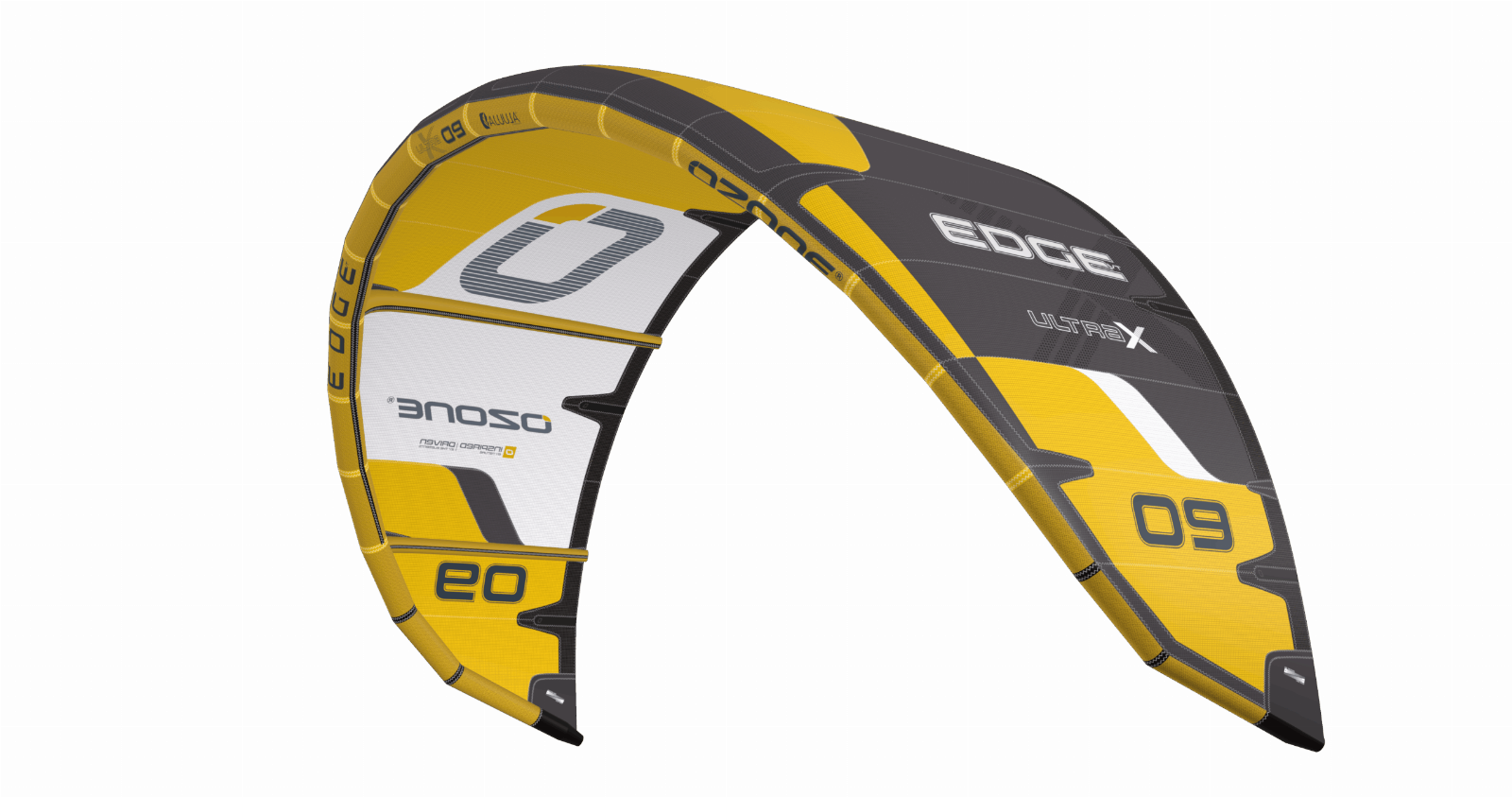
Edge is the fastest and most demanding kite in the Ozone range. Edge VT Ultra-X is its lightweight-cloth version, and the difference is not cosmetic. Here is the kite by the manufacturer's own specification: what it is, who it suits, and why nobody should learn on one.
The short version
- Sizes: 7, 8, 9, 10, 11, 12, 13, 15 and 18 m².
- Construction: 18 leading-edge segments, flat aspect ratio 5.41, projected 3.04 — this is a high-aspect kite.
- Weight: from 2.1 kg in the 7 m to 3.7 kg in the 18 m.
- Lines: 23 m. Bar 45–55 cm depending on size.
- Level: intermediate, advanced, expert. The manufacturer does not list it for beginners, and it is right not to.
- Price: from
What those numbers mean
Flat aspect ratio 5.41 is a lot. The higher the aspect ratio, the more efficient the wing: better upwind, more speed, longer hang time in a jump. The price is that the kite moves through the window faster and demands precision on the bar.
Eighteen leading-edge segments against fourteen on the wave-oriented Reo. More segments mean a more accurate arc and less deformation under load, which matters most on a high-aspect profile — that is exactly where efficiency is lost.
Nearly ten metres of span on the 18 m. This is why kites like this are not handed to beginners: a mistake on that span develops faster than a hand can answer it.
What Ultra-X changes
Ultra-X is a lighter, stronger canopy cloth. The geometry is identical, the profile is identical, the behaviour is not.
Light wind. A lighter canopy sags less when there is little pull. This is the most noticeable difference: where the standard version starts to fall, Ultra-X is still flying.
Response. Less inertia means a faster answer on the bar. For big air that reads as more precise control of the moment you leave the water.
Luggage. Less weight and bulk in the bag, which matters if you fly with kites.
Price. Substantially higher than the standard version — the main argument against.
What it is actually for
The manufacturer lists the disciplines broadly: freeride, big air, freestyle, foil, waves, racing. In our experience the list is more honest when narrowed.
Big air and hang time. The main reason people buy an Edge. High aspect ratio generates lift through the whole jump and holds you on the way down — that slow-motion look on video.
Upwind and speed. Edge points higher than almost anything in its class. For downwinders and long crossings that decides it.
Foiling. The combination of Ultra-X lightness and upwind ability works very well on a foil.
Waves are not its element. Formally the kite is listed for waves. In practice a wave kite needs drift and instant depower, which is the Reo's job, not the Edge's.
Choosing a size
Starting point for a 75 kg rider: 9 m² for 20–25 knots, 11 m² for 16–22, 13 m² for 13–18. Lighter riders drop a size, heavier riders add one.
Edge has a wide depower range, so many riders cover a season with two sizes rather than three. The 18 m is a separate case: it is a kite for near-calm, not simply "a bigger one".
Who should not buy it
Beginners and first-year riders. The kite is fast, delivers power directly and does not forgive vague input. Learning on it is possible and unpleasant — that would be a season spent fighting the kite instead of learning. Take a Catalyst or an Enduro.
Wave riders. Take the Reo; it was built for that.
Riders with steady wind at a home spot. The Ultra-X premium pays off at the edge of the range and on trips. If you have 20 knots every other day, that money works harder in a board.
Frequently asked questions
How does Edge VT Ultra-X differ from the standard Edge VT?
Only in canopy cloth: it is lighter. Geometry, sizes and profile are identical. The difference shows up in light wind and in response speed.
Can I learn on an Edge?
No. The manufacturer lists intermediate and above, and that is not legal caution. Ozone's Catalyst exists for learning.
Which bar should I use?
Ozone Contact Water V5 — the kite is tuned around it. Mixing a bar from one brand with a kite from another is possible, but it changes how the safety systems behave, and that is not a place to improvise.
How many sizes do I need for a season?
Usually two. Edge has a broad depower range, and a 9 and a 12 cover most of what a spot delivers.
Is Edge good for foiling?
Yes, and it is one of its best applications — especially in Ultra-X, where the weight saving tells.
Where to buy
All sizes and availability: Ozone Edge VT Ultra-X from
2 819 €. The full range is on the Ozone page, and the brand itself is covered in our Ozone brand review.We are an official dealer and will size it for your weight, spot and wind at no charge — write to us.
Want advice from an instructor?
Our IKO instructors will help you choose gear or plan a kite trip to Mui Ne — free of charge.
Read next
Starboard came out of windsurfing and became the leading name in SUP. The range: inflatable and hard boards, p…
Inflatable SUP vs Hard Board: What to Choose and the Real DifferenceAn inflatable fits in a boot; a hard board goes faster. Eight differences you feel on the water, and when payi…
Naish Torch Review: Freestyle and Slack in Pure FormThe Torch is Naish's freestyle model and the brand's narrowest specialisation. What slack is, why a freestyle …