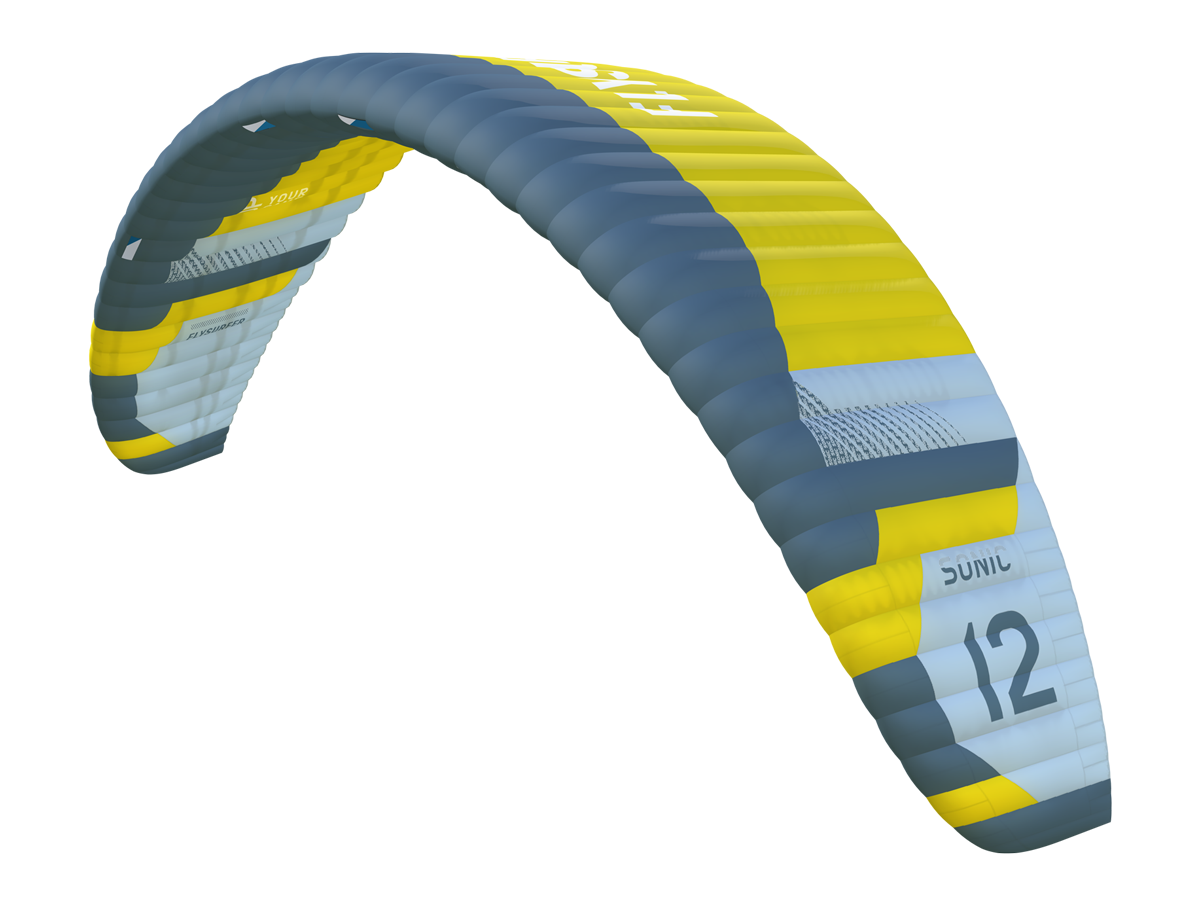
Racing foil kites usually do one thing: go upwind quickly. The SONIC5 claims something else — a race-and-freestyle foil built with big air in mind. That combination is uncommon, and worth unpacking.
The short version
- Sizes: 7, 10, 12 and 15 m².
- Construction: closed-cell foil kite.
- Level: intermediate to pro.
- Purpose: racing, freestyle, big air.
- Price: from
Closed-cell: why that is the key phrase
The intakes are closed by valves that hold air inside the canopy. The kite stays inflated when it hits the water and relaunches from the surface.
Without that, a racing foil kite could not exist on water: one crash and the session — or, in a regatta, the race — is over. Closed cells are what turned the foil kite from a snow craft into a water one.
The cost is the complexity and weight of the valve system, plus a relaunch more demanding than an inflatable's.
Racing and big air in one kite — how that works
At first glance a contradiction. A race kite should track a narrow sector of the window with constant pull. A big-air kite should accelerate hard through the power zone and throw you up.
They share one thing, and it is enough: high wing efficiency. That delivers both speed on a course and lift at takeoff. The difference between a racing and a jumping kite lies not in efficiency but in turning speed and the character of the pull.
So "race and freestyle" is not marketing but a description of a compromise: the kite is efficient enough to race and quick enough to jump. It does not reach the far edge of either discipline.
If you want pure foil racing, that is the Ozone R1 V5 at up to 7.0 aspect ratio on 11 to 14 m lines. The SONIC is about breadth within the performance range.
Four sizes: what that tells you
7, 10, 12, 15 — big steps and only four positions. Compare that with eight sizes on the R1.
Big steps are possible where a kite has a wide working range. On an efficient foil kite with good depower it genuinely is wider than on an inflatable: one model covers what an inflatable needs two sizes for.
In practice that means two Sonics cover a whole season on almost any spot — a 10 and a 15, for instance.
Who it is for
Amateur racers. People who enter local events but do not want a kite that is only good for racing.
Foilers who jump. A light efficient kite plus a foil, plus a stated big-air capability, is a rare combination.
Experienced light-wind riders. Fifteen metres of closed-cell foil kite is a great deal of pull in weak wind.
Who it does not suit
Beginners. The level starts at intermediate, and that matters: foil-kite relaunch and collapse behaviour need experience.
Wave riders. Drift in waves is inflatable territory.
Anyone after one kite for everything. The all-rounder in the Flysurfer range is the SOUL3, not the SONIC.
SONIC or SOUL: choosing between them
A practical question, since both are closed-cell.
SOUL3 — the all-rounder: six sizes from 6 to 18 m, beginner through advanced, from
1 756 €. A kite for riding.SONIC5 — the performance kite: four sizes, intermediate and up, from
2 325 €. A kite for results.The rule is simple: if you are wondering which of the two is yours, it is the SOUL. People buy the SONIC knowing exactly why.
Common questions
Does the SONIC relaunch from water?
Yes, it is closed-cell. But the relaunch asks more of your technique than an inflatable's does.
Can I ride it on a twintip?
You can, unlike pure racing models on short lines. But it comes alive on a foil.
How many sizes do I need?
Two. A wide depower range lets a 10 and a 15 cover a season.
How does it differ from the Ozone R1?
The R1 is pure foil racing: up to 7.0 aspect ratio, 11 to 14 m lines, advanced and up. The SONIC is broader in use and accepts freestyle and jumping.
Is it suitable for snow?
A closed-cell kite works on snow, but the mountains favour a five-line setup with complete depower — the Peak or the Explore.
Where to buy
Flysurfer SONIC5 — from
2 325 €, four sizes. The range is on the Flysurfer page, and the brand in our review.Flysurfer SONIC5 Kite at K1.surf
Official Flysurfer dealer. From 2 325 €. Our IKO instructors match the size to your weight, level and wind.
Read next
AXIS offers a four-component configurator rather than a finished foil. How to choose in the right order, which…
Foil Etiquette: Why Foilers Are Unpopular and How to Fix ItA metal wing underwater is invisible, and that is the root of every conflict at a spot. The rules that formed …
Where to Start in Foiling: A Two-Year RouteFive foil disciplines, and the order of learning is not arbitrary. Which to start with, how long each stage ta…