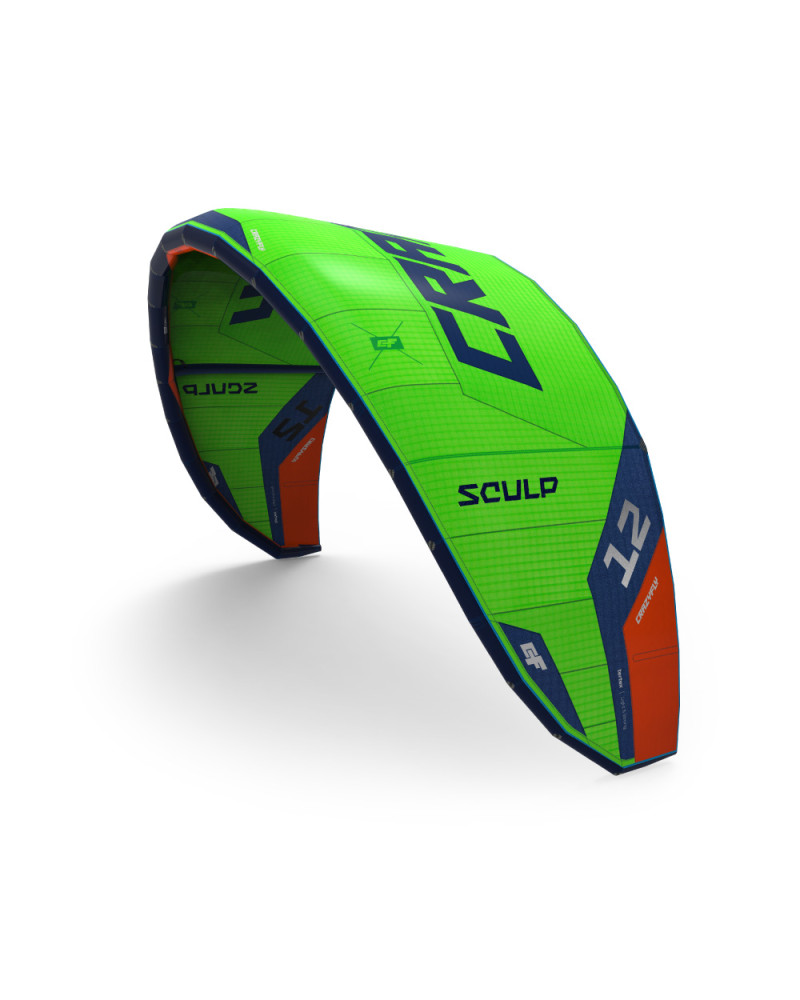
The Sculp is the kite CrazyFly has built for longer than anything else in the range, and it still carries the largest share of the brand's sales. The 2026 version claims a 9 to 40 knot range — the widest figure in the line. Here is what sits behind that, and who actually needs a kite like this.
The short version
- Sizes: 7, 8, 9, 10, 12 and 14 m².
- Construction: three struts.
- Wind range: 9–40 knots across the line.
- Weight: 2.6–4.0 kg depending on size.
- Purpose: freeride, progression, jumps, loops.
- Price: from
What "all-round" actually means
In marketing copy, "all-round" means one of two things: good at everything, or good at nothing. With the Sculp it is the first, and here is why.
A specialised kite is tuned for one job and sacrifices everything else for it. A race kite goes upwind but frightens beginners. A wave kite drifts beautifully but jumps poorly. The Sculp is instead built so that none of its characteristics is extreme: mid-range turning speed, mid-range lift, wide depower.
That sounds dull right up until you count how many different jobs one kite covers in a season. Light wind and a lesson in the morning, jumps in the afternoon, thirty knots by evening. A specialised kite works for two hours of that day. The Sculp works all of it.
Three struts and the top end
Struts are the structural elements running along the canopy, holding the profile in shape under load. The stronger the wind, the more the kite wants to deform, and the more that stiffness matters.
Forty knots refers to the 7 m in the hands of a heavy, experienced rider — not to the whole range. But the claim itself says something about the build: the kite is designed not to fall apart in a storm. In practice you feel it long before forty — at 25 to 30 knots, where softer canopies start to wander and get nervous, the Sculp stays predictable.
The trade-off is honest: a stiff build weighs more than a lightweight one, and at nine knots you will work the bar harder than you would on an ultralight kite.
Water relaunch — the reason schools buy it
Relaunch deserves its own section, because it is the non-obvious argument that matters more than it looks.
A beginner drops the kite in the water many times per lesson. If it relaunches heavily, the student spends energy and confidence fighting the kite instead of riding. If it comes up easily, a crash stops being an event.
The Sculp relaunches predictably and does so consistently across the range, which is one reason it survives in rental fleets longer than fashionable new models. A kite that forgives a crash teaches faster than one that punishes it.
How it flies
The pull is even, without spikes: the Sculp does not fire when it enters the power zone, it builds power smoothly. For progression that is the key quality — you have time to understand what is happening.
In the air it gives moderate lift and moderate hangtime. It is not a big-air machine: if you want maximum height, look at the Nuke instead. But first confident jumps, first loops and first jump transitions are all covered without drama.
Depower is wide, which follows directly from the range: moving the bar genuinely changes the power rather than pretending to.
Who it suits
Riders coming out of lessons. A first personal kite after school is the scenario the Sculp is literally built for.
Anyone running one kite per season. A wide range plus two sizes covers almost any spot.
Schools and rental centres. Relaunch, durability and predictability matter more in a rental fleet than any spec sheet.
Weekend riders. If you ride twenty days a year, a specialised kite per discipline is just an expensive way to complicate your life.
Who it does not suit
Riders chasing height. The Sculp jumps fine but not remarkably, and that is a deliberate design choice.
Foilers. Foiling values low weight and low drag; three struts work against both.
Riders who only sail 10 to 12 knots. The lower limit is honest, but at the very bottom you will envy single-skin foil kites like the Alpha V3.
Which size to buy
The practical logic is simple: take the size that matches your typical wind, then add a second one two or three metres away, not one.
For a 75–85 kg rider on most spots the working pair is 9 and 12. For a light rider under 65 kg, 8 and 10. For a heavy rider over 95 kg, 10 and 14.
We covered the full weight-and-wind table separately: how to choose kite size.
Common questions
How does the 2026 Sculp differ from the 2025?
It is an evolutionary model: same construction, same purpose, with changes in finish, panel layout and materials. If your 2025 Sculp is in good condition, there is no performance reason to replace it.
Can I learn on a Sculp from zero?
Learning is best done on school equipment with an instructor, but as a first personal kite straight after a course the Sculp is one of the most sensible options on the market.
Can you really ride it in 40 knots?
The construction is rated for it. In practice very few people go out in that wind, and the question there is no longer the kite but the state of the water and the cost of a mistake.
How many sizes do I need for a season?
Two. The range is wide enough that a third only makes sense on spots that regularly deliver both ten and thirty knots.
Is the Sculp any good in waves?
In soft waves, yes. For serious wave riding a specialised kite with better drift is the right tool.
Where to buy
CrazyFly Sculp 2026 from
1 489 €, six sizes. The full range is on the CrazyFly page, and the brand itself in our CrazyFly review.Unsure about size? Send your weight and typical wind and we will size it for you at no charge.
Want advice from an instructor?
Our IKO instructors will help you choose gear or plan a kite trip to Mui Ne — free of charge.
Read next
Starboard came out of windsurfing and became the leading name in SUP. The range: inflatable and hard boards, p…
Inflatable SUP vs Hard Board: What to Choose and the Real DifferenceAn inflatable fits in a boot; a hard board goes faster. Eight differences you feel on the water, and when payi…
How to Read a SUP Board Size: 10'8" x 33", Litres and What MattersThree numbers — length, width and volume — decide whether you paddle or fall. What each one means and how to m…