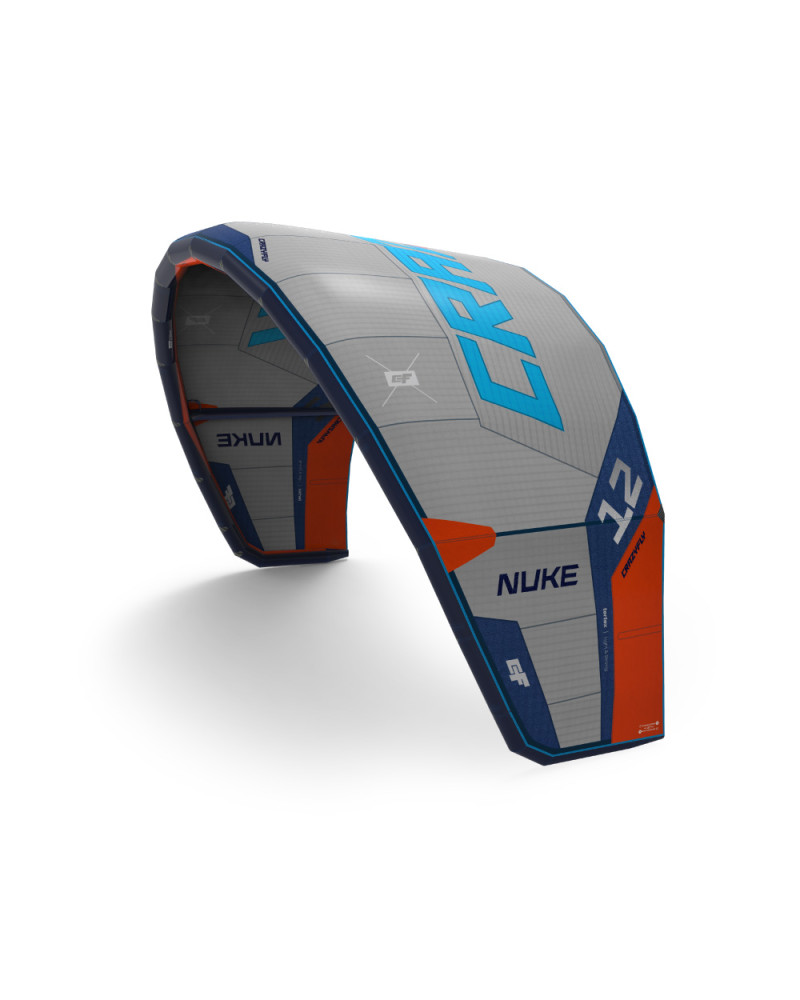
The Nuke is CrazyFly's big-air and powered-freeride kite. Its claimed wind range is unusually wide: 12 to 43 knots. Here is what sits behind that number, who the kite is for, and why 43 does not mean you should be out in it.
The short version
- Sizes: 6, 7, 8, 9, 10, 11 and 12 m².
- Construction: three struts.
- Wind range: 12–43 knots as claimed by the manufacturer.
- Weight: 2.6–3.8 kg depending on size.
- Season: 2026.
- Price: from
Three struts, and why
Struts are the structural elements running along the canopy. Their job is to hold the profile in shape under load.
The stronger the wind, the more a kite wants to deform: the leading edge flexes, the profile wanders, and the kite becomes unpredictable exactly when predictability matters most. Three struts are the answer to that, and they are also where the top end of the claimed range comes from.
The trade-off: a stiffer structure weighs slightly more and responds less eagerly at the very bottom of the range than a lightweight kite would.
What 12–43 knots actually means
Honestly: that is the range of the whole line, not of one size. Twelve knots describes the 12 m; forty-three describes the 6 m in the hands of a heavy, experienced rider.
But the fact that a manufacturer is willing to claim forty-plus tells you something: the kite is built not to fall apart in storm-force wind. For big air, where sessions often happen at the top of the range, that is a design property rather than marketing.
The practical takeaway: you will probably never ride in 40 knots, and you should not. But at 28–30, where many kites turn nervous, the Nuke stays controllable.
How it flies
The manufacturer describes it as: high, floaty jumps with soft landings, a broad depower range, holding gusts and still pulling upwards at the top of the wind.
Translated: the Nuke is not about a sharp instant pop, it is about lift through the whole jump. It lifts and holds rather than firing. That is why the landings are soft — the kite is still carrying you on the way down.
The second point is gust handling. A wide depower range means that when the wind builds you push the bar away and the kite gives the power back instead of dragging you.
Who it is for
Riders who jump. This is the primary audience: lift and gust handling are the reasons the Nuke exists.
Riders in strong, gusty wind. The three struts earn their keep on literally every session.
Powered freeriders. If you do not jump but like speed and want a kite that does not get nervous at the top end, the Nuke handles it.
Who should buy something else
Beginners. A big-air kite always means plenty of lift, and lift is the last thing a beginner needs — it also lifts you when you had no such plan. CrazyFly's Sculp is the kite for learning and progression.
Wave riders. The Nuke is not about drift. Waves want a kite that disappears overhead and stops interfering, which is a different class of kite.
Light-wind riders. A 12 m Nuke will move in 12 knots, but a lightweight kite of the same area will move earlier and more easily.
Choosing a size
Guide for a 75 kg rider: 9 m² for 20–25 knots, 11 m² for 16–21, 7 m² for 27–33. For big air it is normal to size slightly up compared with freeride — lift scales with area.
The depower range is broad, so two sizes cover most seasons.
Frequently asked questions
How does the Nuke differ from the Sculp?
By purpose. The Sculp is the all-rounder for progression and freeride; the Nuke is a dedicated big-air kite built around lift and strong-wind stability.
Can you really ride it in 43 knots?
Technically the kite is built for it. Practically, very few people go out in that, and at that point the limiting factor is the water and the cost of a mistake, not the kite.
Is the Nuke stiff on the bar?
Noticeably present, but not heavy: three struts give response rather than resistance. A beginner will read that as abrupt, an experienced rider as precise.
How many sizes do I need?
Two. With this depower range a third only makes sense if your spot regularly delivers both 14 and 30 knots.
Is it good for foiling?
Not the best choice: foiling values lightness and low drag, and the Nuke is built stiff for the top end.
Where to buy
CrazyFly Nuke 2026 from
1 519 €, all seven sizes. The range is on the CrazyFly page, and the brand in our CrazyFly review.Unsure about size? Send your weight and typical wind and we will size it for you at no charge.
Want advice from an instructor?
Our IKO instructors will help you choose gear or plan a kite trip to Mui Ne — free of charge.
Read next
Starboard came out of windsurfing and became the leading name in SUP. The range: inflatable and hard boards, p…
Inflatable SUP vs Hard Board: What to Choose and the Real DifferenceAn inflatable fits in a boot; a hard board goes faster. Eight differences you feel on the water, and when payi…
How to Read a SUP Board Size: 10'8" x 33", Litres and What MattersThree numbers — length, width and volume — decide whether you paddle or fall. What each one means and how to m…