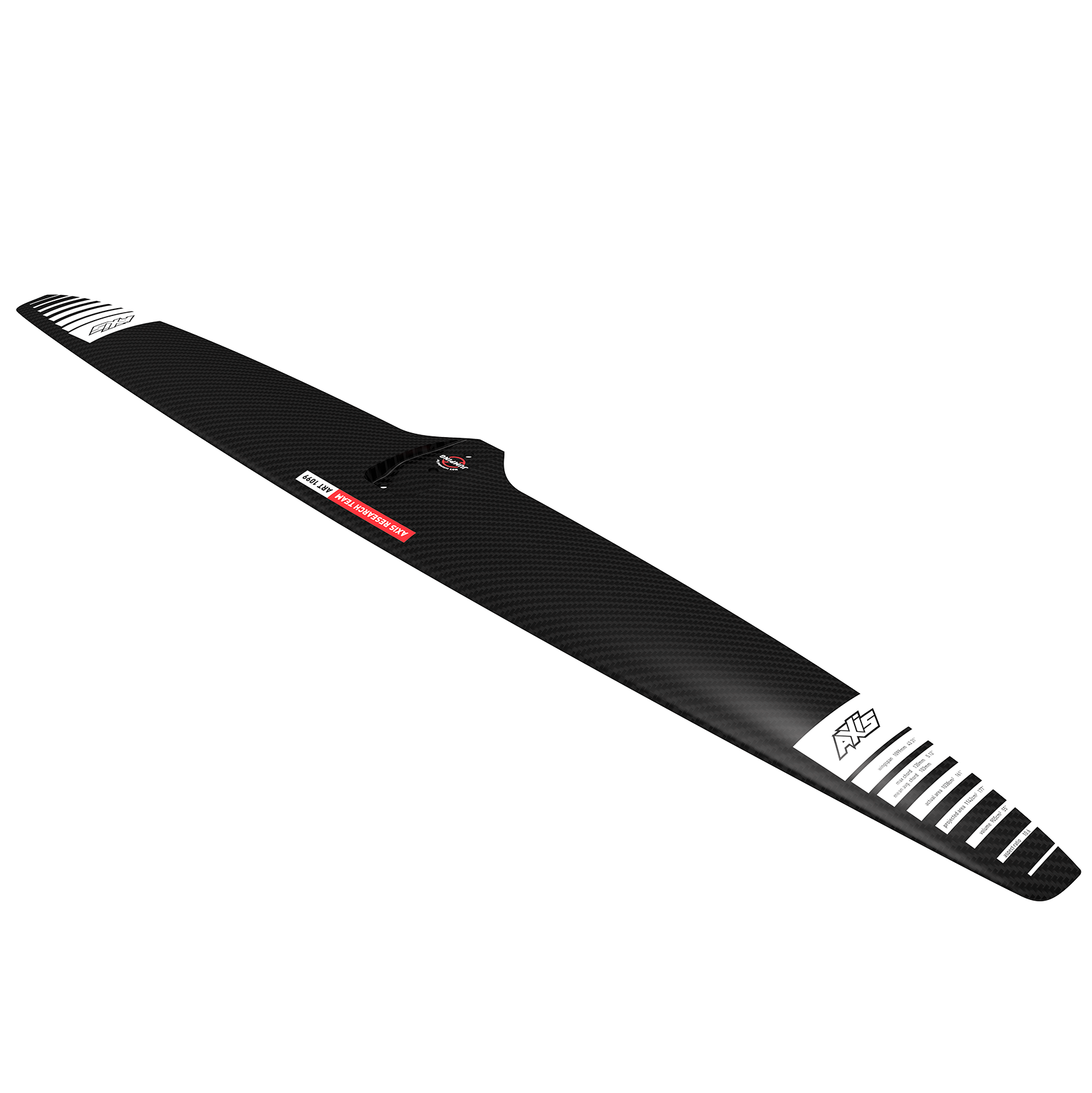
A hundred and four wings in a catalogue is a number that makes people give up. Here is the structure: there are really eight families, and ten minutes is enough to grasp them.
Families by price
- Speed —
First division: front or rear
Half the confusion disappears once you grasp this.
The front wing generates lift and sets the setup's character. From
444 €.The rear wing (stabiliser) handles pitch stability. From
100 €.The practical conclusion: Speed, Freeride, Progressive and SKINNY are stabilisers. If you are choosing the "main wing", you want HPS, PNG, ART or FIREBALL.
What the numbers mean
The names carry figures: 340, 400, 1000, 1500, 1750.
That is wing area in square centimetres. A FIREBALL 1500 is a 1500 cm² wing.
The logic is the reverse of kites:
- More area → earlier takeoff, lower speed, forgives mistakes.
- Less area → later takeoff, higher speed, sharper response.
Front wing area by weight:
- under 70 kg: 1000 to 1300 cm²
- 70–85 kg: 1300 to 1600 cm²
- over 85 kg: 1500 to 1900 cm²
Those are learning figures. A confident rider drops 20 to 30 % below them.
Rear wings carry smaller numbers — 250, 340, 400: a stabiliser is always several times smaller than the front wing.
SKINNY: two numbers instead of one
A special case worth explaining: SKINNY 358/35, 359/40, 360/45, 362/50, 365/55.
The first number is area, the second span or chord. At near-identical area (358 to 365) the proportion changes.
Why that matters. Two stabilisers of equal area but different shape behave differently: narrow and long responds sharply, wide and short more gently.
Who needs it: riders who have found their front wing and are tuning the setup's character. Not beginners.
How to choose a front wing
A practical sequence instead of reading a hundred listings.
Step 1: settle the discipline. Wing, prone, downwind, kite, pumping — the requirements differ.
Step 2: take the area from your weight using the table above.
Step 3: pick a family by job.
- HPS — the most affordable front branch, a sensible start.
- PNG — the middle step.
- ART — the widest family at 24 items: something for almost any job.
- FIREBALL — the top, with ULTRA High Mod Carbon versions.
Step 4: ask us. For a specific area and discipline we confirm specifications and availability with the supplier before payment. In a range of a hundred and four items that is standard practice rather than a favour.
On paying for High Modulus
Top items carry High Mod Carbon and ULTRA High Mod Carbon in their names.
That is the elastic modulus of the carbon fibre. Higher modulus means a stiffer wing at the same weight.
What wing stiffness gives: it does not "breathe" under load, so it holds the intended angle of attack more precisely. At speed a soft wing starts to vibrate and lose efficiency.
When it repays: at speed, in downwind, and for heavier riders.
When it does not: while learning. You simply will not feel it — the same logic as kite suffixes.
Common questions
What do 1000 or 1500 mean in a wing name?
Area in square centimetres. More area means earlier takeoff and lower speed.
Which families are front wings?
HPS, PNG, ART and FIREBALL. Speed, Freeride, Progressive and SKINNY are rear stabilisers.
What area at 80 kg?
1300 to 1600 cm² for learning. A confident rider takes 20 to 30 % less.
What do SKINNY's two numbers mean?
Area and proportion. At equal area, a different shape gives a different stabiliser character.
Is High Modulus worth paying for?
At speed and in downwind, yes — stiffness holds the angle of attack. While learning you will not feel it.
Where to look
Wings are in the hydrofoil section. To read: modular foils and our AXIS review.
Wingfoil in Mui Ne
Wingfoil lessons with an instructor at the K1 station, and a December wing camp with stay and transfer.
Read next
AXIS offers a four-component configurator rather than a finished foil. How to choose in the right order, which…
Foil Etiquette: Why Foilers Are Unpopular and How to Fix ItA metal wing underwater is invisible, and that is the root of every conflict at a spot. The rules that formed …
Where to Start in Foiling: A Two-Year RouteFive foil disciplines, and the order of learning is not arbitrary. Which to start with, how long each stage ta…