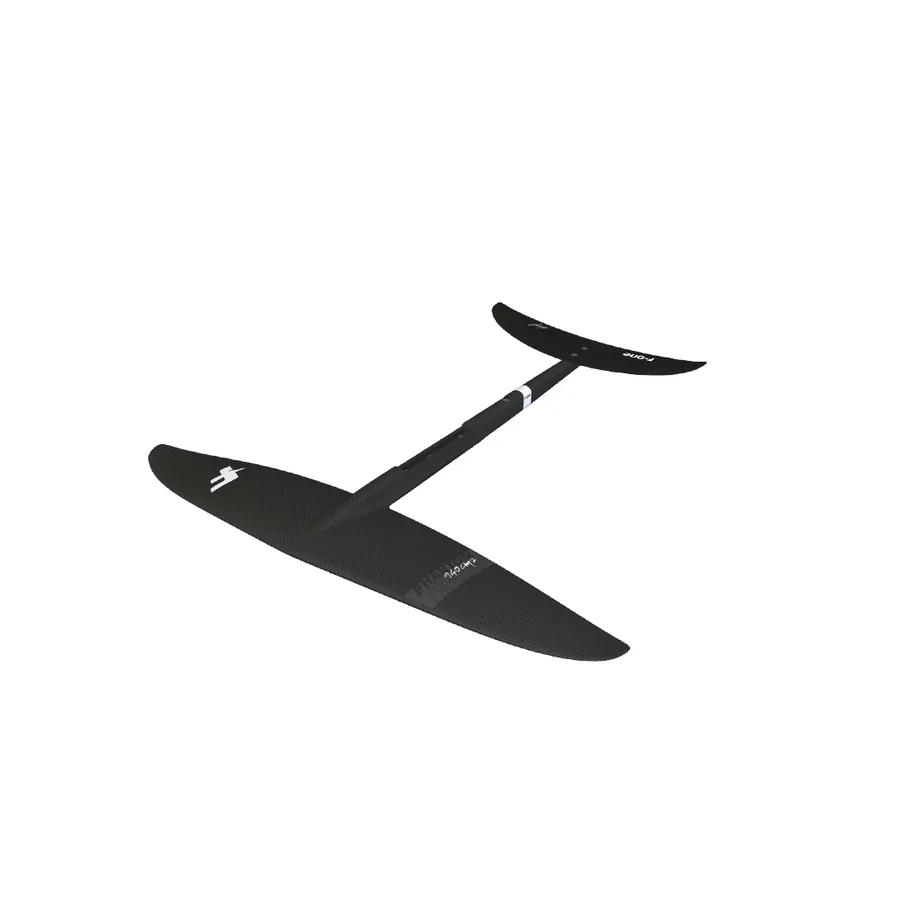
A front wing starts at
444 €, a rear wing at 100 €. A fourfold price gap and a far smaller gap in influence. Here is the most underrated part of a foil.What a stabiliser does
It holds the foil in pitch — stopping the nose from rising or dropping.
It works like this: the rear wing generates a small amount of negative lift, pressing the tail down. That creates a couple which returns the foil to equilibrium after any disturbance.
The analogy is exact: it is an aircraft's horizontal tailplane. Without one the machine flies but cannot be controlled.
A practical conclusion worth remembering: the feeling that "the foil is unstable and keeps throwing me" is nearly always about the rear wing and fuselage rather than the front wing.
Three parameters of a rear wing
1. Area
More area → stronger stabilisation, calmer foil, but more drag and slower turns.
Less area → livelier and faster, but more nervous.
Guide: stabiliser area is typically 20 to 30 % of the front wing. With a 1500 cm² front wing, a rear of around 300 to 450.
2. Profile
AXIS names its families after their purpose:
- Speed —
Note the prices: Speed costs less than Progressive. A rare case where the more "sporting" part is cheaper — because it is smaller and uses less material, not because it is worse.
3. Shim angle
A parameter beginners do not know about, and it decides a great deal.
The angle between rear wing and fuselage, set by shims, changes the foil's balance. Many fuselages accept thin wedges that alter the angle by fractions of a degree.
What that gives:
- More angle → the foil lifts more willingly and takes off earlier, but pitches up more sharply.
- Less angle → calmer, later takeoff, higher speed.
This adjustment is free. Before buying a new wing for hundreds of euros, try changing the angle of the one you have — often that is exactly what you were looking for.
When to change the rear wing
The foil throws you up and the nose rises → a larger rear wing, or less shim angle.
The foil feels dull and will not lift → smaller area, or more angle.
Not enough speed → a Speed profile instead of Freeride.
Learning and everything feels unstable → Progressive with more area.
It will not turn on a wave → less area plus a shorter fuselage — covered in our fuselage article.
Why this is the best-value upgrade
The arithmetic worth reading to.
Front wing — from
444 €. Changes lift and speed.Fuselage — from
184 €. Changes stability and turning.Rear wing — from
100 €. Changes balance and character.The right order of experiments: play with shim angle for free first, then change the rear wing for a hundred, then the fuselage, and only last of all the front wing.
The classic mistake: a rider dislikes how the foil behaves and buys a five-hundred-euro front wing. Half the time the problem was balance, and a two-euro shim would have fixed it.
On wear
Rear wings break more often than front wings. They are thinner, sit behind, and take the first hit when you touch the bottom on the way out.
Check the edges before the season. A chip on a stabiliser's trailing edge produces vibration that is easily blamed on the mast.
Check the bolts. A loose stabiliser behaves like a wrongly chosen one: the foil "floats" in pitch. On bolts and corrosion, see our care article.
Common questions
What does a foil's rear wing do?
It holds pitch: generating downforce at the tail and returning the foil to equilibrium.
What area should a stabiliser be?
20 to 30 % of the front wing. With a 1500 cm² front wing, around 300 to 450.
How does Speed differ from Progressive?
Speed means minimum drag and less area; Progressive means more stability. Speed also costs less.
What is rear wing shim angle?
The stabiliser's tilt relative to the fuselage, set with shims. More angle means earlier takeoff but sharper pitch-up.
The foil misbehaves — what should I change first?
Shim angle first (free), then the rear wing (from 100 €), then the fuselage. The front wing last.
Where to look
Wings are in the hydrofoil section. To read: AXIS wing families and wing aspect ratio.
Wingfoil in Mui Ne
Wingfoil lessons with an instructor at the K1 station, and a December wing camp with stay and transfer.
Read next
Red and White Dunes, Fairy Stream, Red Canyon, the fishing village, Cham towers and the Whale Temple — what fi…
Where to Start in Foiling: A Two-Year RouteFive foil disciplines, and the order of learning is not arbitrary. Which to start with, how long each stage ta…
Foil Etiquette: Why Foilers Are Unpopular and How to Fix ItA metal wing underwater is invisible, and that is the root of every conflict at a spot. The rules that formed …