A foil in a catalogue can look like a pile of parts priced from
199 €. Here is what each one is and how to assemble a working setup.The four parts of a foil
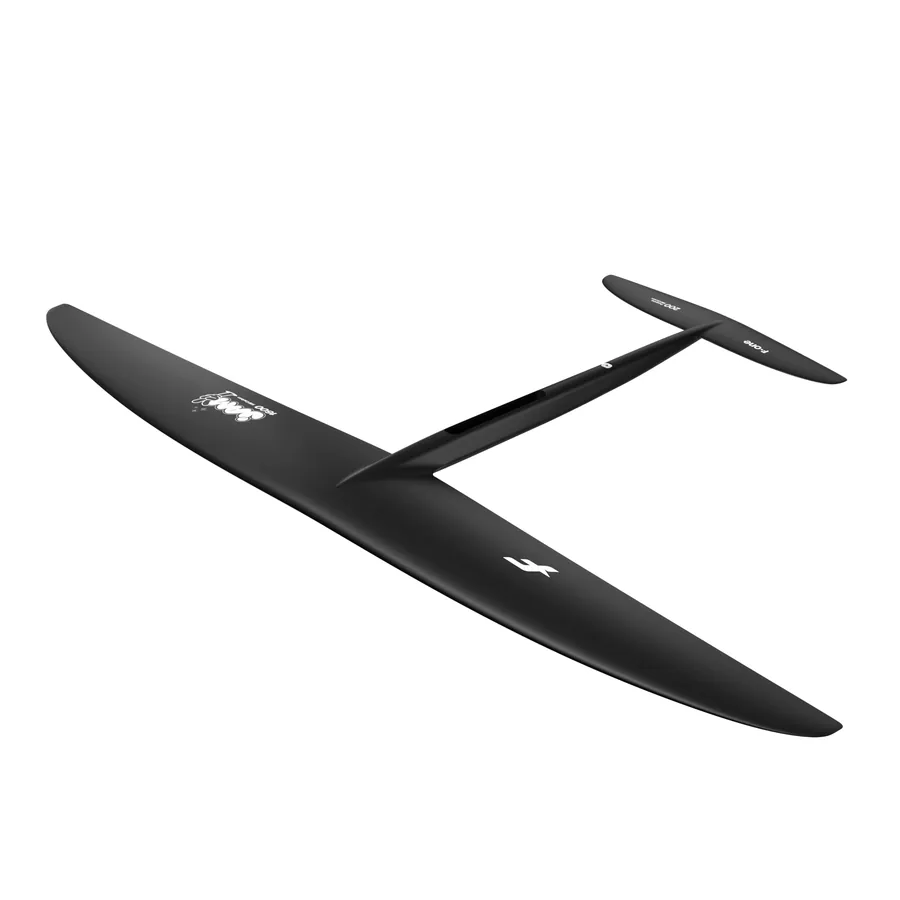
- Front wing. The main part: it generates lift and sets 80 % of the character.
- Rear wing (stabiliser). Responsible for pitch stability.
- Fuselage. The tube joining the wings. Its length affects responsiveness.
- Mast. Joins the foil to the board. Length 60 to 90 cm.
The key idea of this whole article: progression in foiling means changing the front wing, not the whole setup. Mast and fuselage last several seasons.
Front wing: area decides
The one parameter to understand thoroughly.
More area → earlier takeoff, lower speed, forgives mistakes.
Less area → later takeoff, higher speed, sharper response.
The logic is the reverse of kites, which confuses people: on kites a big size means light wind; on foils a big area means beginner and light wind at once.
How it is labelled. Some brands print area in cm² (650, 810, 980), others use sizes. At GONG it is a scale from S to 6XL: the Curve H comes in M, L, XXL, 3XL, 6XL; the Fluid H from M to 4XL.
What to do with a letter scale: do not try to map it onto other brands. Look at the stated area and rider weight, and if the listing lacks them, ask — we check with the supplier before payment.
Wing profile: HA and LA
The second most important parameter, often carried in the name.
High Aspect (HA) — a long, narrow wing. Higher speed, longer glide, better pumping. But a sharper stall and worse manoeuvring.
Low Aspect (LA) — short and wide. Slower, but more manoeuvrable and gentler with mistakes.
The practical choice:
- Learning → low aspect, large area.
- Waves and turning → low aspect.
- Downwind, pumping, speed → high aspect.
Mast: length and material
Short (60 to 70 cm) — for shallow water and learning. You fall from lower and breaching is more forgiving.
Long (85 to 90 cm) — more height in reserve, the wing breaches less on a wave.
Aluminium — cheaper, heavier, more flexible. Flex in a mast is loss: part of your effort disappears into bending.
Carbon — lighter and stiffer, dearer.
An important rule: start with a short aluminium mast. It costs less, and while learning you fly low anyway.
Assembling a first setup
The simple option: buy a complete one. A Semi Complete or a package means compatibility is proven. We covered this in our Kite Foil Semi Complete article.
Buying in parts makes sense if:
- You already own some of the parts.
- You know exactly what wing area you need.
- You want two front wings from the start for different conditions.
Spending order: mast and fuselage first (they outlive everything), then a large front wing, then — a season later — a second smaller wing.
Compatibility: the one thing that really breaks plans
The most common source of disappointment when buying in parts.
Mast-to-board mounting. Several standards exist and they are not interchangeable.
Wing-to-fuselage mounting. Every brand has its own geometry. One brand's wing will almost never fit another's fuselage.
The practical consequence: choosing a foil brand means choosing an ecosystem for several years. This is exactly the case where a wide in-brand range matters more than the price of a single part.
What to do: before buying any part for an existing foil, send us the model — we verify compatibility before payment. Cheaper than discovering the mismatch after delivery.
Choosing in under a minute
First foil at 75 to 85 kg → a large low-aspect front wing and a 70 cm aluminium mast.
Second season → add a wing 20 to 30 % smaller in area and change nothing else.
Shallow spot → a 60 to 65 cm mast.
Waves → low aspect, medium area.
Pumping and downwind → high aspect, long mast.
Travelling with the setup → a splittable fuselage and mast pack smaller.
Common questions
What is a foil made of?
Front wing, rear wing, fuselage and mast. The front wing sets most of the character.
What does wing area mean?
More area means earlier takeoff and lower speed. Beginners want large area.
How does high aspect differ from low?
High aspect is faster and glides further but stalls more sharply. Low aspect turns better and forgives mistakes.
Which mast should I buy first?
A short aluminium one, 60 to 70 cm: cheaper, and while learning you fly low anyway.
Will one brand's wing fit another's foil?
Almost never: fuselage mounting geometry is brand-specific. Send us the model and we will check before payment.
Where to look
Hydrofoils and components. To read: the foil package guide and kite foil versus wing foil.
Want advice from an instructor?
Our IKO instructors will help you choose gear or plan a kite trip to Mui Ne — free of charge.
Read next
The cheapest SUP in our catalogue costs 99 euros, the cheapest adult one 199. Where that price comes from, wha…
GONG I-SUP: Nine Models for Nine JobsAllround, Cruising, Race, Family, Explorer, Adventure, Hybrid, Longboard, Shortboard — a range split by purpos…
Assembling a Setup Without Forgetting Anything: Five ChecklistsIn modular ranges half the parts are sold separately, and it is easy to reach the water without a pad or a lea…