We have covered kite foiling and wing foiling. There is a third way to rise above the water — with a sail. Here is how it differs and why it has Starboard's widest board range.
What the range holds
- Foil X —
The main advantage: wind
Ordinary windsurfing starts planing around 12 to 14 knots. Below that you float rather than sail.
A windfoil lifts from 7 to 10 knots. The wing generates lift at low speed — the same physics as kite and wing foiling, covered in our discipline comparison.
What that changes in practice. At most spots 8 to 12 knots is the most common wind. Windfoiling turns those days from "sitting on the beach" into real sessions.
And the other side of the same coin: above the water there is no hull drag, so it not only goes earlier but noticeably more quietly. Chop that rattles a normal board simply disappears under a foil.
iQFoil — what the abbreviation means
A separate story that explains half the range.
iQFoil is the Olympic windfoil class. Not a marketing name but the designation of regulated racing equipment.
What follows. Class boards are built to fixed rules, so their characteristics are predictable and comparable across brands.
Who needs it: anyone going racing. Who does not: everyone else — a rulebook brings strictness rather than convenience.
Note the price: the iQFoil 85 at
1 899 € is cheaper than the freeride Foil FreeRide at 2 059 €. Racing class does not mean dearer here.Three branches by job
GO-Fly — the learner. High volume, forgiving, stated purpose exactly first steps.
Foil FreeRide and Foil X — freeride. Riding for pleasure, no rulebooks.
iQFoil 85 and 95, Millennium — racing. The number is volume in litres: 85 for light riders and strong wind, 95 more versatile.
The rule: start on a learner board even if racing is the plan. On a foil, volume decides whether you fly or flounder — equally true across all three foil disciplines.
How windfoiling differs from kite and wing foiling
Spot requirements: as for normal windsurfing — little space needed, but a metre of depth for the mast.
Load: the pull goes through the harness as in kiting, not through your arms as in winging. Long sessions are easier.
Difficulty: harder than both. You handle a sail and balance on a wing at once, and both tasks are new.
An honest warning: windfoiling is a poor first discipline. The logical path is windsurfing to confident planing, then foiling.
What else you need beyond the board
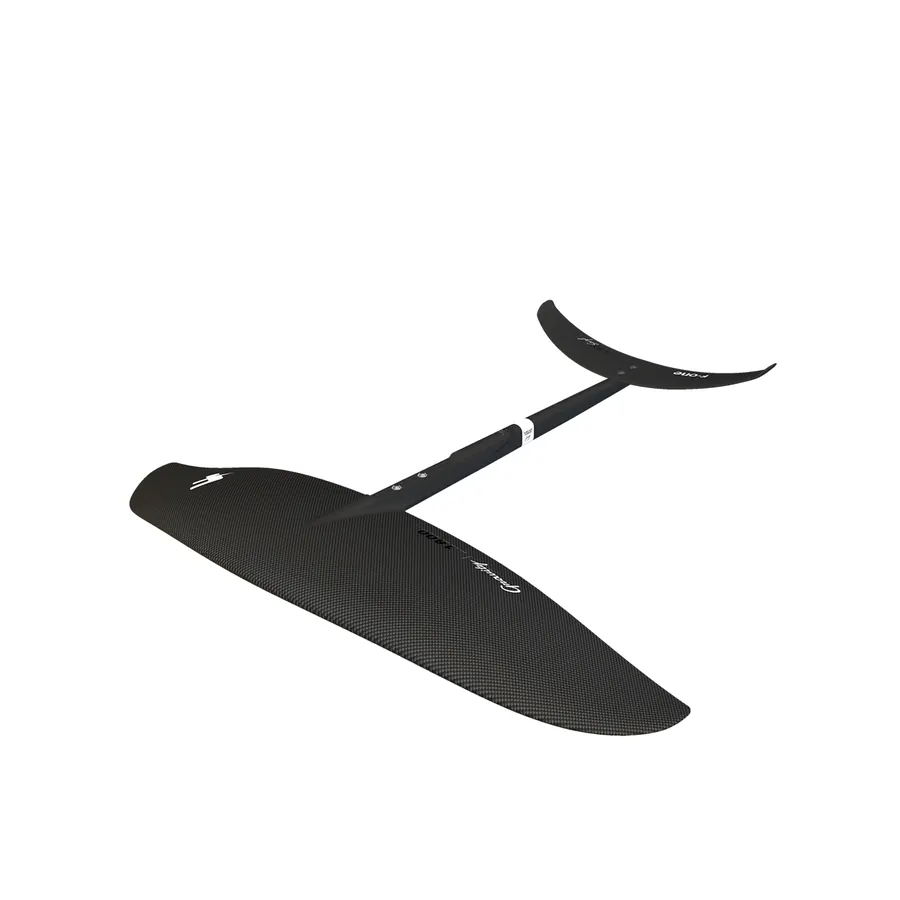
The foil itself — mast, fuselage, wings. A separate purchase comparable to the board's price.
A sail. Foiling uses slightly larger sails than usual: since you go from seven knots, area matters.
Helmet and vest. Mandatory, non-negotiable: there is a metal wing underwater.
The wing area rule: more front wing area means earlier takeoff and lower speed. Beginners take large. We covered the mechanics in our foil package article.
Who it suits
Windsurfers at light-wind spots. The main and most honest scenario.
Anyone tired of chop. There is none above the water.
Anyone going racing. iQFoil is the Olympic class.
Who it does not suit
Windsurfing beginners. Planing first, foiling later.
Anyone with a shallow spot. The mast needs depth.
Anyone who always has 20+ knots. In strong wind a normal board is simpler and more fun.
Common questions
From what wind does a windfoil work?
From 7 to 10 knots against 12 to 14 for normal windsurfing. It makes the most common days rideable.
What is iQFoil?
The Olympic windfoil class with regulated equipment. Relevant if you race.
Can I start windsurfing straight on a foil?
Better not. You would be learning sail handling and wing balance at once. Planing first.
What do 85 and 95 mean?
Board volume in litres. 85 suits light riders and strong wind; 95 is more versatile.
What front wing should a beginner buy?
A large area: it lifts earlier and forgives mistakes.
Where to look
2 069 €, iQFoil 85 1 899 €. Sections: windsurfing and foil boards.Want advice from an instructor?
Our IKO instructors will help you choose gear or plan a kite trip to Mui Ne — free of charge.
Read next
The cheapest SUP in our catalogue costs 99 euros, the cheapest adult one 199. Where that price comes from, wha…
GONG I-SUP: Nine Models for Nine JobsAllround, Cruising, Race, Family, Explorer, Adventure, Hybrid, Longboard, Shortboard — a range split by purpos…
Assembling a Setup Without Forgetting Anything: Five ChecklistsIn modular ranges half the parts are sold separately, and it is easy to reach the water without a pad or a lea…