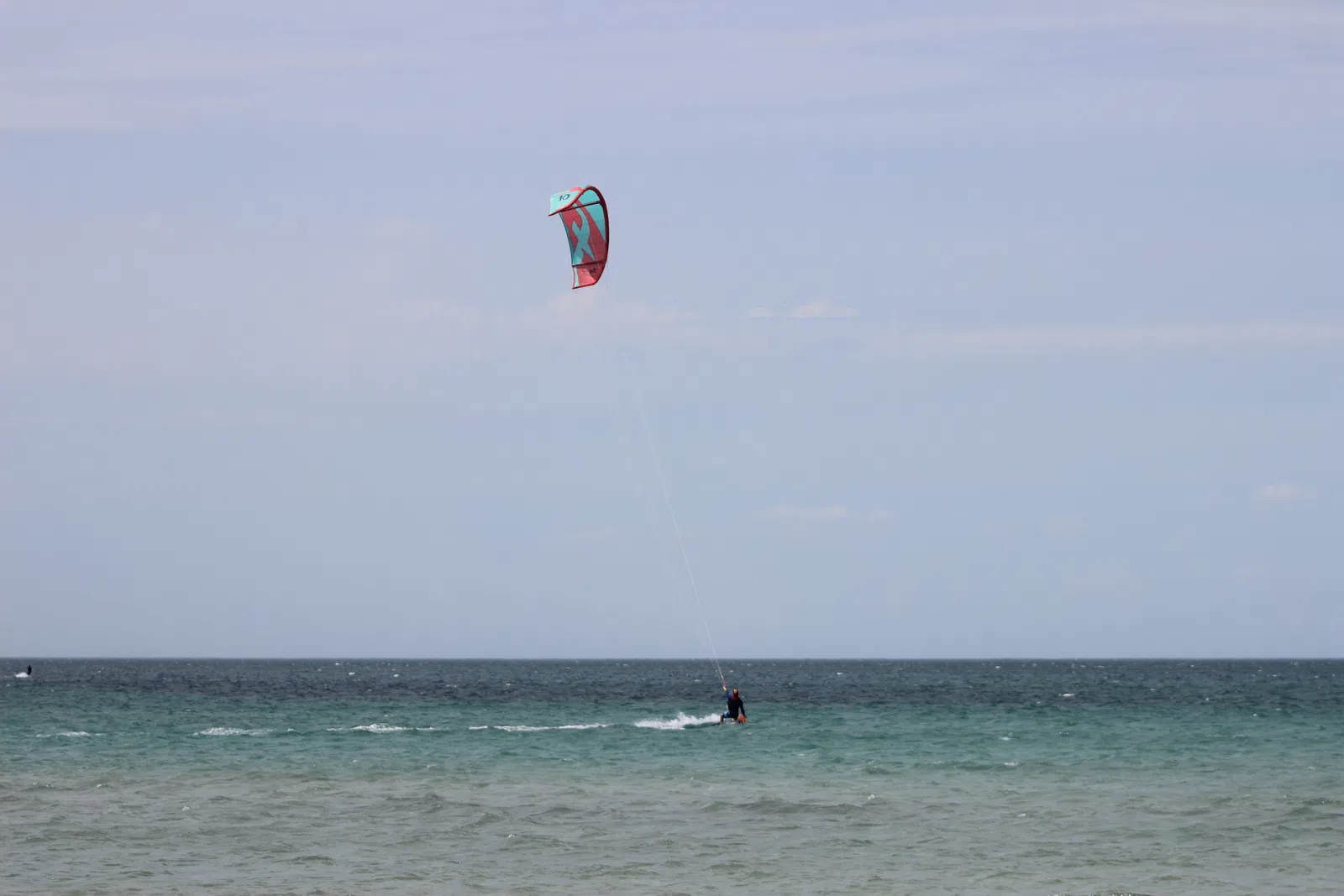
Every kite spot rewrites the forecast. The model sees a smooth flow over tens of kilometres; the beach you stand on adds buildings, palms, a headland, warm sand and cool water. Below are the local wind effects a visiting rider should read in the first five minutes on the beach — with how each one shows up at Mui Ne, where our K1 station sits.
The short version
- Wind shadow: lighter, broken wind downwind of anything tall. Launch from open sand and ride through it without stopping.
- Headland acceleration: air squeezed around a point speeds up. Size down when you ride near one.
- Surface friction: land slows the wind, water lets it run. It usually blows harder 100 m out than on the sand.
- Direction to the shoreline decides whether a mistake brings you back or takes you out.
- Clouds and squalls switch the thermal off or throw a gust front at you within minutes.
Wind shadow
Behind a building, a row of palms or a moored boat the air tumbles into eddies. In that zone the kite sags, drifts to the edge of the window, then snaps back as a gust comes through. Water in a shadow looks calmer, with finer ripples.
At Mui Ne the first 50–100 metres off the beach sit in the shadow of buildings, palms and fishing boats; further out the wind is steadier and denser. Launch and land on open sand, keep the kite away from the zenith close to shore, and ride through the band rather than stopping in it. Why gusts from obstacles never appear in the model is covered in our article on reading gusts.
Headland and gap acceleration
Flow that has to bend around a point, or squeeze between two rises, speeds up — the same reason wind whistles between houses. Spots next to headlands therefore often blow stronger than a straight beach a kilometre away, with stronger gusts right at the tip.
Our summer spot «The Cape» by the whale temple works partly for this reason: with the right direction it blows denser there than on the central beach. Pick your kite for the wind at the point, not for the regional forecast, and keep a margin from the point itself, where the wind also swirls.
Friction: why the sand lies
Land is rough and drags the lowest layer of air; water is smooth and loses less. Standing on the beach you will usually feel less wind than there is offshore — the classic way to rig a kite that is too big. Judge by the water (whitecaps, ripple texture, how riders already out are powered) and by instruments: we keep a live camera and wind sensor on the spot for exactly this.
Direction to the shoreline
| Direction | What it does | Good for |
|---|---|---|
| Onshore | Pushes you to the beach; shore break makes launching hard | Confident riders |
| Side-on | Runs along the beach and drifts a stuck rider back to it | Learning |
| Side-shore | Parallel to the beach | Everyone |
| Side-off | Flatter water inshore, but a mistake takes you out | With support, in a closed bay |
| Offshore | Deceptively smooth inshore, gusty off the land, carries you out if anything breaks | Not for riding alone without a boat |
In the season Mui Ne mostly blows along the coast. At our station on Malibu beach it is side-shore with a slight offshore component, and the bay helps: on the left tack you are brought back towards the beach rather than out to sea.
Thermals, clouds and squalls
Much coastal wind is thermal — quiet morning, building by lunch, fading at sunset (the mechanism is explained in our piece on sea breezes). Cloud cover in the middle of the day weakens it, whatever the forecast said. A dark cloud line does the opposite: a gust front, a direction change, then a lull. See it on the horizon — head in early.
Five-minute beach check
- Wind direction against the shoreline.
- Obstacles upwind and where the open launch area is.
- Any headland or gap nearby.
- Water texture, the sensor and the camera — not the feel on the sand.
- Sky: clear, clouding over, or a dark line coming.
Learning with us? Your instructor makes these calls during the first lessons — what you need from day one is to launch in open space and come in when the sky darkens.
Want advice from an instructor?
Our IKO instructors will help you choose gear or plan a kite trip to Mui Ne — free of charge.
Read next
The cheapest SUP in our catalogue costs 99 euros, the cheapest adult one 199. Where that price comes from, wha…
GONG I-SUP: Nine Models for Nine JobsAllround, Cruising, Race, Family, Explorer, Adventure, Hybrid, Longboard, Shortboard — a range split by purpos…
Assembling a Setup Without Forgetting Anything: Five ChecklistsIn modular ranges half the parts are sold separately, and it is easy to reach the water without a pad or a lea…