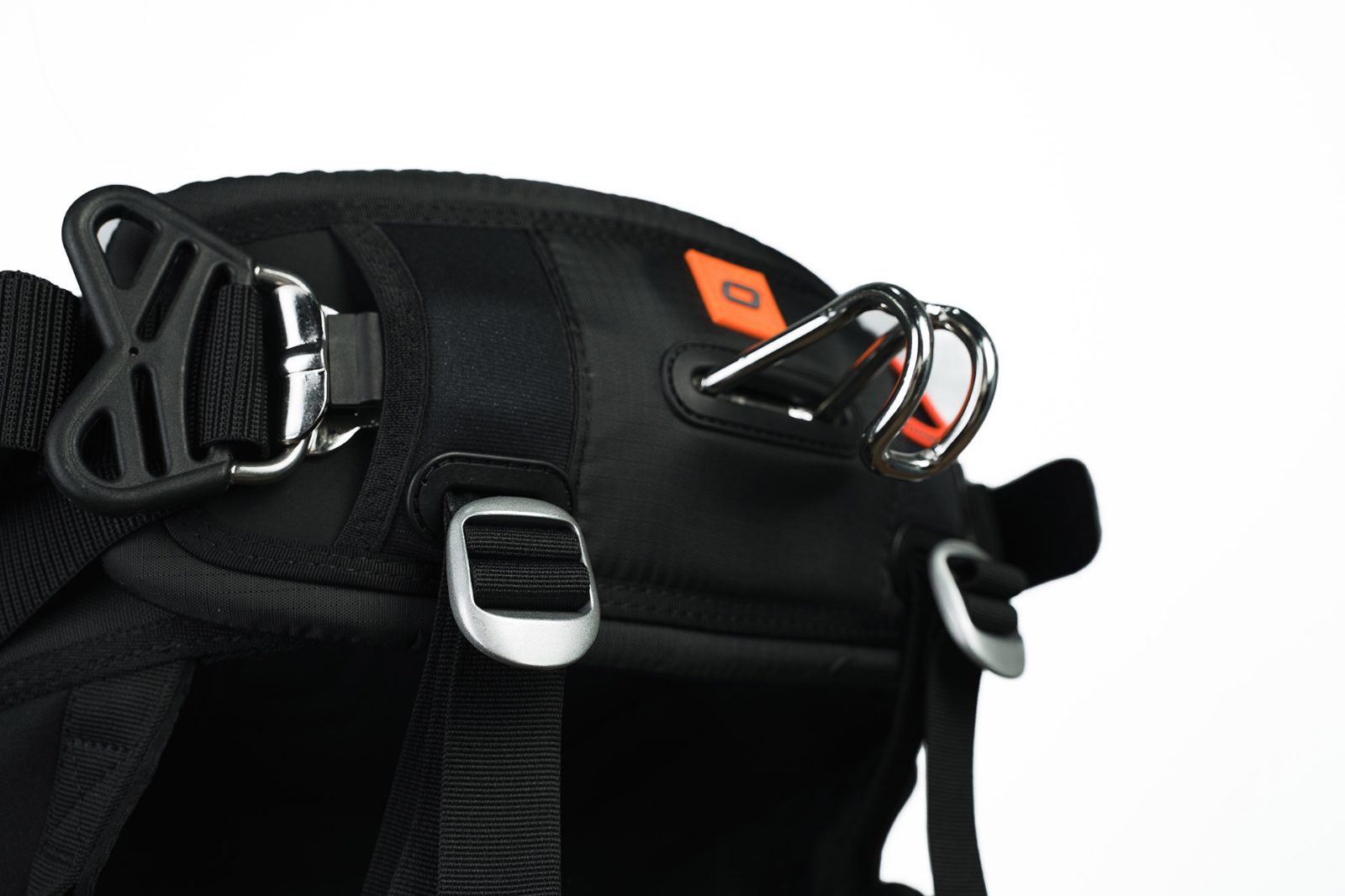
The Connect Seat V3 is a rare case where the manufacturer says outright where the model came from: it is built on the Connect Waist V4 but aimed at a different job. Here is what that job is.
The short version
- Type: seat harness — belt plus fully adjustable leg straps.
- Sizes: XXS, XS, S, M, L, XL, XXL — seven of them.
- Waist girth: from 68–73 cm (XXS) to 95–102 cm (XXL).
- Purpose: holding the torso in a low, stable stance at speed.
- Price:
"Low stable stance" — what that means on the water
The manufacturer's phrasing is precise and worth unpacking.
On a seat harness the hook sits lower than on a waist harness — closer to your centre of gravity. Pull applied low rotates your torso upright and sits you into your stance, instead of dragging you forward by the waist.
What that gives you: easier edge loading, easier tracking, less effort holding position under constant pull. Exactly what a long upwind tack and a foil session ask for.
The downside is equally direct: leg straps restrict hip movement, and in rotations that gets in the way.
Seven sizes — the same logic as the waist model
The size range matches the Connect Waist V4: XXS to XXL in four- to five-centimetre steps of waist girth.
Twice the precision of a typical four-size range, and precision matters just as much on a seat harness. A loose seat harness will not ride up — the straps prevent it — but it will shift about and rub, which is no better in its own way.
A word on XXS and XS: small sizes are rarer in seat harnesses than in waist ones, and people with a narrow waist are usually left choosing between junior models.
Fully adjustable straps — why that matters
The leg straps adjust to the rider's build, and that is not a cosmetic option.
Over-tightened straps compress the thigh and restrict circulation — your leg starts going numb after half an hour. Too loose and they do not do their job: the harness still shifts, only more slowly.
The correct setting: the straps hold, but a flat hand fits between strap and thigh. Adjust while wearing it under load, not standing on the beach.
Who it suits
Anyone learning. A seat harness forgives a weak stance — and stance takes months to build.
Foilers. On a foil the pull is lower and the stance more relaxed, so a waist harness tends to ride up even for experienced riders. A seat harness removes the question.
Anyone with back problems. The load spreads between belt and thighs, taking some off the lumbar spine.
Anyone riding long tacks. Distance runs, light wind, racing — anywhere stability matters more than mobility.
Who it does not suit
Freestylers and big-air riders. The straps get in the way of throwing your legs and twisting. A waist harness, without question.
Anyone who wants freedom in the air. You can jump, but rotations become awkward.
Wingers. On a board you need to move your body freely, and a seat harness fights that.
On the "seat harnesses are for beginners" myth
Worth saying plainly, because this stereotype stops people choosing what is comfortable.
Seat harnesses are not only for learners. Foilers with ten years behind them buy them, so do distance racers and anyone whose back has already spoken up. It is a question of the kind of load, not the level of riding.
The full comparison: seat versus waist.
Price in context
The Connect Seat V3 costs
349 € against 269 € for the Connect Waist V4. The 80 € difference is the straps, their mounts and their adjustment.The pricing logic is honest: a seat harness is structurally more complex and has more parts.
Common questions
How do I find my size?
By waist girth, just above the hip bones, over your wetsuit if you ride in one. Between sizes, take the smaller.
Can I jump in it?
You can, but rotations become awkward: the straps restrict your hips.
My leg goes numb — what is wrong?
The straps are too tight. A flat hand should fit between strap and thigh.
Is it suitable for winging?
Not the best choice: winging needs a free torso. Look at the Connect Wing V2.
How long does a seat harness last?
Like a waist harness, three to four seasons. Additionally, check the stitching at the strap mounts — that is a load point.
Where to buy
349 €, seven sizes. All harnesses are in the catalogue section, and the range on the Ozone page.Ozone Connect Seat V3 Harness at K1.surf
Official Ozone dealer. From 349 €. Our IKO instructors match the size to your weight, level and wind.
Read next
Five foil disciplines, and the order of learning is not arbitrary. Which to start with, how long each stage ta…
Foil Etiquette: Why Foilers Are Unpopular and How to Fix ItA metal wing underwater is invisible, and that is the root of every conflict at a spot. The rules that formed …
Build Your Own: Assembling a Foil for Yourself Without Getting It WrongAXIS offers a four-component configurator rather than a finished foil. How to choose in the right order, which…