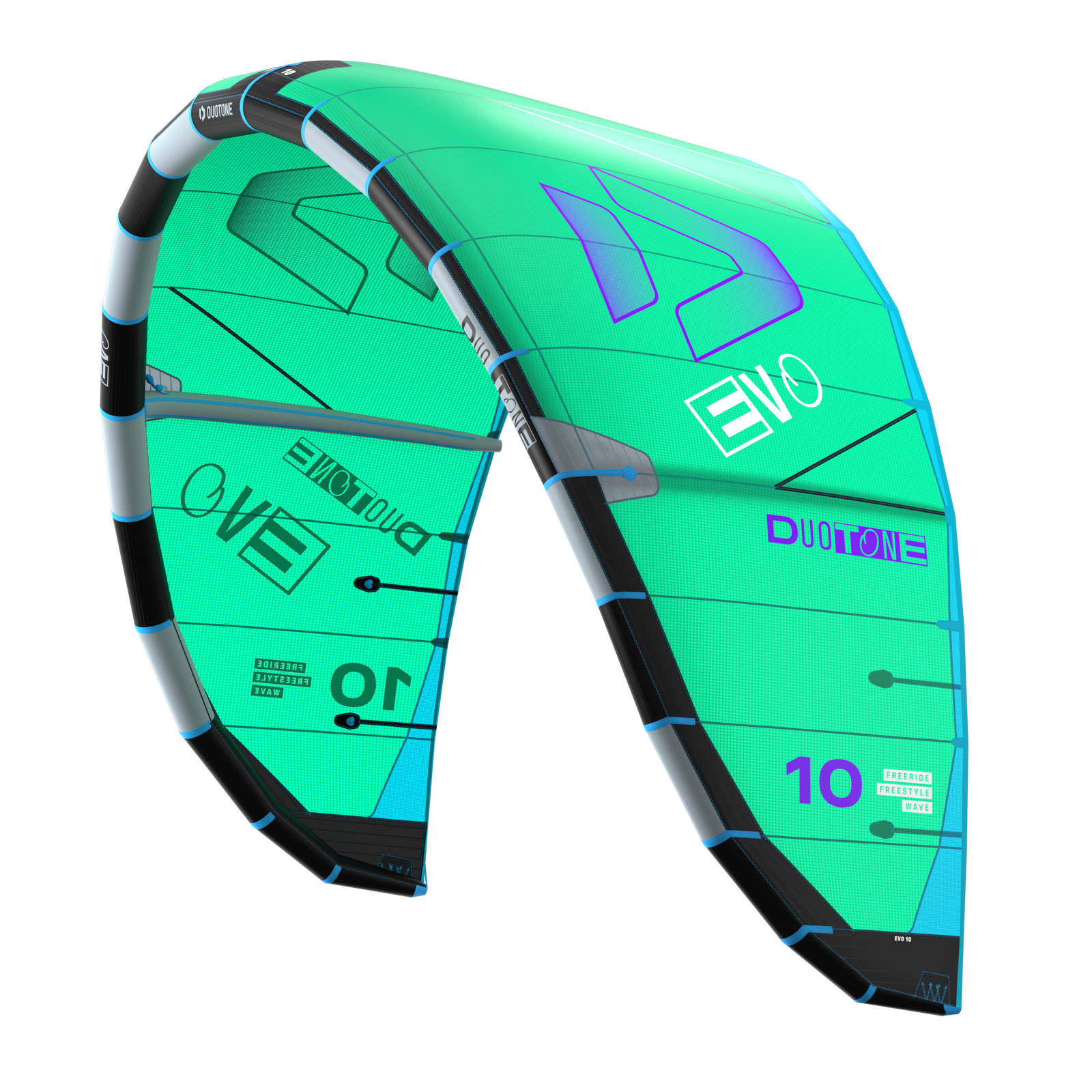
Normally a lightweight version of a kite is the same kite, only lighter. Not with the Evo: three constructions are stated for three different disciplines. Here is why that happens.
The short version
- Evo —
How lightness becomes drift
The first of two explanations, and it concerns the SLS.
A reminder of what drift is: a kite's ability to stay airborne and hold position when the lines go slack. In detail: our North Carve review.
Drift comes from two qualities, the first being low weight. A light kite stays up on less tension: it needs less lift simply not to fall.
Hence Duotone's logic. Take the all-round Evo, lighten the construction, and you get a kite that holds better when tension is lost. In other words, it became a wave kite not because it was redesigned for waves but because it was lightened.
How lightness becomes lift
The second explanation, concerning the D/LAB.
A kite's lift first raises the kite itself, and only the remainder reaches you. We repeated that in our Alpha V3 Ultra-X and Bandit BRAINCHILD reviews.
In a jump that works twice over: a lighter kite lifts higher and holds longer at the top. So "high jumps" in the D/LAB's stated purpose is a consequence of lightness and stiffness rather than a separate development.
Why not everyone needs the D/LAB, then
A fair question: if the top construction gives both drift and lift, what are the others for?
Three reasons, all honest.
One: price. The gap between a base Evo and a D/LAB is
1 150 €. That is a second kite, or a board and foil.Two: durability. Lightweight constructions tolerate extreme loads less well. At F-One that is visible in the table: the lighter BRAINCHILD gains a 40-knot ceiling the standard TEC does not have.
Three, and the main one: while learning, your limit is technique. Differences between constructions reveal themselves once you already work the kite confidently. Before that you are paying for qualities you do not use.
Which version to buy
A first kite after lessons → the base Evo. Its stated purpose is exactly that, and
1 150 € is better spent on a board and coaching.You ride waves or a directional → the Evo SLS. Drift earns its keep every session.
You jump and want more height → the Evo D/LAB. But compare it with the North Orbit: a dedicated big-air kite may give more for the same money.
You ride storms → the base Evo. A heavier construction tolerates extremes better.
You are buying two kites → a base Evo in the large size plus an SLS in the small, or the reverse. Mixing constructions within a quiver is perfectly sensible.
The Evo against its rivals
Worth lining up, because the market is full of all-rounders.
Against the F-One Bandit: the Bandit is cheaper to enter and comes with full weight and range tables per size. The Evo offers a higher construction ceiling. Full comparison separately.
Against the North Reach: the Reach has a wider size range and deeper catalogue by season. The Evo has three constructions for three jobs.
Against the Cabrinha Switchblade: one construction, but fifteen years of refinement towards predictability.
On sizes
In our catalogue the Evo is listed as "size to be confirmed" — the range is verified against the brand's stock before payment.
More honest than showing everything as available. Send us your weight and typical wind and we will confirm the available sizes before you pay.
Common questions
Are the three Evo versions really different kites?
By stated purpose, yes: base for progression, SLS for waves, D/LAB for jumping.
Why does lightness produce drift?
A lighter kite stays airborne on less line tension — which is what drift is.
Should a D/LAB be a first kite?
No. While technique is your limit, differences between constructions will not show.
Which version is more reliable in strong wind?
The base. At every brand, lightweight constructions tolerate extreme loads less well.
Can I mix constructions in a quiver?
Yes, and it is sensible: a base version in the large size for storms, a lightweight one in the small size for light wind.
Where to buy
Duotone Evo from
1 399 €, Evo SLS from 1 919 €, Evo D/LAB from 2 549 €. The brand is in our Duotone review.Want advice from an instructor?
Our IKO instructors will help you choose gear or plan a kite trip to Mui Ne — free of charge.
Read next
The Pivot is Naish's core model and a wave-riding benchmark. Eight sizes from 6 to 14 m, from 1,225 €. What th…
Naish Brand Review: From Windsurfing to Foils, Half a Century on the WaterNaish began with Robby Naish's windsurfing and today offers the widest foil range in our catalogue. 124 items.…
Repairing a Canopy on a Trip: What to Pack, How to Patch, When Not ToA canopy tear on day one need not end the trip if you carry twenty grams of the right materials. Repairs step …