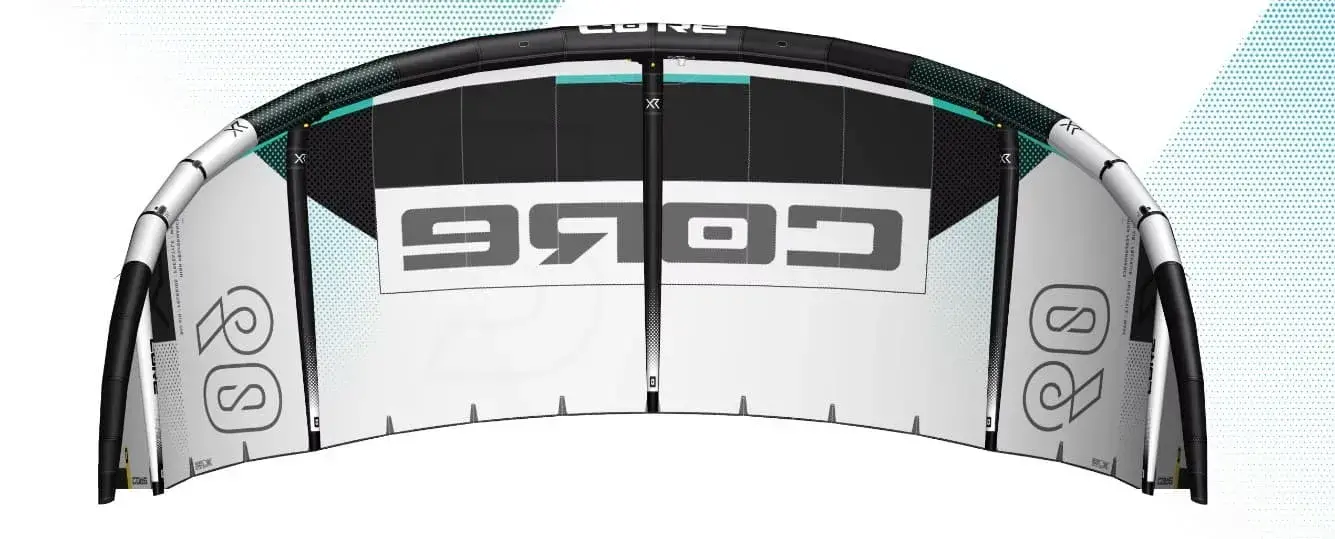
The number in the name is the most informative thing about this kite. XR8 is the model's eighth generation, and in an industry that renames kites every three years that says a great deal.
The short version
- Sizes: 5, 6, 7, 8, 9, 10, 11, 12, 13.5, 15, 17 m² — eleven positions.
- Disciplines: big air, freeride, freestyle.
- Manufacture: Germany.
- Price: from
Eighth generation: what that means
A generation change normally means substantial rework rather than new graphics. Eight generations means eight cycles of refining one idea.
Compare what we have covered. The Cabrinha Switchblade has stayed on top for fifteen years — and we explained that behind it lies evolution in one direction rather than an annual change of character.
The XR8 is the same case. The brand does not release a new model each season; it refines the existing one.
What that gives the buyer: predictability. A kite through eight iterations rarely springs surprises — the sharp corners have been worn off by rider feedback.
Three disciplines in one kite
Stated: big air, freeride and freestyle. That is broad, and worth examining whether it is possible.
We have shown repeatedly that disciplines conflict. Freestyle demands slack — the kite must dump power instantly. Big air demands lift — the kite must raise and hold you. Different tunings.
But Core has no choice, and that is the essence of a narrow range: when there is one model, it has to cover every discipline.
North has a model per job: Orbit for height, Pulse for freestyle, Carve for waves. At Core the XR8 must do all of it.
The honest conclusion: an all-rounder of that breadth will be good at everything and best at nothing. If you know your discipline precisely, a specialist from another brand will give more.
Eleven sizes from 5 to 17
Same principle: one model must cover the whole wind range.
The 5 is for storm sessions, thirty-five knots and up.
The 17 is genuine light wind, larger than most brands offer.
For comparison, the F-One Bandit runs 6 to 14 m with the extremes handled by other models.
A note on the 13.5 m. A fractional size between 13 and 14 is unusual and always means something. Round numbers suit a price list; fractional ones mean the size was chosen around a real power curve. We noted the same logic on the Orbit Ultra with its 5.9 / 6.6 / 7.3 / 8.1 ladder.
Picking a pair from eleven
The temptation is to take the extremes — a 5 and a 17 — and cover everything. A mistake, as we showed with the Naish Boxer.
A gap remains in the most common 18 to 28 knot band.
Working pairs:
- under 70 kg: 7 and 10 m²
- 70–85 kg: 9 and 12 m²
- 85–95 kg: 10 and 13.5 m²
- over 95 kg: 12 and 15 m²
How to calculate overlaps from tables is shown in our Bandit review.
On price — plainly
A 5 m XR8 costs
1 879 €. That is more than a 10 m F-One Bandit TEC (1 237 €) and comparable with North's and Cabrinha's flagships.What you pay for: German manufacturing, eight generations of refinement, an exceptionally wide size range.
What you do not get: choice within the brand. At North the same money buys four models for four jobs, plus four seasons in the catalogue from
750 €.The decision depends on what you value: European manufacturing and a settled model — or freedom of choice and the option of last season at half the price.
Who it suits
Anyone who cares where a kite is made. A legitimate criterion, and Core is one of few options.
Anyone on a spot with extremes. Eleven sizes cover everything.
Anyone who does not want to study ranges. One model, one decision — just the size.
Riders who jump and freeride. Those are the first two stated disciplines.
Who it does not suit
Anyone who knows their discipline. A specialist gives more: the Orbit for height, the Carve for waves.
Anyone on a budget. The entry price is among the highest in our catalogue.
Anyone wanting last season. There is no depth by year here as there is at North.
Common questions
What does the 8 mean?
The model's eighth generation. The brand refines the XR over years rather than launching a new model each season.
Can one kite really do everything?
It can do everything well but will be best at nothing. That is the price of a narrow range.
Why a 13.5 m?
Fractional sizes are chosen around power curves rather than price lists. A sign of a considered size ladder.
Which two sizes at 80 kg?
9 and 12 m². The extremes — 5 and 17 — are a third kite if they genuinely occur.
Why is the XR8 dearer than rivals?
German manufacturing, plus eight generations of refinement, which also cost money.
Where to buy
Core XR8 — from
1 879 €, eleven sizes. The brand is in our Core review.Want advice from an instructor?
Our IKO instructors will help you choose gear or plan a kite trip to Mui Ne — free of charge.
Read next
The Torch is Naish's freestyle model and the brand's narrowest specialisation. What slack is, why a freestyle …
Naish vs Core: A Wide Range or One Refined KiteNaish runs seven kite models and thirteen boards; Core runs one kite in eleven sizes. What each approach gives…
Choosing a Spot in an Unfamiliar Country: Eight Questions Before You BookGood wind is only one criterion, and far from the first. What to check before booking: depth, bottom, current,…