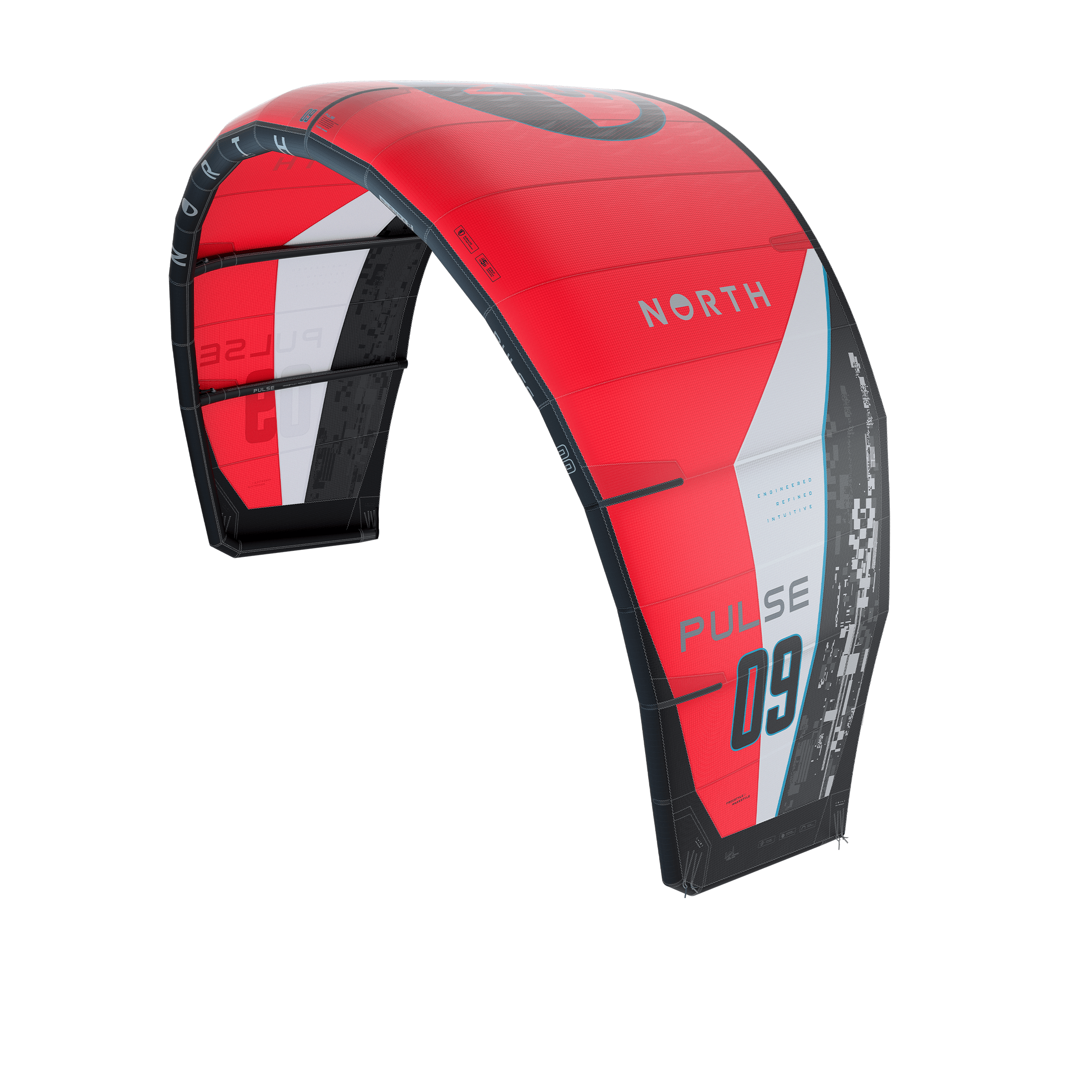
Freestyle asks a kite for the opposite of what freeride asks. The Pulse is a good place to explain why.
The short version
- Model: Pulse Kite, 2025 season.
- Sizes: 7, 9, 11, 13 m² — four positions.
- Colour: Rubine Red.
- Purpose: freestyle and wakestyle.
- Price: from
What slack is and why it matters
The key concept of this article.
In freeride and big air the kite works constantly: pulling, lifting, carrying. In freestyle there is a moment when it must stop pulling entirely and instantly.
It happens like this. The rider loads the edge, takes off on the board's pop — not the kite's — and performs a trick in the air, often with the bar fully released or a line passed around the body. At that moment the kite's pull is in the way. It twists your torso, blocks the rotation and pulls in the wrong direction.
Slack is a kite's ability to release its power for the trick and return it exactly when you need to land. The kite waits for you overhead, asking nothing.
Which is why a freestyle kite cannot be judged on lift. Like a wave kite, its defining quality is knowing when not to interfere. A wave kite needs that horizontally; a freestyle kite needs it in the air.
How the Pulse differs from the Orbit
Both are about jumping, and that is where the similarity ends.
The Orbit lifts you itself. You enter the power zone, the kite throws you up and carries you. Height comes from the kite.
The Pulse does not lift you. Height comes from the board's pop and your edge load, and the kite is there to hold you up and stay out of the way.
Hence the practical point: a freestyle kite will not make you jump higher. It will let you jump more technically. And conversely, a trick with a full bar release is awkward on a big-air kite.
Different disciplines, different tools, and substituting one for the other does not work in either direction.
Four sizes in two-metre steps
7, 9, 11, 13 — large, even steps with nothing in between.
Typical for freestyle, and here is why. A freestyler rarely rides at the edge of a range. They need a kite that pulls consistently in comfortable wind: a trick demands predictability rather than working the extremes.
So instead of eight closely spaced sizes there are four widely spaced ones, and that covers the working band.
The working pair for 75 to 85 kg is a 9 and an 11.
Who it suits
Riders doing tricks with slack. The stated purpose and the only audience where the Pulse comes alive.
Wakestylers. Riding in boots with winch-style technique is the neighbouring discipline with the same demands.
Riders on flat water. Freestyle needs a flat surface, and that is a spot constraint rather than a kite one.
Who it does not suit — and this matters
Freeriders. A kite tuned for slack feels nervous at the low end in ordinary riding: it does not pull where an all-rounder does.
Beginners. Categorically. A freestyle kite requires an already-developed edge load.
Anyone who wants height. That is the Orbit, and the difference is fundamental.
Wave riders. You want drift — that is the Carve.
Its place in North's range
Worth bringing together, because North's four kites do not overlap at all.
- Reach — the all-rounder. Freeride and progression.
- Orbit — lift and hangtime. Big air.
- Carve — drift. Waves.
- Pulse — slack and pop. Freestyle.
If you cannot confidently place yourself in one of the last three, your kite is the Reach — and that is the normal answer for most people.
On previous versions
The catalogue holds a Pulse 2024 from
909 € and an older 2021 version. Nearly half the 2025 price.For a freestyle kite, last season makes particular sense: the discipline demands technique rather than the last few percent of performance, and the money is better spent on coaching and on a board with good pop.
Common questions
What is slack in plain terms?
A kite's ability to release its power instantly for a trick and return it in time for the landing.
Can I freeride on a Pulse?
You can, but it will feel nervous at the low end: it is tuned to give power away rather than hold it.
How does the Pulse differ from the Orbit?
By where height comes from. The Orbit lifts you; on the Pulse the board's pop provides height and the kite stays out of the way.
Do I need boots for freestyle?
Not necessarily, but wakestyle is done in them: rigid fixing gives different pop and different control.
Which sizes should I buy?
For 75 to 85 kg, 9 and 11 m². The steps are large, and two sizes suffice.
Where to buy
North Pulse 2025 from
1 629 € and the Pulse 2024 from 909 €. The range is on the North page, and the brand in our review.Try before you buy
Rent at the K1 station in Mui Ne and ride the model before buying. Our instructors match the size to your weight and wind.
Read next
59 items: boards, kayaks, platforms, vests and apparel. A brand built around recreation rather than sport — an…
Kitting Out a Family by the Sea: What to Buy and What to SkipTwo adults, a child, two weeks on the coast. What you genuinely need, in what order to buy it, and where econo…
Red Paddle Co Brand Review: Premium Inflatable SUP and What You Pay For31 boards from 1,000 to 1,751 euros, paddles to 175, and a pump with its own spare hose. What sits behind a pr…