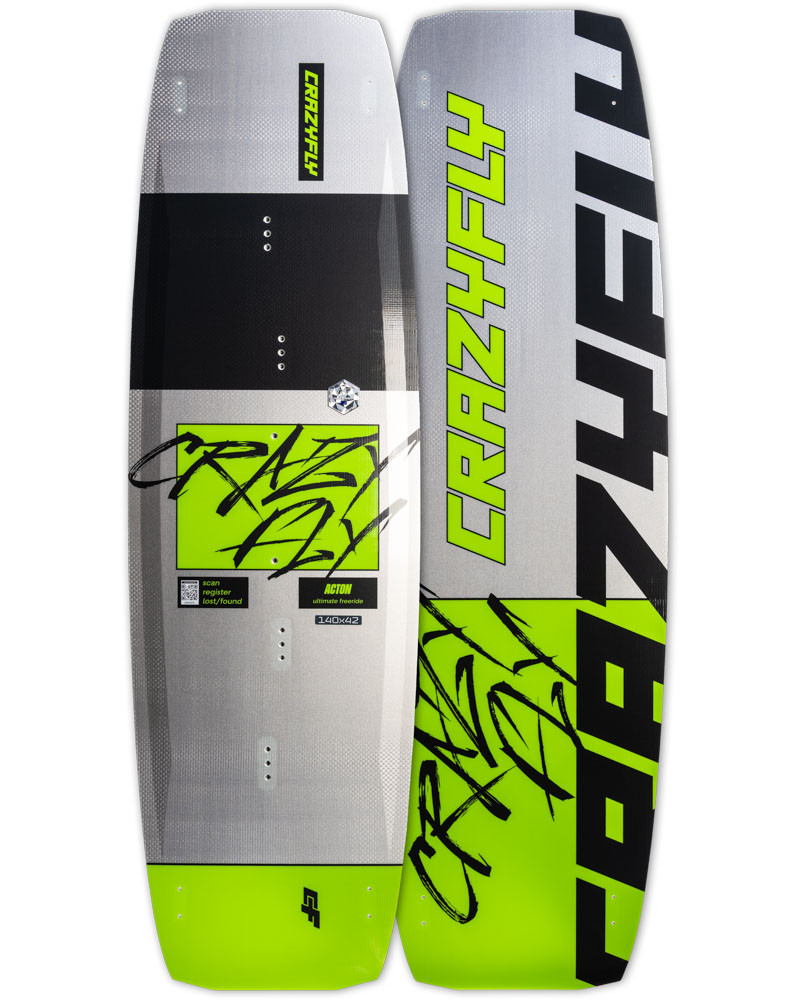
The Acton is the entry point into CrazyFly's board range. Three sizes, one price for all of them —
349 € — and a character described as forgiving. Here is what that means on the water, and where the money was actually saved.The short version
- Sizes: 138 × 43, 140 × 42, 145 × 44 cm.
- Weight: 3.0–3.2 kg.
- Purpose: starting out, progression, freeride.
- Season: 2026.
- Price:
A learning board is not a "lesser" board
The common assumption is that a budget board is simply worse, and therefore harder to ride. In reality a learning board has the opposite job to a freestyle board, and "forgiving" is not an absence of qualities but a specific set of choices.
An advanced board is stiff. Stiffness delivers strong pop and a precise response — and it also transmits every mistake straight into your knees. A softer board absorbs chop, forgives a crooked landing and does not throw you off your stance on a sloppy approach.
For someone learning, softness is a function, not a compromise. It directly determines how many hours you can ride in a day and how quickly you tire.
Three sizes, one selection rule
The Acton sizes sit close together — 138 to 145 cm — and the difference between them is about rider weight and wind rather than style.
- 138 × 43 — light riders up to about 70 kg, or spots with consistently strong wind.
- 140 × 42 — the middle and most universal option: 70 to 85 kg.
- 145 × 44 — heavier riders over 85 kg and light-wind spots.
The rule worth remembering: a bigger board planes earlier and starts more easily, a smaller board is faster and easier in the air. When you are learning, the first almost always matters more.
Where the savings are — honestly
You cannot get a thousand-euro board for 349 €, and pretending otherwise is dishonest. The difference usually sits in three places.
Core materials and carbon layup. Premium boards use more expensive composites that deliver stiffness at lower weight. The Acton weighs 3.0 to 3.2 kg — normal, but not remarkable.
Finish and hardware. Fins, bindings and pads are simpler at this price. They work, but adjust less.
Range of use. A forgiving board will never be a top freestyle board — that is not what it is for.
What has not been saved on is durability. A learning board has the hardest life of any: it gets dropped, dragged across sand and thrown into car boots. A brand building boards since 1999 understands that.
Who it suits
A first personal board after lessons. The main scenario: you already water start and go upwind, but you are still building hours.
A second travel board. One you do not mind checking into hold luggage or leaving at the spot.
Rental fleets. One price across three sizes makes purchasing far simpler.
Occasional riders. Twenty sessions a year do not require a thousand-euro board.
Who it does not suit
Freestylers. You need pop and stiffness — that is a different shelf.
Heavy riders in light wind. Even 145 cm may not be enough; look at boards from 150 cm up.
Riders who already feel the board limiting them. If you have reached that feeling, you have outgrown the Acton, and that is fine.
What to buy alongside it
The board ships with bindings and pads, so nothing else is strictly required. Two things are worth thinking about, though.
A bag. The most common damage to a twintip happens in transit, not on the water. Even a basic bag pays for itself in one flight.
Spare fins and screws. A trivial item that saves a session. Fins get lost and broken on the bottom far more often than you would expect.
Common questions
Can I learn from zero on my own board?
The first lessons happen without a board at all — kite first, then body dragging. Your own board becomes relevant at the water start stage, and the Acton fits that point exactly.
How does the Acton differ from the Elite or Max?
By class and job. Elite and Max are stiff boards for powered freeride and freestyle; the Acton is a soft board for progression. We compared the senior models in our Elite V versus Max 2026 comparison.
Why do all three sizes cost the same?
It is a deliberate policy in the budget segment: the buyer chooses by weight, not by price. That makes it less likely someone takes the wrong size to save money.
Will it last several seasons?
In durability, yes. In level, it depends how fast you progress. If you ride a lot, after a season and a half you will want something stiffer.
Is the Acton good for jumping?
For first jumps, absolutely. A softer board gives less pop but forgives landings more gently, and at that stage this matters more.
Where to buy
349 €, three sizes. The rest of the brand's boards are on the CrazyFly page.Not sure which size is yours? Send your height, weight and typical wind and we will size it for you at no charge.
Want advice from an instructor?
Our IKO instructors will help you choose gear or plan a kite trip to Mui Ne — free of charge.
Read next
Starboard came out of windsurfing and became the leading name in SUP. The range: inflatable and hard boards, p…
Inflatable SUP vs Hard Board: What to Choose and the Real DifferenceAn inflatable fits in a boot; a hard board goes faster. Eight differences you feel on the water, and when payi…
How to Read a SUP Board Size: 10'8" x 33", Litres and What MattersThree numbers — length, width and volume — decide whether you paddle or fall. What each one means and how to m…