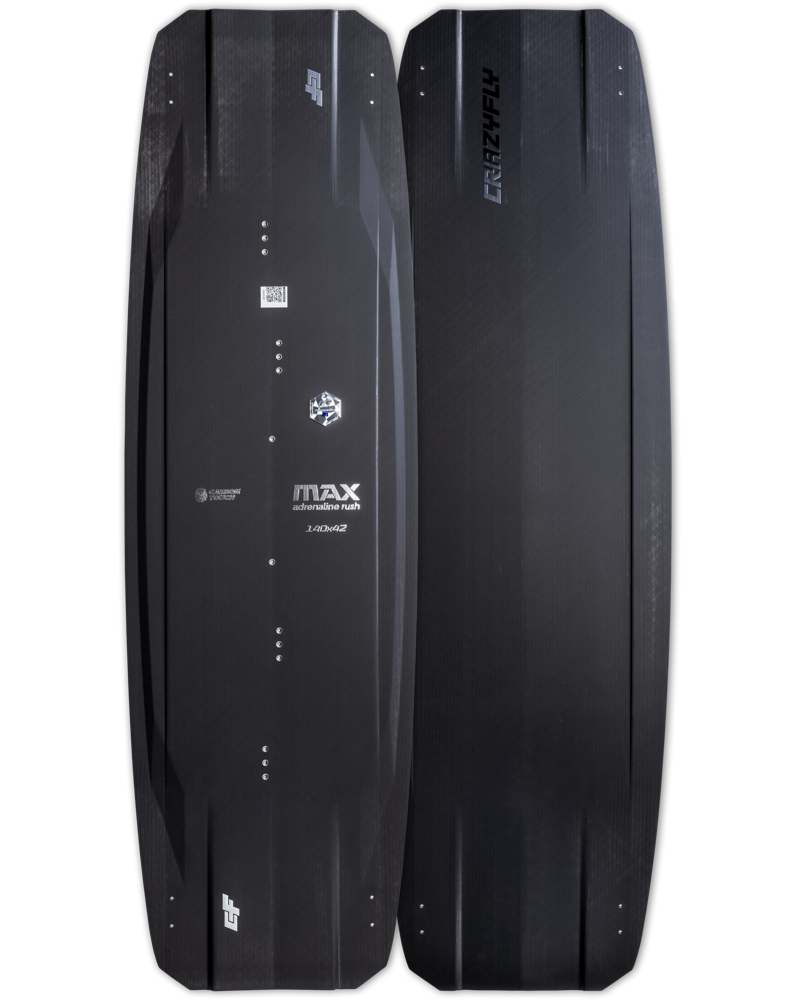
These two CrazyFly boards get compared constantly, and the comparison is usually pointless, because they answer opposite questions. The Elite V exists to launch you upwards; the Max exists to get you moving when nothing else will. Here is which is which.
The short version
| Elite V | Max 2026 | |
|---|---|---|
| Purpose | Freestyle and big air | Light wind |
| Sizes | 136 × 41, 140 × 42 | 138 × 42, 140 × 42 |
| Weight | 1.85–1.95 kg | 2.5–2.6 kg |
| Construction | Full carbon | Light-wind shape |
| Price | from 1 399 € | from 1 119 € |
The number that decides it: 600 grams
The Elite V weighs 1.85–1.95 kg, the Max 2.5–2.6 kg. Six hundred grams on a board is a lot, and it explains nearly everything else.
A light board answers faster, follows you up in a jump and loads the front leg less. A heavier one is more inert, but it tracks through chop more calmly and breaks loose less at speed.
Weight here is a consequence rather than a goal: full carbon on the Elite, a different shape on the Max.
Elite V: the board that pops
A full-carbon top-end board for freestyle and big air. Carbon delivers exactly what it is put there for — explosive pop. The board unloads sharply and throws you, rather than merely leaving the water.
The second consequence of carbon is precision. The Elite goes where you point it, without delay and without vagueness. In freestyle, where everything depends on the instant you load the edge, that is the whole point.
The usual carbon price: it is stiff. Through chop it transmits everything happening underneath, and on a long session in rough water your legs notice.
Max: the board that goes
A large light-wind board that planes early and keeps moving when an ordinary twin-tip has already stopped.
That solves a specific problem familiar to anyone who does not ride in perfect conditions: 12–14 knots, the kite still pulls, the board no longer moves. The Max shifts that threshold down by a couple of knots — and an afternoon on the beach becomes a session.
In exchange it is heavier, slower through turns, and in strong wind it becomes surplus to requirements: it starts skipping across chop and demands more active legs.
How to choose: three questions
How much wind do you actually get? If your season is 12–16 knots and a lot of waiting, the Max will buy you more water time than any other purchase. If it is a steady 18–22, a light-wind board will sit in the bag.
Do you jump or do you ride? Elite is about leaving the water. Max is about moving at all.
What do you weigh? Above 90 kg the Max earns its place even in mid-range wind — area compensates for mass. A light rider will find the Max in the way at 18 knots.
Who should buy neither
Beginners should not buy the Elite V. A stiff carbon board punishes bad landings and transmits every ripple to your legs. While you are still learning to ride upwind, it will make the process painful. Take something softer.
Riders with plenty of wind should not buy the Max. It is a specialist tool. Buying one "just in case" means carrying half a kilo of extra board and losing agility every day for the sake of a few marginal ones.
Neither suits anyone who wants one board for everything. CrazyFly's all-rounder is the Raptor or the Sculp.
Frequently asked questions
Can I ride the Elite V in light wind?
You can, but it is not efficient: it has less area and a slower start than the weight suggests. Below 15 knots is not its job.
Can I jump the Max?
It jumps, but it lands harder and behaves inertly in the air. It is a board about going, not about height.
What should I buy as a first board?
Neither. Both are specialist. A first board wants a mid-flex all-rounder, and in the CrazyFly range that is the Raptor.
Do 600 grams really matter?
In a jump, very much: it changes how the board follows you upwards. Cruising in a straight line, hardly at all.
Are both discounted right now?
Yes, both are in the stock sale: Elite V down from 1,999 to
1 399 €, Max from 1,599 to 1 119 €. Check the product pages for size availability.Where to buy
CrazyFly Elite V from
1 399 € · CrazyFly Max 2026 from 1 119 €. The full range is on the CrazyFly brand page, and the brand itself in our CrazyFly review.Torn between them? Send us your weight, your spot and your typical wind and we will work it out — advice is free.
Want advice from an instructor?
Our IKO instructors will help you choose gear or plan a kite trip to Mui Ne — free of charge.
Read next
Starboard came out of windsurfing and became the leading name in SUP. The range: inflatable and hard boards, p…
Inflatable SUP vs Hard Board: What to Choose and the Real DifferenceAn inflatable fits in a boot; a hard board goes faster. Eight differences you feel on the water, and when payi…
How to Read a SUP Board Size: 10'8" x 33", Litres and What MattersThree numbers — length, width and volume — decide whether you paddle or fall. What each one means and how to m…