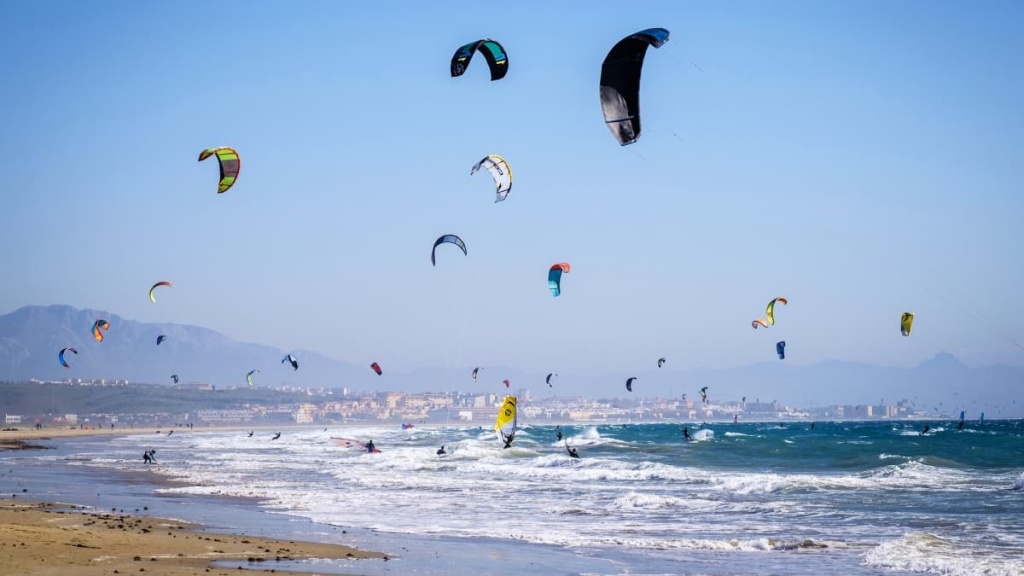
Kitesurfing is one person, one board and a kite the size of a small parachute, using the wind to move across water. That is the whole idea. Everything else — the harness, the bar, the lines, the vocabulary — exists to make that idea controllable.
This is a plain explanation of what the sport is, what the equipment does, how hard it is to learn and what it costs, written by a school that teaches it every day in Mui Ne, Vietnam.
How it actually works
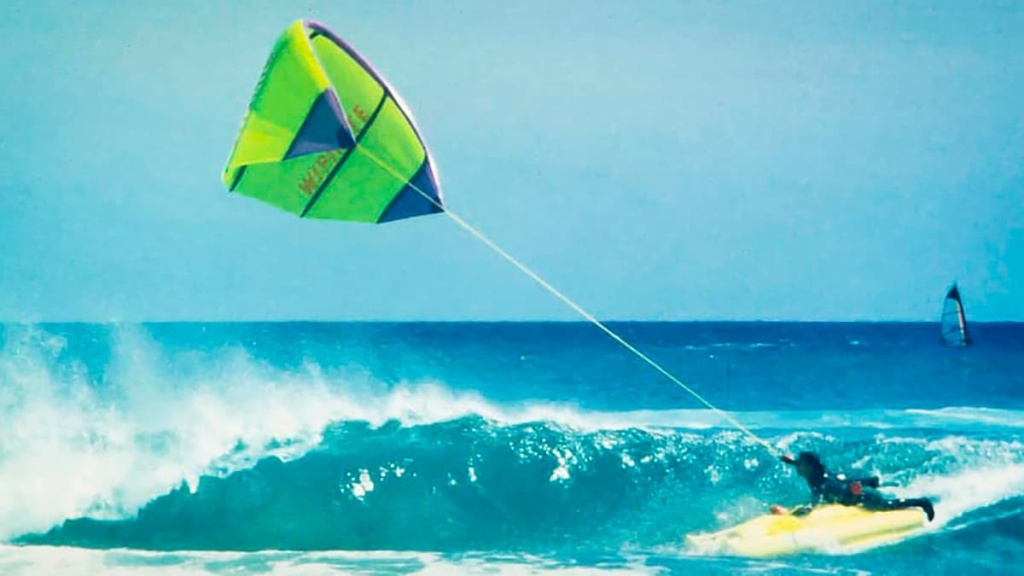
The kite flies on four or five lines about 20–24 metres long, attached to a bar you hold in front of you. The bar connects to a harness around your waist or hips, and the harness takes the load — not your arms. This is the detail that surprises people: you are not hanging on. You are steering.
Pull one end of the bar and the kite turns. Push the bar away and it depowers — the angle of attack changes and the pull drops. Pull it in and the power comes back. Sheeting in and out is the throttle of the sport.
The board is a twin-tip, which rides either direction, or a directional surfboard. Your feet sit in straps or bindings, and unlike wakeboarding there is no boat: the kite provides the pull, and you angle the board against the water to go where you want, including upwind.
The wind window
This is the one piece of theory nobody can skip. Imagine a quarter-sphere of sky downwind of you: that is where the kite can fly.
- The edge of the window — directly overhead or out to the sides. The kite sits there quietly and pulls very little. This is the parking space.
- The power zone — the middle, directly downwind at about 45 degrees. Fly the kite through here and it generates its maximum pull.
- The neutral position — at 12 o'clock, straight above your head, where a kite waits while you sort yourself out.
Riders describe kite position on a clock face: 12 is overhead, 9 and 3 are the sides. "Send it to 11" is an instruction, not a mood. Almost everything a beginner does wrong is a wind window mistake: too much power because the kite went through the middle, or no power because it never left the edge.
The equipment, and what each part is for
The kite
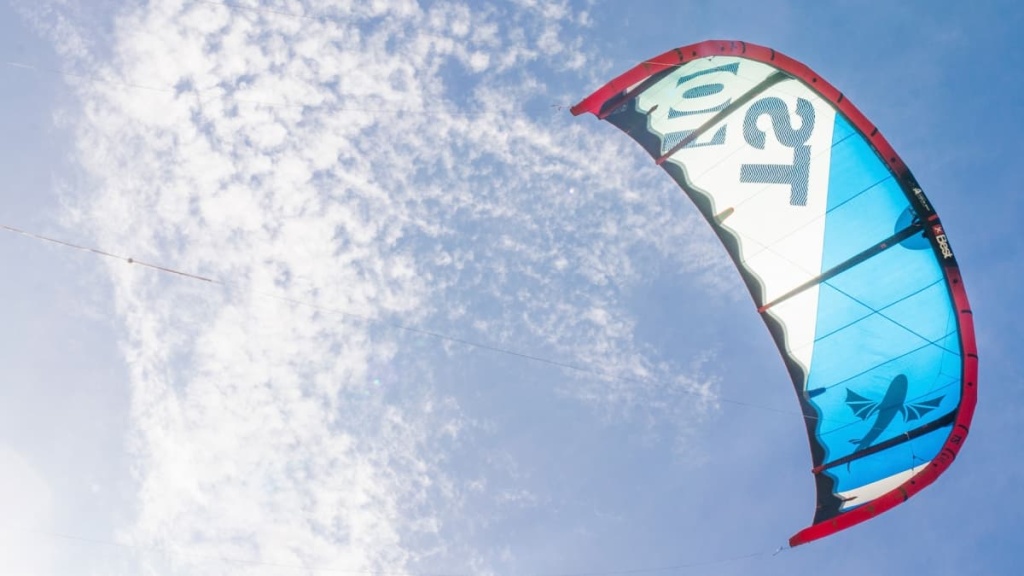
Modern kites are inflatable: a leading edge and struts pumped up with air, which gives the kite its shape and — crucially — lets it float and relaunch from the water. Sizes run from about 5 to 17 square metres. Bigger kite for lighter wind, smaller for stronger. A 75 kg rider in 20 knots is typically on a 9 or 10 metre.
There are also foil kites, with no inflatable structure, which are common in snowkiting and light-wind riding.
The bar and lines
Four or five lines: two front lines carrying most of the load, two steering lines to the wingtips. The bar slides up and down the centre line to power and depower. It carries the safety systems, and those matter more than any other part of your equipment.
The harness
Waist or seat. The chicken loop hooks into it, which is how the kite's pull goes into your hips rather than your hands. Seat harnesses sit lower and suit beginners and people with back trouble; waist harnesses give more freedom and are what most riders end up in.
Safety systems
Two levels, and both are one-handed. The quick release depowers the kite onto a single safety line, so it flags out and stops pulling. The leash release separates you from the kite entirely. Every modern kite has both, and every course spends time making them automatic — you should be able to find them without looking.
The other essential item, which is not sold as safety equipment and should be: a hook knife on your harness. If you are ever tangled in lines with a kite that powers up, seconds matter.
The board
Twin-tips are symmetrical and ride both directions — what almost everyone learns on and most people ride for good. Directional boards look like surfboards and come into their own in waves. Foilboards have a hydrofoil under them and fly clear of the water in light wind: a separate discipline with its own learning curve.
How hard is it to learn
Easier than it looks from the beach, harder than it looks on Instagram. Most people need 8–15 hours with an instructor to ride independently — four to seven days at one or two hours a day, because wind sets the schedule.
The order is fixed for good reason: theory and the wind window, then flying the kite on land, then body dragging in the water without a board, then self-rescue, then the water start, then riding upwind. The board comes late, and that is correct.
Fitness barely matters — the harness carries the load. Weight matters only in choosing kite size. What actually predicts fast learning: patience with the boring kite-control drills, and not panicking when something goes wrong.
Is it dangerous?
It has a reputation earned in the early 2000s, when kites had no depower and no releases. Modern equipment is a different sport. That said, the honest list of what deserves respect:
- Getting tangled in lines in the water. The real one. Carry a hook knife and know where it is by feel.
- Offshore wind. Wind blowing off the land takes you away from it. Side-offshore is workable; straight offshore is not.
- Squalls and thunderstorms. Wind can double in minutes under a storm cloud. When the beach lands, land.
- Hard objects downwind. Piers, rocks, boats, people. Know what is downwind before you launch.
- Being overpowered. The most common cause of beginner injury, and the easiest to avoid: take the smaller kite.
Taught in the right order with a helmet, an impact vest and someone watching, it is a sport with manageable risk — comparable to skiing rather than to base jumping.
What it costs
Lessons. A private hour with us is
55 €; the full course from zero to independent riding is 600 €, gear and radio helmet included. Prices elsewhere vary widely; be suspicious of the very cheapest.Rental.
80 € a day, 330 € a week for a full set with us.Your own gear. A new kite, bar, board and harness runs to a few thousand euros; a sensible used set is far less. Do not buy until you have finished a course and know what you actually ride.
After the entry cost, it is cheaper than skiing: no lift passes, equipment lasts several seasons, and the wind is free.
The disciplines
- Freeride — riding around, cruising, small jumps. What most people do most of the time, and what all courses lead to.
- Freestyle — unhooked tricks and rotations, done on flat water.
- Big air — going as high as possible. Cape Town is the world capital.
- Wave riding — a directional board and a kite used as a means of getting to the wave.
- Foiling — a hydrofoil under the board, flying above the surface in wind too light for anything else.
- Snowkiting — the same kite on skis or a snowboard, on frozen lakes and tundra.
Frequently asked questions
Do I need to be strong?
No. The harness takes the pull. If your arms are tired, you are doing it wrong — that is a technique problem, not a fitness one.
Do I need to swim well?
You need to be comfortable in water over your head wearing a flotation vest. You do not need to be a strong swimmer, and in shallow learning spots you are rarely far from standing depth.
What wind do I need?
Roughly 12–25 knots for most riders. Below that you need a foil or a very large kite; above it becomes a job for smaller kites and better skills.
How old is too old, or too young?
We have taught people in their sixties and children of ten. What matters is body weight relative to kite size and the ability to listen — not the number.
Can I teach myself?
Physically yes; sensibly no. Self-taught riders usually have the same two gaps — self-rescue and upwind riding — and they are also the ones rental stations refuse. A course is cheaper than one broken kite.
What is the difference between kitesurfing and kiteboarding?
Nothing meaningful. "Kiteboarding" is more common in the United States, "kitesurfing" in Europe. Strictly, kitesurfing sometimes implies a directional board in waves, but in everyday use they are the same sport.
Where to start
With a lesson, on a beach with shallow water and side-shore wind. If you are coming to Asia, our courses in Mui Ne are on the lessons page, and the destination is described honestly — season, currents, budget, visas — in the Mui Ne guide.
Want advice from an instructor?
Our IKO instructors will help you choose gear or plan a kite trip to Mui Ne — free of charge.
Read next
One board for a whole family almost never works. Starboard's kids' models, the tandem, and why 'a smaller adul…
Touring vs All Star: A Touring SUP and a Racing SUPBoth boards are long and both are fast, but the jobs differ. How 14'0"×30" differs from 14'0"×24.5", and why a…
Starboard iGO Review: The All-Rounder People Start WithThe iGO is Starboard's best-selling board: several sizes, inflatable and hard versions, a package with paddle …