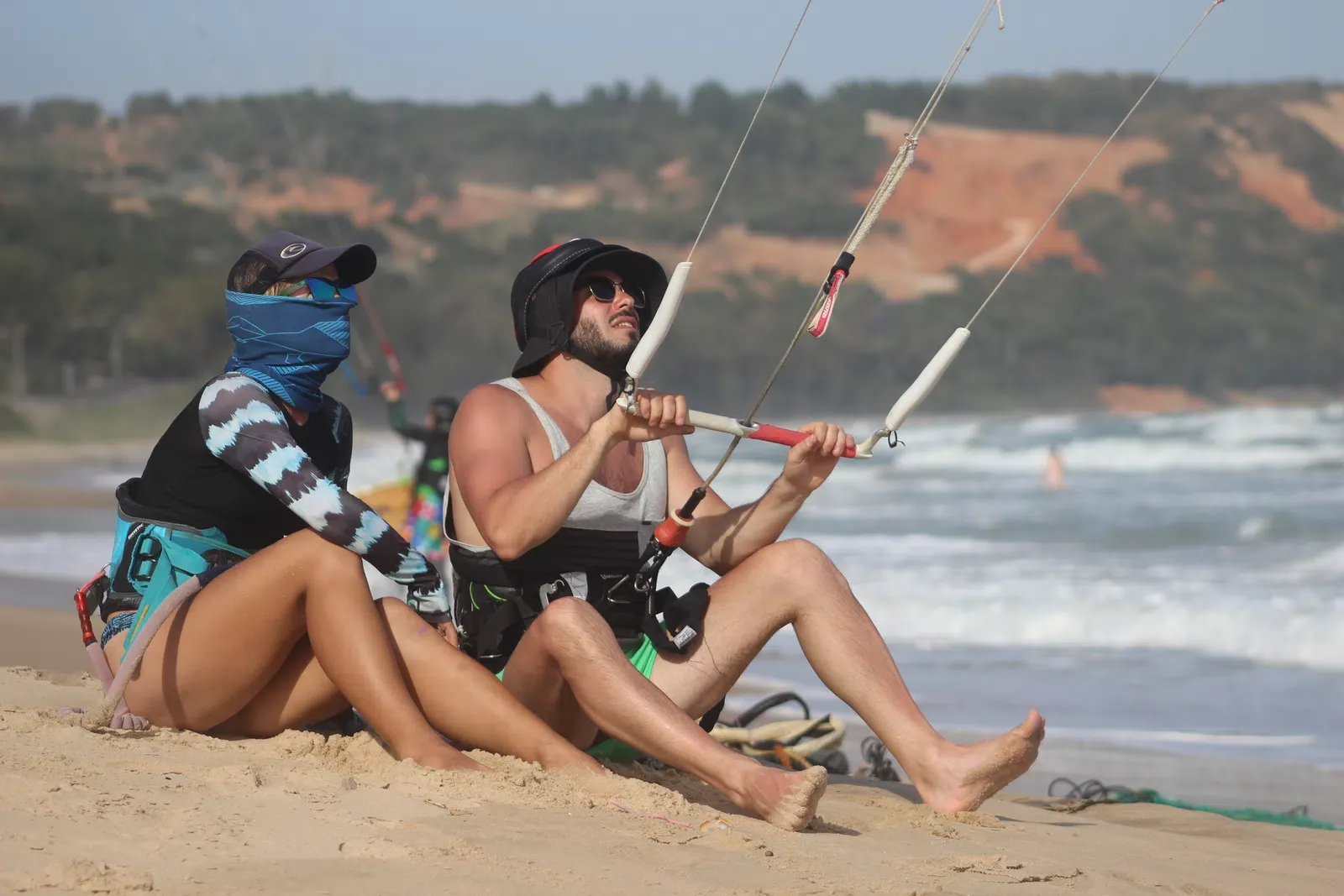
Depower is what separates a kite from a toy: the ability to remove the pull at any moment without letting go and without losing control. Here is how it works physically, the one mistake every beginner makes, and how to stop making it.
What depower is
Depower means reducing the kite's pull by changing the canopy's angle of attack. You push the bar away — the front lines tension more than the back ones, the kite meets the wind at a sharper angle, and lift drops.
Pull the bar in and the opposite happens: angle of attack increases, the canopy loads up and pulls harder.
The bar is the throttle. In for more, away for less. Everything else in kitesurfing is built on that movement.
The mistake everyone makes
It is the same for everybody and it is instinctive: when people get frightened, they pull the bar in.
The reflex makes sense — we grab what scares us. In kiting it is exactly backwards: the pull increases, the kite hauls harder, the fear grows, the hands pull harder still. Most unpleasant first-week stories look like that.
The correct movement is to push the bar away. The kite gives the power back and becomes something close to a flag hanging above you.
The reflex can only be retrained by repetition: on land, then in the water, dozens of times, until it is automatic. That is precisely why a course spends so many hours on kite control before the board appears.
How it works on the bar
The bar slides up and down the centre line. The travel is thirty to forty centimetres, and the kite's entire power range lives inside it.
The trim strap above the bar sets the baseline: shorten it and the kite is more powerful across the whole range, let it out and it is softer. That is the coarse adjustment for the day's wind; the bar is the fine adjustment for the moment.
A properly trimmed kite in working wind should ride with the bar around the middle of its travel. If you only move with the bar pulled all the way in, the kite is too small or the trim is out. If you ride with arms extended, the reverse.
Depower and safety
Depower is the first level of safety, not the last. The order is:
- Push the bar away. Power drops and the situation usually resolves itself.
- Release the chicken loop. The kite goes onto the safety line and flags out — it stops pulling entirely.
- Release the leash. Full separation from the kite. Last resort; the kite goes.
All three are one-handed and all three must be automatic. On the water there is no time to think.
How much depower different kites have
Depower range is a property of the kite and it varies a lot. High-aspect kites like the Ozone Edge have a wide range: one size covers more wind. Wave kites like the Reo use depower differently — what matters there is how fast the pull disappears, not how deep the range is.
The practical consequence: the wider the depower range, the fewer sizes you need for a season. That is real money, not a spec-sheet line.
Frequently asked questions
Can depower remove the pull completely?
Almost. A fully depowered kite pulls very little but stays in the air and keeps flying. Only a release removes the pull entirely.
Why does the kite still pull when I have pushed the bar away?
Two usual reasons: the trim is shortened, so you are working at the top of the range; or the kite is simply too big for the wind. The first takes a second to fix, the second takes a different size.
Do all kites have depower?
All modern inflatables and foil kites with a bar do. Early 2000s kites barely had any — which is where the sport's dangerous reputation came from.
How do I know the trim is right?
You ride confidently with the bar near the middle of its travel, with room to move in both directions.
Should I adjust trim while riding?
Yes, and it is normal. Wind builds, let the trim out; wind drops, shorten it. It is done one-handed on the move.
What comes next
Depower is taught in the very first lesson, before anything else — it is part of the IKO Discovery level. We described the whole course day by day in how a kitesurfing course is structured, and lessons in Mui Ne are on the course page.
Want advice from an instructor?
Our IKO instructors will help you choose gear or plan a kite trip to Mui Ne — free of charge.
Read next
Starboard came out of windsurfing and became the leading name in SUP. The range: inflatable and hard boards, p…
Inflatable SUP vs Hard Board: What to Choose and the Real DifferenceAn inflatable fits in a boot; a hard board goes faster. Eight differences you feel on the water, and when payi…
How to Read a SUP Board Size: 10'8" x 33", Litres and What MattersThree numbers — length, width and volume — decide whether you paddle or fall. What each one means and how to m…