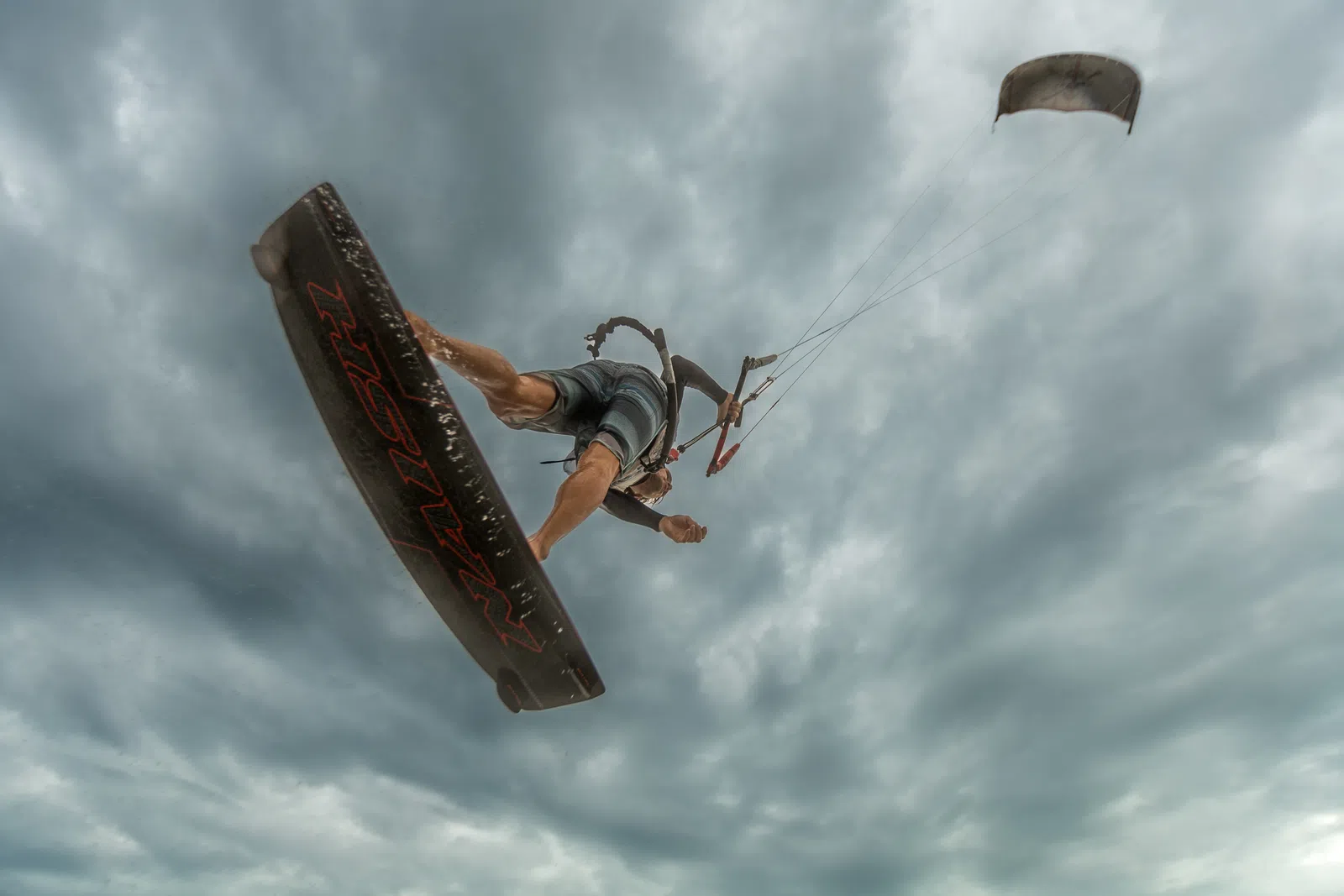
Most people booking a course want to know one thing that price lists never answer: what will I actually be doing on Tuesday? Here is the honest shape of a full course, based on how ours run in Mui Ne.
The days below assume one or two hours on the water each day. Wind decides everything, so treat this as a sequence rather than a calendar.
Day one: the ground school nobody photographs
Wind direction, the wind window, hazards, the safety systems. Then a trainer kite on the sand, then the real kite on land: parking it, moving it, taking the power away on purpose.
What people feel on day one: impatience. You came to ride and you are standing on a beach holding a bar. This is normal and it is not a waste — riders who rush this day fight the kite for the rest of the week.
Day two: into the water, without a board
Relaunching the kite from the water, then body dragging: downwind first, then across the wind. You will swallow some sea and lose track of the kite a few times. Everyone does.
What usually goes wrong: looking at the kite instead of where you are going, and pulling the bar in when startled instead of pushing it away. The second one is instinct, and unlearning it is what this day is for.
Day three: upwind body drag and self-rescue
Dragging upwind and one-handed, as if recovering a board. Then packing the kite down on the water and getting yourself home.
This is the day people find least glamorous and value most later — usually about a month later, when the wind dies far from the beach and they know exactly what to do.
Day four: the water start
Board on your feet at last. The first attempts are short and ugly. Then something clicks and you get a few metres, then twenty, then a proper run.
What usually goes wrong: standing up too early, sending the kite too hard, and staring at the kite. Your instructor will say all three into your helmet radio about forty times, and by evening you will be saying them to yourself.
Day five and beyond: riding upwind
The skill that turns a beginner into a rider: edging the board so you finish where you started instead of walking back up the beach. It takes a few sessions and then arrives all at once.
After that: controlling speed, stopping deliberately, turning, and self-launching. At that point you can rent equipment anywhere.
How this maps to the IKO levels
- Level 1, Discovery (1A–1E) — days one and part of two: conditions, setup, safety, kite control.
- Level 2, Intermediate (2F–2I) — days two and three: body dragging both ways and upwind, water relaunch, self-rescue, first water starts.
- Level 3, Independent (3J–3N) — days four onward: riding upwind, speed control, transitions, toeside, self-launching.
Each level is recorded on your IKO card, which is what a rental station abroad will ask to see.
Frequently asked questions
Why does the board come so late?
Because the dangerous part of this sport is above your head. A rider who cannot control the kite on a board is not learning faster — they are learning to be dragged.
Can I skip ahead if I pick it up quickly?
Yes. The syllabus is a sequence, not a fixed number of hours. Fast learners move up the same day; the levels record what you can do, not how long you took.
What happens if the wind stops mid-course?
Hours are moved, not burned. On windless days there is surf, SUP or foil, and theory that is genuinely worth doing on the sand.
How many hours in total?
8–15 with an instructor for most people. Our full course is 15 hours precisely because that covers the slower path without anyone feeling rushed.
Course levels, prices and what is included are on the kitesurfing lessons page. If you have already started somewhere else, tell us where you stopped and we will pick up from there — write to us.
Want advice from an instructor?
Our IKO instructors will help you choose gear or plan a kite trip to Mui Ne — free of charge.
Read next
Starboard came out of windsurfing and became the leading name in SUP. The range: inflatable and hard boards, p…
Inflatable SUP vs Hard Board: What to Choose and the Real DifferenceAn inflatable fits in a boot; a hard board goes faster. Eight differences you feel on the water, and when payi…
How to Read a SUP Board Size: 10'8" x 33", Litres and What MattersThree numbers — length, width and volume — decide whether you paddle or fall. What each one means and how to m…