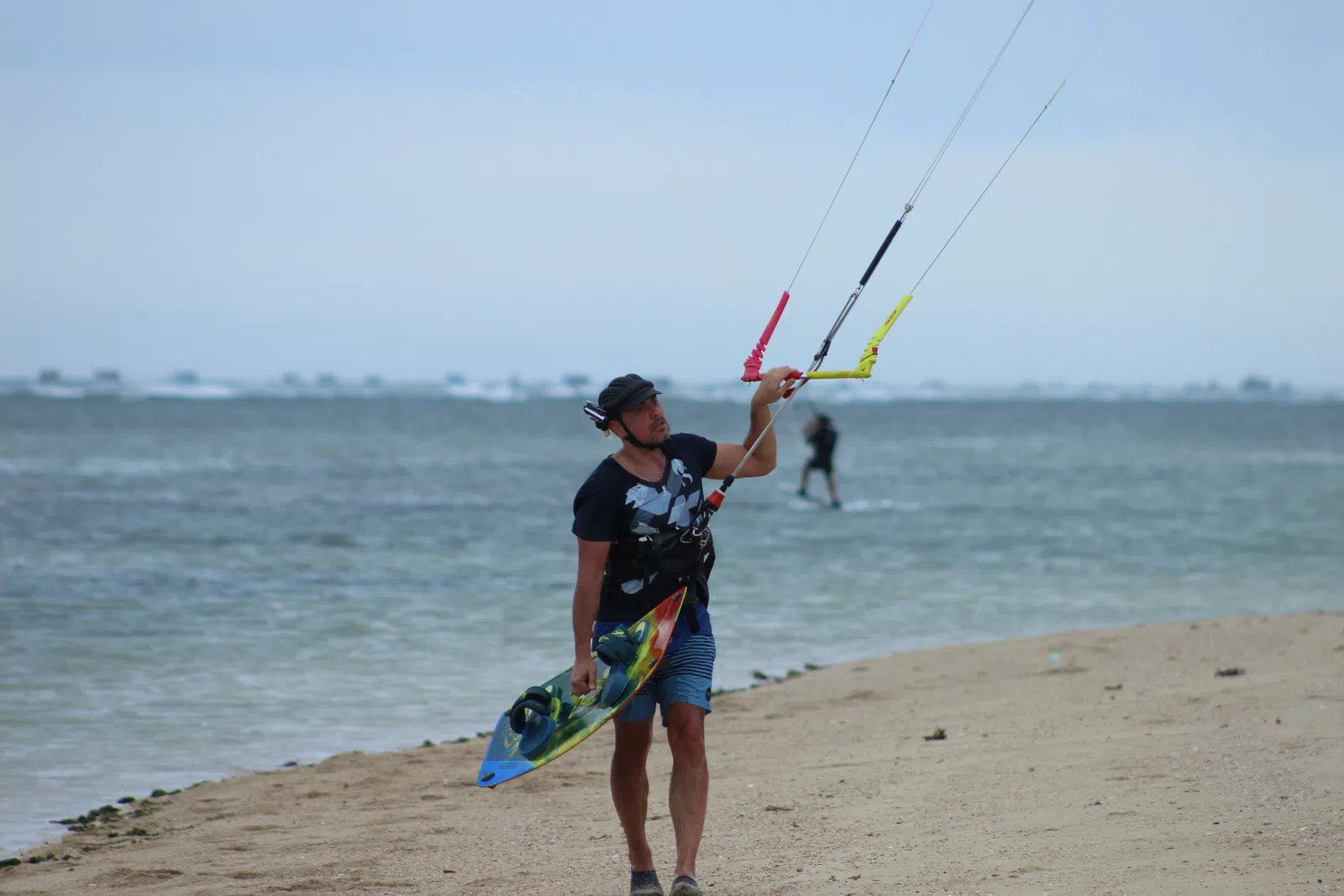
"How much does it cost to open your own school?" is a question we get on the beach regularly — usually from students who have ridden a season and fallen in love with the thing. We have been running since 2006, with a station in Mui Ne and a base in Crimea, so we have an answer. It is an inconvenient one.
Equipment is not the main line item. Let us go through it in order.
Certification: where it starts
A school without certification is a person teaching for money. Formally that is possible in many countries; in practice it means no standard, no insurance and no right to call yourself a school.
IKO is the international body that defines the teaching programme, the levels and the requirements for instructors. What that gives you in practice:
- A single programme. A student who starts with you continues at any school in the world from the same point.
- Liability insurance. The critical one. Without it, a single accident closes the school.
- A criterion the student understands. Someone choosing a school in an unfamiliar country goes by the certificate.
An instructor takes a course and certifies their level; the school is accredited separately. More on how the system works in our article on the IKO standard.
The teaching fleet: how much you actually need
The number to work from is not "how many kites" but "how many students on the water at once".
The standard allows a maximum of two students per instructor. Each student needs a kite, bar, harness, board, helmet and impact vest. Plus a spare kite in another size: the wind changes during a lesson, and without a second size half the session is wasted.
A realistic starting fleet for two instructors is six to eight kites in three sizes, four boards, six harnesses in assorted sizes and a full set of protection per student. At catalogue prices for entry-level gear — an Acton at
349 €, a Sculp at 1 489 € — that adds up to a knowable number, and it is not the scariest one on the list.What people miss at the start: school equipment lasts one or two seasons, not five. Students drop kites, drag them across sand and tangle lines. It is a consumable, not an asset. Budget for replacing a third of the fleet every year.
The boat: the cost that decides everything
Teaching from a boat is not a luxury. It is safety, and it is speed of learning.
Students drift downwind. Without a boat the instructor walks after them through the shallows — where shallows exist — or the lesson becomes an endless trudge back to position. With a boat the instructor is right there, sees everything, and picks someone up in a minute.
A boat drags fuel, mooring, servicing, licences and permits along with it. Across a season it usually costs more than the entire kite fleet. And on many spots you cannot legally operate without one.
People: where you cannot economise
An instructor is not someone who rides well. It is someone who can explain, who sees a mistake before it happens, and who stays calm when a student panics.
Good instructors are scarce and know their worth. Seasonal work means you need something to keep them between seasons, or you rebuild the team every year — and every year the quality drops back to beginner level.
Language is its own line. On an international spot a bilingual instructor costs more and repays it three times over.
Location: the thing you cannot buy
The spot shapes the school more than the equipment does. What matters:
- Wind consistency. Not strength, predictability. A student needs a steady 12 to 18 knots, not thirty.
- Shallow or flat water. Learning in chop is misery.
- Beach width. Kites are launched on land, and there has to be room.
- Season length. Three months of wind means the entire annual economy has to fit into three months.
Season length is exactly why we run two bases: Mui Ne in winter, Crimea in summer. A single spot means the team and the fleet sit idle for half the year.
What eats money quietly
Moving equipment. Shipping a fleet between bases is expensive. Often it is cheaper to keep two fleets.
Repairs. Patches, lines, valves, bars. Small items that add up to a real number over a season.
Weather downtime. A windless week means wages without revenue. A reserve is mandatory.
Marketing. A school without a flow of students is a fleet in a storeroom. A website, photographs, reviews and search presence are year-round work, not season work.
The honest conclusion
A kite school is not passive income and not a way to turn a hobby into a job. It is a service business with seasonality, physical asset wear and full responsibility for people's lives on the water.
It works for those who treat teaching as a craft rather than as an extension of their own riding. An instructor who rides more than they teach during the season is a bad sign for a school.
Common questions
Is IKO certification mandatory?
Legal requirements vary by country. In practice, without it you will not get proper liability insurance, and you lose the students who choose a school by its standard.
Can you start without a boat?
On shallow spots, yes, for a while. On deep water, no: that is a safety question, not a convenience one.
How many instructors do you need at the start?
Two. One instructor means no backup: illness, travel or injury and the school stops.
How fast does school equipment wear out?
Several times faster than personal gear. Plan on replacing roughly a third of the fleet each season.
What matters more, equipment or instructors?
Instructors. A good instructor will teach on average equipment. A poor one will not, on excellent equipment.
What to read next
How lessons are structured step by step — IKO levels. Why the standard matters at all — learning to the IKO standard. Our station and team are on the school page.
Try kitesurfing in Mui Ne
A trial hour with an IKO instructor is €55, all gear included. Then a course to independent riding or a December kite camp.
Read next
Red and White Dunes, Fairy Stream, Red Canyon, the fishing village, Cham towers and the Whale Temple — what fi…
Mui Ne or Nha Trang (or Phu Quoc): Where to Go in Winter and Where to RideThree popular Vietnamese resorts in winter: where it is dry, where the sea is calm, where you get wind and wav…
Mui Ne with Kids: Sea, Season, Safety and What Children Can DoWhen the sea in Mui Ne is calm and when it is rough, the best time to swim, from what age kids learn to surf a…