Anyone can hand you a kite. A school with an IKO affiliation is promising something narrower and more useful: that the person teaching you was trained to teach, that the sequence you are taught in has been thought about by people who investigated accidents, and that what you learn is recorded in a way the rest of the world recognises.
This article explains what the standard actually contains, why the order of lessons matters more than the number of them, and what you should ask a school before you pay. We are an IKO school in Mui Ne, Vietnam, so we have a stake in the answer — which is why everything below is checkable rather than promotional.

What IKO is
The International Kiteboarding Organization was founded in 2001, at the point where kitesurfing stopped being a handful of experimenters and started being a sport that ordinary people wanted to try. It is the largest certification body in kiteboarding: it certifies instructors, affiliates schools and issues student cards recognised at centres worldwide.
Three things carry the IKO name, and they are often confused:
- Instructor certification. A person who has completed an instructor training course and keeps the certification current.
- School affiliation. A centre that commits to equipment, insurance, ratios and rescue provision.
- Student levels. The card recording what you can actually do, from 1A to 3N.
A school can employ a certified instructor without being affiliated. An affiliated school can, in theory, be sloppy. The card in your hand is the only part that follows you afterwards — which is the part most students underestimate.
Why the order of lessons is the whole point
The instinct of every beginner is to get on the board. The instinct of every good instructor is to keep you off it for longer than you would like. That tension is what the standard resolves, and it resolves it in favour of the instructor for reasons that have been paid for in injuries.
Kitesurfing has an unusual property: the dangerous part is above your head, not under your feet. A snowboarder who loses control stops. A kiter who loses control has an engine still attached to them, still generating power, still able to drag them across a beach or into an obstacle. Everything in the syllabus flows from that single fact.
So the sequence runs: understand the wind, control the kite on land, control it in water without a board, rescue yourself, and only then ride. A school that sells you a board on day one is not being generous with your time. It is skipping the part that keeps you alive.
The levels, in plain language
Level 1 — Discovery (1A–1E)
Ground school and first flights. You learn to assess a spot: wind direction relative to the beach, what is upwind and downwind, hazards, and how to decide whether today is a day to ride at all. You learn the wind window — the arc of sky the kite can fly in, where it pulls hardest and where it rests. You set up the kite, learn the safety systems, and fly a trainer and then the real kite on land.
Most people find this level slower than they expected. It is also the level that determines whether your third day is calm or frightening.
Level 2 — Intermediate (2F–2I)
Water, without a board. Body dragging downwind, then across the wind, then upwind, then one-handed to recover a board. Relaunching the kite from the water. And self-rescue: packing the kite down on the water, winding the lines and getting yourself back to the beach under your own power.
This is the level at which you stop being a liability. A rider who can self-rescue is a rider who can have a bad session instead of an emergency.
Level 3 — Independent (3J–3N)
Riding, and riding properly: the water start, riding upwind so that you finish where you started, controlling speed, transitions, riding toeside, self-launching and landing. At the end of this level you can rent equipment, travel to a new spot and ride without a school.
That last sentence is the definition of independence in this sport, and it is what the third level exists to produce.
What a certified instructor is actually trained in
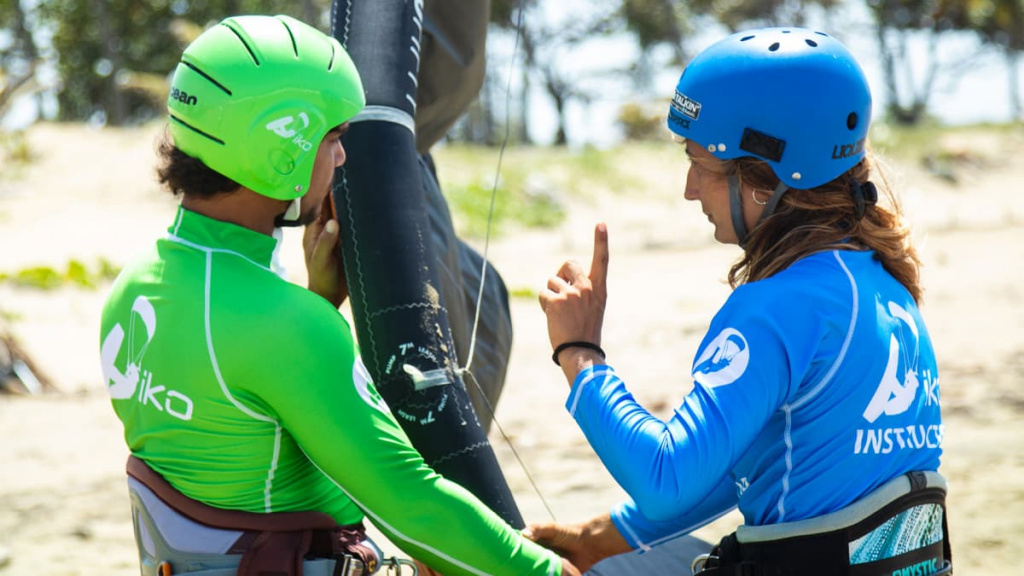
People assume instructor training is about riding well. It is mostly not — plenty of excellent riders are poor teachers. The training covers:
- Teaching methodology. How to break a skill into steps, how to demonstrate, how to correct without overwhelming, how to adapt to a nervous student versus a reckless one.
- Risk assessment. Reading a spot, judging conditions, deciding when a lesson does not happen. Saying "not today" is a skill with a cost, and it has to be trained.
- Rescue. Getting to a student in trouble, dealing with a tangled kite, managing an injury far from shore.
- Equipment. Rigging, trimming, inspecting lines and safety systems, matching kite size to rider weight and wind.
- Communication. Including radio work — in modern teaching the instructor speaks into a helmet rather than shouting across fifty metres of chop.
Certification is also renewed rather than granted for life, which matters in a sport where equipment and safety systems change every few years.
The practical reason the card matters
Here is the argument that convinces people who are unmoved by the safety one.
You finish your course, you travel, and you walk into a rental station in Egypt, Sri Lanka or Brazil and ask for a kite. They will ask what you can do. "I've been riding for a while" is not something a station can act on. They are handing a stranger equipment that can hurt other people on their beach, and their insurance is on the line.
An IKO card answers the question in a form they trust. Without it, expect to be offered a lesson instead of a rental, or to be sent out with a supervisor at your own expense. With it, you are a known quantity.
It also saves you money on your next lesson anywhere in the world, because a new instructor knows where to start instead of spending the first hour finding out.
What affiliation obliges a school to provide
The parts that cost money, which is exactly why they are worth asking about:
- Equipment in serviceable condition, with modern safety systems — not last decade's kites with a chicken loop nobody has tested.
- Helmets and impact vests as standard, not as an upsell.
- Rescue capability on the water.
- Insurance covering the lesson.
- Sane student-to-instructor ratios.
None of this is exotic. All of it is skipped by somebody on every popular beach in the world.
What to ask before you pay
Five questions. Ask them by message before you arrive, and judge the answers as much as the content:
- Is my instructor certified, and by which organisation? Ask to see the card. A real instructor shows it without taking offence.
- How many students per instructor? One-to-one is fastest. Two-to-one is a reasonable economy. Four means you are watching more than riding.
- Is there radio communication in the helmet? This single detail changes how much you learn per hour more than almost anything else.
- What happens if the wind does not blow? A good school moves the hours. Ask before, not after.
- Is insurance included, and what does it exclude? Most standard travel policies exclude kitesurfing entirely.
How long the whole thing takes
Honest numbers from our own students: 8 to 15 hours with an instructor to reach independent riding. That is four to seven days of one or two hours, because the wind decides your schedule, not you.
Roughly: four hours in and you are flying the kite confidently and body dragging. Eight hours and you are getting up on the board. Twelve to fifteen and you are riding upwind and coming back to where you left your towel.
Age and fitness matter far less than people fear. What matters: how much water time the wind gives you, whether you are willing to spend the boring hours on kite control, and whether you panic when something goes wrong.
Frequently asked questions
Can I learn without any certification, from a friend?
You can, and people do. Two things usually go wrong: the friend teaches in the order that seems natural rather than the order that is safe, and there is nobody watching the beach while you are watching the kite. It is also the route that leads to being refused rental later.
Is IKO the only system?
No. VDWS is the major European alternative and is a serious organisation with a comparable syllabus. Some national federations run their own. IKO is the most widely recognised internationally, which is why it is the practical choice if you plan to travel.
Does the card expire?
The student card does not expire. Instructor certifications do — they are renewed, which is the point.
Do I need my own equipment for a course?
No, and you should not buy any until you have finished. Your weight, your local wind and the discipline you end up enjoying all point at different kites. Buying before you know means buying twice.
I already ride. Is there any point in getting certified?
Yes, for two reasons: rental stations, and the fact that most self-taught riders have gaps — usually self-rescue, upwind riding technique, or launching in awkward conditions. A single assessment hour often fixes something that has been annoying you for a season.
Where we stand
We teach the full IKO path in Mui Ne, from Discovery to Independent, with radio helmets, gear and insurance included in every lesson. Prices, levels and dates are on the kitesurfing lessons page, and the destination itself — season, currents, budget — is covered in our Mui Ne guide.
If you are choosing between schools anywhere in the world, use the five questions above. A school that answers them plainly is the one to book, whether or not it is ours.
Want advice from an instructor?
Our IKO instructors will help you choose gear or plan a kite trip to Mui Ne — free of charge.
Read next
Starboard came out of windsurfing and became the leading name in SUP. The range: inflatable and hard boards, p…
Inflatable SUP vs Hard Board: What to Choose and the Real DifferenceAn inflatable fits in a boot; a hard board goes faster. Eight differences you feel on the water, and when payi…
How to Read a SUP Board Size: 10'8" x 33", Litres and What MattersThree numbers — length, width and volume — decide whether you paddle or fall. What each one means and how to m…