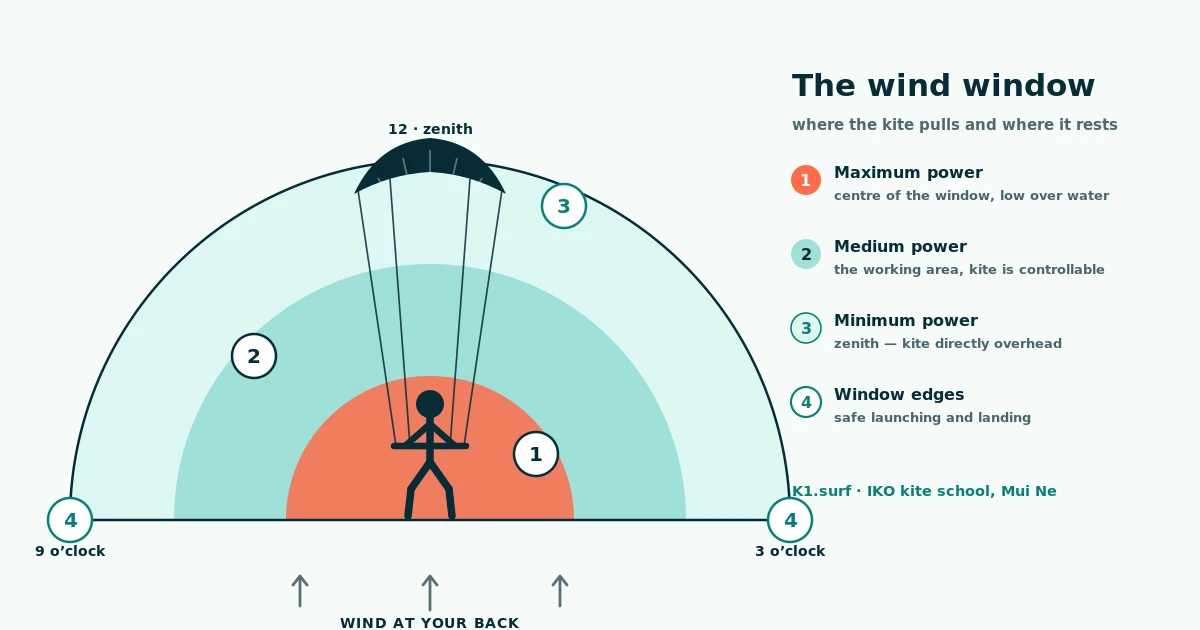
A kite pulls very differently depending on where it sits in the sky. That "where" is called the wind window — the fundamental concept without which you can neither launch nor ride safely. Here's how we explain it to students on the course: simply, using a clock face, and with practice.
What the wind window is
Stand with your back to the wind and spread your arms. Everything in front of you that the kite can fly into is the wind window. Geometrically it's a quarter of a sphere: the zenith above your head caps it, the line you're standing on marks the sides (roughly "3 and 9 o'clock"), and the depth is how far downwind the kite travels. The kite can't fly outside the window — behind you and past the edges the wind no longer holds it.
To describe where the kite is, kiters use a clock face. The zenith directly overhead is 12 o'clock. The horizon to your right is 3, to your left 9. It's a shared language: your instructor says "bring it to 11" and you know exactly where.
Power zones: where the kite pulls and where it rests
The window splits into zones by pull:
The power zone is the centre of the window, straight downwind of you, roughly from 12 down to the water. Here the kite catches the most flow and pulls hardest. This is where we send the canopy for a water start — but a sharp move through the power zone will simply yank a beginner off their feet. The power here needs to be dosed.
The intermediate zone sits between the centre and the edges. Medium pull, controllable kite. This is your working area for accelerating and turning.
The neutral zone — the edge of the window and the zenith — is where pull is lowest. At the zenith (12 o'clock) or right at the edge (3 and 9) the kite barely pulls; it simply holds in the air. These are your rest points: park the kite here when you need to stop, catch your breath or walk into the water.
Why the neutral points save you
The zenith and the window edges are your "stop zones". While the kite is there it isn't dragging you forward and you're in control. This teaches a beginner the single most important habit: to kill the power, don't yank or drop the bar — smoothly steer the kite into neutral.
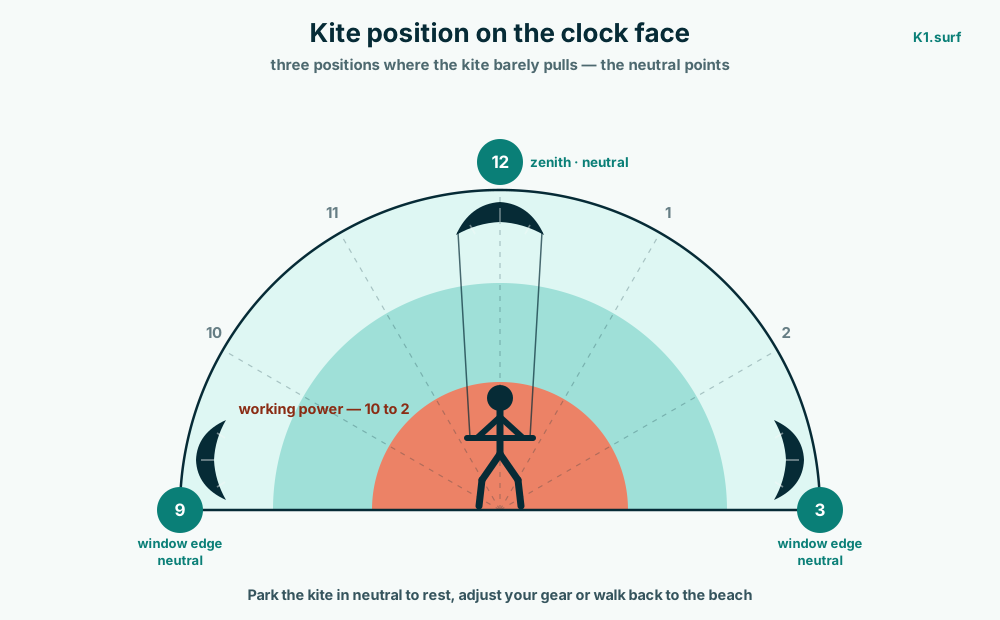
A note on the zenith: holding the kite at 12 is handy for standing still and looking around, but it isn't a permanent parking spot — in strong wind a kite at the zenith can lift and tug, so don't leave it there for long. The window edges are often the safer place to pause.
How the window relates to wind direction
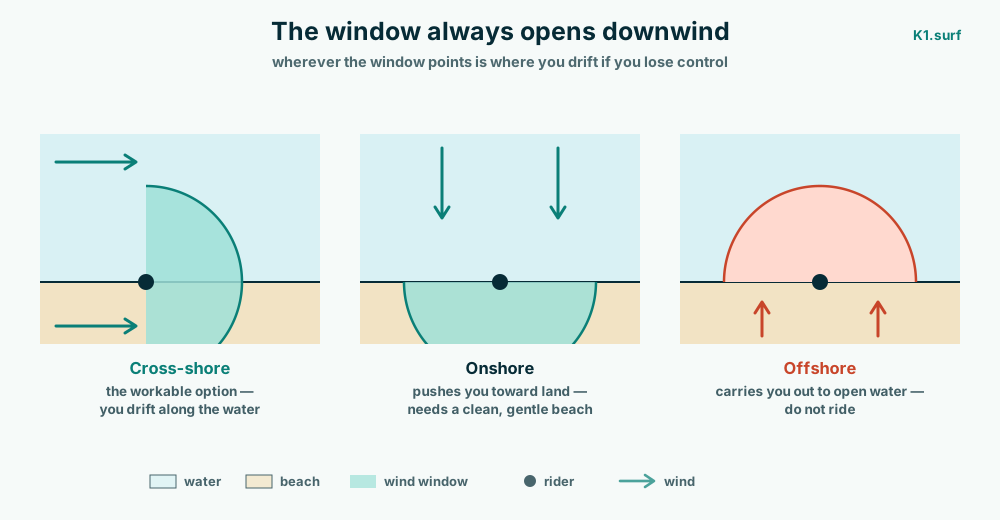
The wind window always hangs downwind of you and rotates with the direction you face. So the first thing a kiter does at a spot is work out where the wind is coming from — from flags, the water, the feel on your face — and stand with their back to it. That determines where the power zone sits and which way you'll ride. How to read the wind and the forecast itself is covered in our guide to reading the wind forecast.
Kite size and the window
The bigger the kite and the stronger the wind, the more powerful the power zone feels. That's why the right size for your weight and wind is half the comfort on the water: with the correct size, the pull in the centre of the window works predictably rather than firing off. Browse kites in the K1 catalogue.
How this is drilled on a course
The theory of the wind window takes five minutes; the feel for it is built on the water. On our kitesurfing course in Mui Ne we first fly the kite around the "clock" on land and on a trainer, then in the water — so your hands learn where neutral is and where the power lives. By the end of the basic course you read the window without thinking.
Frequently asked questions
What is the wind window in simple terms?
It's the space in front of you (standing with your back to the wind) that the kite can fly into — a quarter of a sphere. In the centre the kite pulls hard (the power zone); at the edges and the zenith it barely pulls at all (neutral). Kiters describe the kite's position using a clock face: 12 is the zenith, 3 and 9 are the edges.
Where does the kite pull hardest?
In the centre of the wind window — straight downwind of you, in what's called the power zone. That's where you send the kite for a water start, but you need to move through it in a measured way: a sharp movement through the centre delivers maximum yank.
How do I reduce the pull if the kite is pulling too hard?
Don't yank the bar and don't let go of it — steer the kite smoothly into the neutral zone, either to the edge of the window (3 or 9 o'clock) or to the zenith (12). Pull is minimal there. It's the first thing we teach on a course: control the power through the kite's position, not through panic.
Why doesn't the kite fly behind me?
Because behind you and beyond the edges the wind no longer fills the canopy — the kite loses lift and drops. The wind window is bounded by the line you're standing on; past it the kite can't stay in the air.
Want to build a feel for the window on the water rather than from diagrams? K1 instructors in Mui Ne teach the fundamentals from scratch to the IKO standard — book a course or pick your first kite in the shop.
Want advice from an instructor?
Our IKO instructors will help you choose gear or plan a kite trip to Mui Ne — free of charge.
Read next
The Pivot exists as base, Q Series, LTD, NVision and LW. How they differ in stated purpose and price, and whic…
Naish Pivot vs Ozone Reo: Two Views of a Wave KiteThe Pivot is stated as freeride plus waves, the Reo as pure wave. How an all-rounder with a wave bias differs …
Naish Boxer Review: From 2.8 to 16 Metres in One RangeThe Boxer covers a span most brands split across three models. Why a 2.8 m exists, what a 16 m does, and how t…