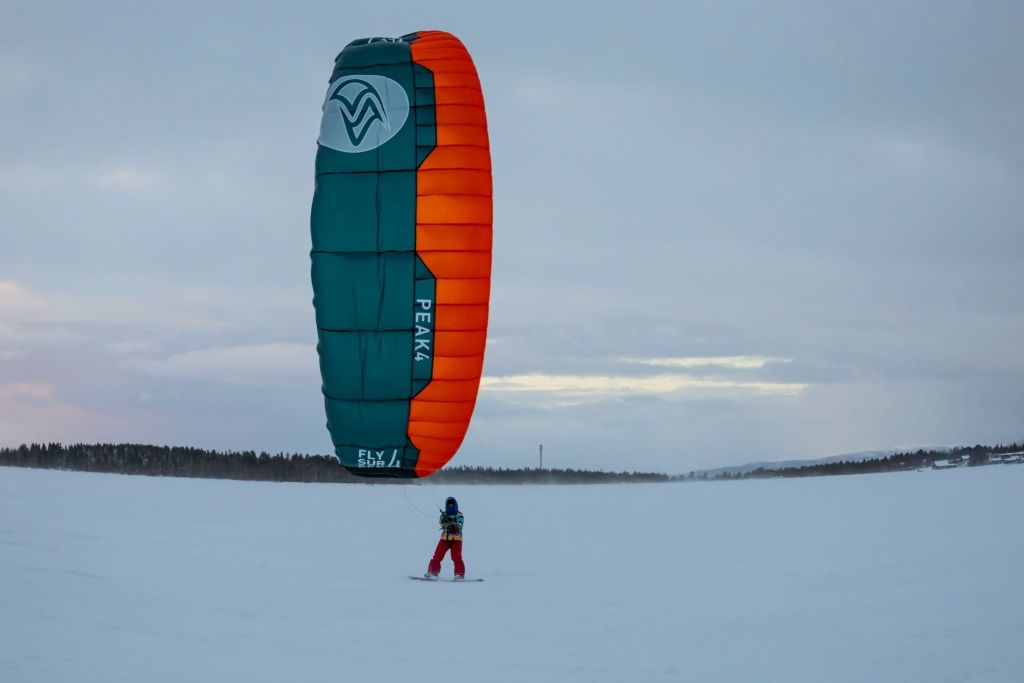
Snowkiting is the same kite, a different surface. Instead of a board on water you have skis or a snowboard on snow, and instead of a summer coastline you have frozen lakes, tundra and open plateaus.
It is also, for most people, the easier way into kiting — and that surprises people who assume the winter version must be harder.
Why it is easier to learn than water kiting
You stand on solid ground from the first minute. On water, a beginner spends hours body dragging and losing the board. On snow, if the kite drops you simply stand there, sort it out and carry on.
Falls are softer and you are never out of your depth.
Your board cannot swim away. Skis and snowboards stay attached, which removes an entire category of beginner disasters.
You can start moving almost immediately. Many people ride on their first day, which on water usually takes several sessions.
What is genuinely harder: cold management, and the fact that a hard surface punishes a bad landing more than water does. Helmets are not optional.
Where you can ride
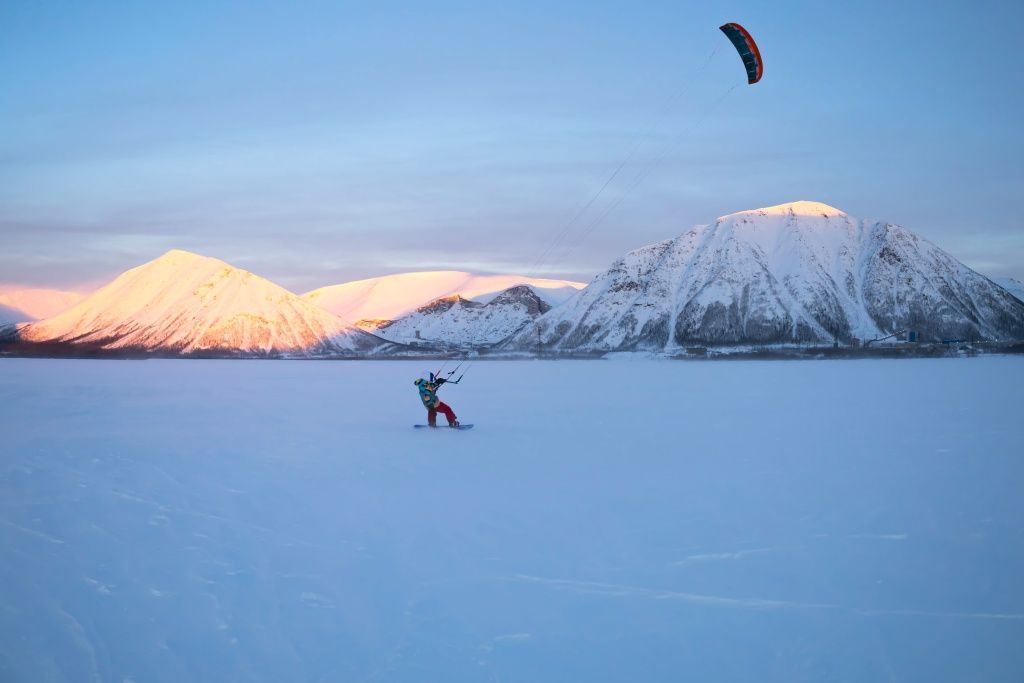
Frozen lakes and reservoirs — the classic surface. Flat, wide, no obstacles. The only rule that matters: know the ice.
Tundra and open plains — the Russian north, where you can ride for kilometres in a straight line. This is distance riding, a different pleasure from doing tricks in one spot.
Mountain plateaus — high, open ground above the tree line. Beautiful, and the most demanding: mountain wind is gusty and turbulent, and altitude changes both kite behaviour and your own.
What does not work: anywhere with trees, fences, power lines or rocks downwind. As on water, always know what is downwind before you launch.
When the season is
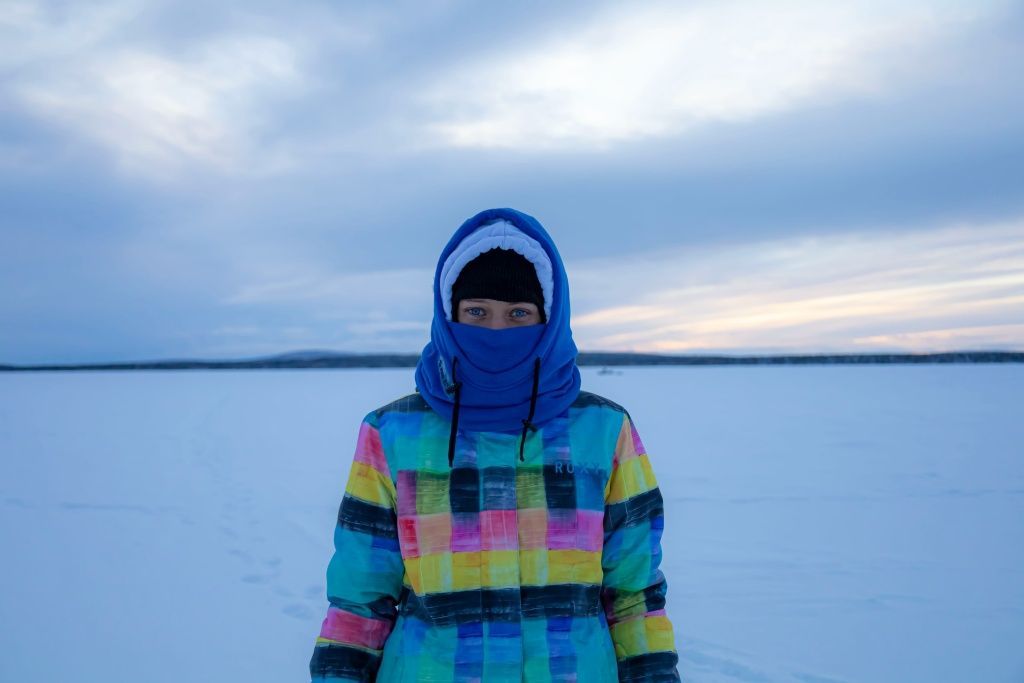
Wherever there is stable snow and open space, which in the Russian north means January to March, and in the mountains often longer. The working temperature range is around −6 to −15 °C: warmer and the snow goes wet and slow, colder and the day becomes about survival rather than riding.
What is different in the equipment
Kites are largely the same, though foil kites dominate on snow: they need no pump, relaunch differently and pack small. Bars and safety systems are identical in principle.
The real difference is everything else — layered clothing, goggles, a face covering, spare gloves, and a helmet you will actually keep on. And a hook knife, exactly as on the water.
Who it suits
Anyone who skis or snowboards and wants a reason to be on a flat, empty plain instead of a queue. Anyone who kites in summer and does not want to stop in winter. And anyone who wants to learn kiting from scratch in conditions where the learning curve is gentler than at sea.
We run winter trips and lessons in the Russian north — see the snowkiting page. Coming from abroad and wondering about logistics? Ask us.
Want advice from an instructor?
Our IKO instructors will help you choose gear or plan a kite trip to Mui Ne — free of charge.
Read next
Three numbers — length, width and volume — decide whether you paddle or fall. What each one means and how to m…
Inflatable SUP vs Hard Board: What to Choose and the Real DifferenceAn inflatable fits in a boot; a hard board goes faster. Eight differences you feel on the water, and when payi…
Starboard Brand Review: SUP, Windsurfing and Foils — 200 ProductsStarboard came out of windsurfing and became the leading name in SUP. The range: inflatable and hard boards, p…