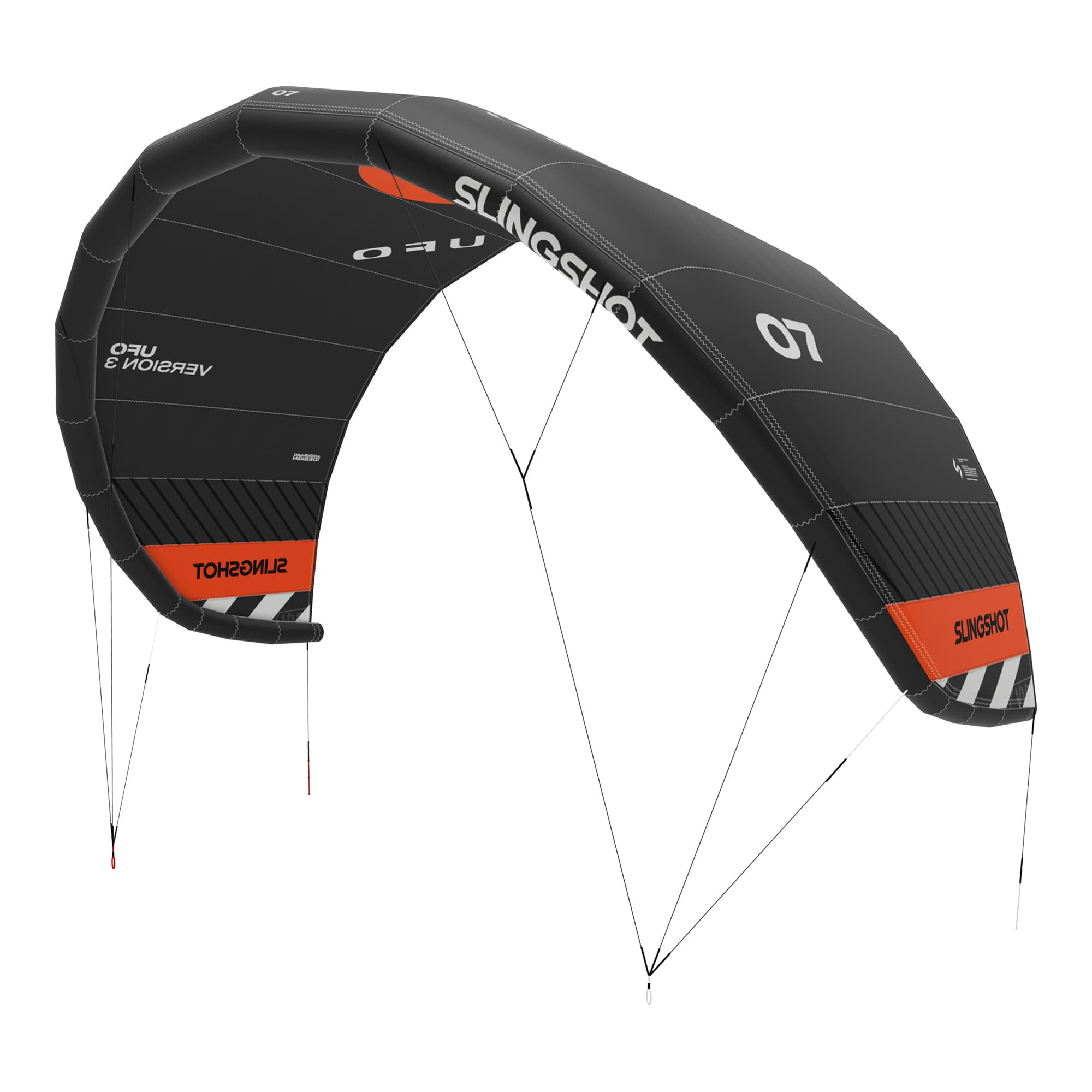
A kite with an unusual construction and a very narrow ladder — 6, 7 and 8 metres. Here is why it is built that way.
The short version
- Price:
What minimal framing gives
We covered a similar idea on the GONG Strutless, and the physics is the same.
Struts are cloth, seam tape, valves and air. Remove them and you remove a noticeable share of canopy mass.
Then the familiar mechanics apply: lift first raises the kite itself, and only the remainder reaches you. So:
- It starts pulling earlier in light wind.
- It drifts better — staying airborne when line tension is lost.
- Faster setup — fewer tubes to inflate.
- Smaller packed size.
The puzzle of the size ladder
Here is the interesting part, and it sets the UFO apart from other lightweight constructions.
A light kite is usually made large: weight matters most at big sizes, where the kite works at its lower wind limit. Which is why the Zephyr is seventeen metres, and why the A-Series' widest price gap falls on the light-wind model.
The UFO comes only in 6, 7 and 8 metres — the upper part of the wind range.
What that means. Small sizes are used in strong wind, where a light canopy's value is not an early start but something else:
- Drift on a wave. In strong wind on a wave a light canopy holds when tension is lost — the thing wave riders accept any compromise for.
- Turning speed. Less mass, faster response.
- Less inertia in gusts.
Conclusion: the UFO is not a light-wind kite despite its light construction. It is a wave and strong-wind kite, and the size ladder says so directly.
What it costs
Honestly, as with any minimal-frame kite.
Less stiffness. Without a full frame the canopy deforms more under load.
Harder water relaunch. A canopy with minimal tubes sticks to the surface more readily.
Less feedback. A framed kite reports its position through the bar more precisely.
More sensitive to tension. Slack lines matter more to this construction.
Who it suits
Wave riders. Drift is the main argument, and it is here.
Foilers. On a foil the lines go slack regularly, and a light canopy stays up where a heavy one falls — mechanics here.
Anyone who travels. Packed size and setup speed.
Anyone who already has a main quiver. The UFO makes sense as a third kite for a specific job rather than as the only one.
Who it does not suit
Beginners. Not because of handling but because of relaunch: while the kite falls twenty times a lesson, a framed one is simpler.
Anyone wanting one kite for everything. A 6 to 8 metre ladder covers a narrow band.
Anyone with light wind. An eight-metre kite will not go in 14 knots however light it is.
Big-air riders. You want stiffness and predictable lift.
Fitting it into a quiver
The practical part, because buying a UFO as your only kite is a mistake.
A sensible layout: a 10 to 12 m all-rounder for the main range plus a 7 m UFO for waves and strong wind.
What that gives: on a stormy day you take a light, turny kite instead of a "small and angry" one, and on a wave you get drift a framed kite of the same area cannot provide.
What it does not give: a wider range downward. For that you need a big kite or a big board.
Common questions
How does the UFO differ from an ordinary kite?
Minimal framing: less weight, better drift and faster setup, but less stiffness and harder relaunch.
Why only 6, 7 and 8 metres?
It is a wave and strong-wind kite. Lightness here works on drift and turning speed rather than an early start.
Will it work in light wind?
No. An eight-metre kite will not go in 14 knots regardless of canopy weight.
Can it be a first kite?
Better not: water relaunch is harder, and while learning the kite falls often.
Where does it belong in a quiver?
Third, for waves and strong wind, alongside a 10 to 12 m all-rounder.
Where to look
994 €. To read: our Slingshot review and the GONG Strutless.Slingshot at K1.surf
Genuine Slingshot gear. Our IKO instructors match the size to your weight, level and wind.
Read next
WKT boards are built for towing behind a boat or a cable park. How it works, why the boards are so small, and …
Kites Above Two Thousand Euros: What You Pay For and When It Pays BackThe Harlem PEAK at 2,144, the Thrive LiteX at 2,794, the Ozone Edge Ultra-X at 2,819. What really sits behind …
The Control Bar: What It Is Made Of and What to Check When BuyingA bar costs 167 to 734 euros and carries your safety entirely. Chicken loop, quick release, depower, line leng…