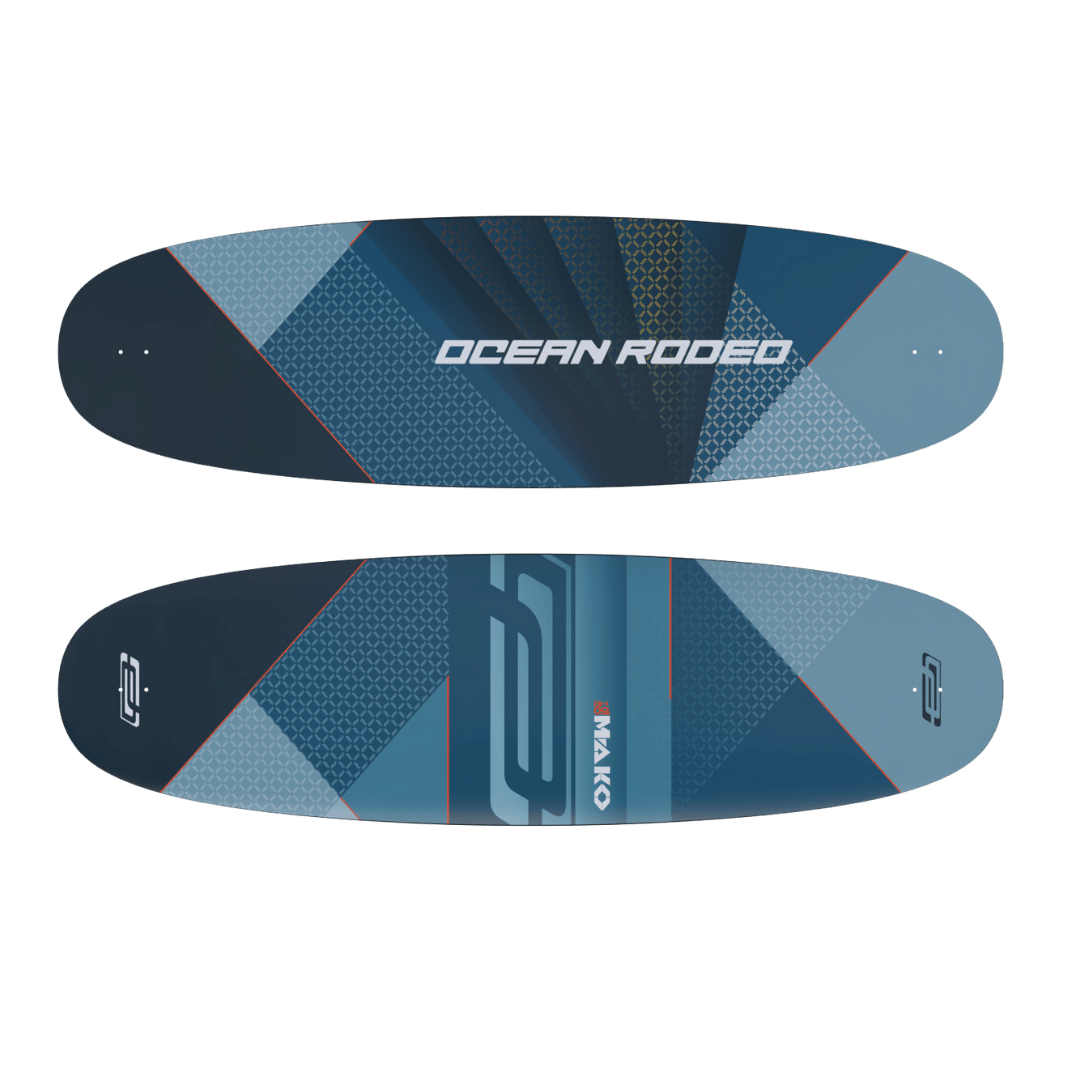
An average twintip is 135 to 140 cm. The MAKO comes in 140, 150 and 165. Here is what the extra quarter-metre does.
The short version
- Price:
What length gives
Simple mechanics, and they explain the whole board.
A longer board has more area at the same width. More area means planing starts earlier.
In practice: you will ride in wind where a standard board leaves you sinking. The gap between 135 and 165 cm is substantial — a different working range rather than a nuance.
A second, less obvious consequence: a long board goes upwind better. More edge in the water means more lateral resistance and less drift.
Third: it is softer in chop. A long board bridges the swell instead of dropping into every trough.
What it costs
Honestly, because length is a compromise rather than a free win.
Worse turning. Transitions are slower and the board resists abrupt direction changes.
Heavier in the air. More area means more drag and more mass.
Worse for tricks. Freestyle on 165 cm is not what this board is for.
Awkward to transport. 165 cm no longer fits every bag or boot.
Who actually needs it
Three scenarios, all real.
1. A light-wind spot. The main one. A big board extends your range downward much as a big kite does — and often more cheaply:
466 € for a board against a thousand-plus for a light-wind kite.An important point people miss: instead of buying a seventeen-metre kite, sometimes changing the board is enough. Especially if you already own a twelve.
2. A heavy rider. Above 95 kg a standard board demands noticeably more wind. Area compensates for weight.
3. Learning. A big board planes earlier and forgives water-start mistakes. This is the case where an "unsporting" size saves you a week of lessons.
Choosing between the three sizes
140×40 — the all-rounder. Already above average yet still manoeuvrable.
150×40 — biased towards light wind at unchanged width.
165×45 — an explicit light-wind board. Note that the width grew too, and width affects early planing more than length does.
Guide by weight:
- under 75 kg: 140
- 75–90 kg: 140 or 150
- over 90 kg, or very light wind: 165
The general twintip logic is in our separate article.
MAKO against SURGE and TEMPEST
Three boards at similar prices, separated by their size ladders:
MAKO — 140 to 165 cm. Light wind and all-round.
SURGE — 133 to 145 cm in 3 cm steps. A fine step signals a board for precise weight matching.
TEMPEST — 135 and 138 cm. Only two sizes, both mid-range: a specialist rather than an all-rounder.
The reading rule: a wide ladder in coarse steps means all-rounder; a narrow two-size ladder means specialisation.
A bigger board or a bigger kite?
The question worth reading to, and the answer is not clear-cut.
The board is cheaper.
466 € against 949 € to 1 702 € for a light-wind kite.But a board extends the range less. A big board buys a couple of knots downward; a big kite buys four or five.
The sensible order: board first, kite second. If you are still ashore after changing boards, then buy the light-wind kite.
And a third option people forget: a foil. It goes from 10 to 12 knots, where no twintip will — comparison here.
Common questions
Why a 165 cm board?
For light wind and heavy riders: more area planes earlier.
What do you lose on a long board?
Turning, ease in the air and transportability. It does not suit freestyle.
What size at 85 kg?
140 or 150 cm. The 165 is for riders above 90 kg or very light wind.
Bigger board or bigger kite for light wind?
Board first — it costs less. But a kite extends the range further: a board gives a couple of knots, a kite four or five.
How does the MAKO differ from the TEMPEST?
By size ladder: the MAKO at 140 to 165 is all-round and light wind; the TEMPEST's two mid-range sizes make it a specialist.
Where to buy
466 €. The section: kiteboards. To read: our brand review.Ocean Rodeo MAKO Kiteboard at K1.surf
Genuine Ocean Rodeo gear. From 466 €. Our IKO instructors match the size to your weight, level and wind.
Read next
Harlem is a small Dutch brand with five kites, four boards and custom colourways. The range from 515 to 2,794 …
ALUULA in Kites: What Double the Price Buys and When It PaysThe A-Series costs 55 to 80 % more than the Dacron version of the same kite. What ALUULA is, why it works hard…
Ocean Rodeo Brand Review: The Canadians Who Built the First ALUULA KiteOcean Rodeo is a small brand with a big technology: the A-Series built on ALUULA composite. The kite range, th…