The catalogue holds boards marked WKT — Wake, Kite, Tow. Here is the most underrated way into foiling.
What tow foiling is
A boat or a cable tows you while you stand on a foil board. You accelerate, take off, and then either stay behind the boat or drop the rope and fly on momentum and pumping.
Three sources of thrust:
- A boat — the classic, holding a rope.
- A cable park — a circulating cable, no boat at all.
- The boat's wake — you drop the rope and ride the wake, as in wakesurfing.
Why it is the best way to learn to fly
The idea worth reading on for.
In any foil discipline a beginner spends 90 % of the time trying to take off rather than flying. You fall, turn around, accelerate again — and a two-hour session yields ten minutes of actual flight.
Behind a boat the thrust is constant, smooth and repeatable. The driver sets the speed, there are no gusts, and every acceleration is identical.
What that gives: in one day you make as many takeoff attempts as a week of winging would provide. And, more importantly, every attempt happens under identical conditions — so you learn balance rather than fighting wind.
Electric assist gives the same effect — covered in our separate article. The difference is that a boat already exists at many bases, while assist must be bought from
3 901 € upward.Which board you need
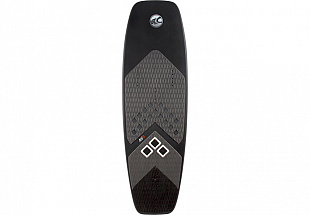
Very short and very low volume — and that is fundamental.
Armstrong WKT Board —
1 182 €, sizes 109, 122, 137 cm.Armstrong WKT Mk II —
1 226 €, 10.5 l (3'7") and 12.5 l (4'0").Note the volume: 10.5 litres. For comparison, a wing foil learner board is 100 to 110 litres — ten times more.
Why so little. The board does not have to hold you on the water: the start comes from the rope, and you simply float with it waiting for tension. Extra volume hinders you — it pushes the board up and prevents submerging the wing.
The same logic as pumping: where standing still is unnecessary, volume becomes an obstacle.
What else you need
A foil. To start: a large front wing area and low aspect — the boat supplies speed, you want predictability.
A short mast. 60 to 70 cm: behind a boat you fly low, and cable parks are often shallow.
Helmet and vest. Mandatory. A fall at boat speed is harsher than in winging.
A rope. Shorter than a wakeboard line: on a foil you ride closer to the boat.
Safety rules — specific to this
The risk differs from other foil disciplines, and it is worth spelling out.
Never wrap the rope around your hand. A basic towing rule, and more critical with a foil: the pull is stronger and there is metal beneath you.
Keep your distance from the boat. A foil travels faster than it looks and closes on the stern surprisingly quickly.
When releasing the rope, release it sideways. A rope under the board means a stop at speed.
Agree hand signals with the driver before starting. Shouting is useless over an engine.
Do not ride in other boats' wakes. Someone else's wash arrives without warning.
Who it suits
Anyone wanting to learn to fly quickly. The most efficient way to accumulate hours.
Anyone near a cable park or a boat. Neither wind nor waves required.
Wakeboarders. Half the skill is there: you can start from a rope and read a wake.
Schools. A first lesson behind a boat lets a student feel flight on day one.
Who it does not suit
Anyone without boat access. Hiring one with a driver is a substantial cost.
Anyone wanting independence. You depend on a boat and the person steering it.
Anyone wanting one board for everything. A 10-litre WKT is good for nothing else.
Common questions
What does WKT mean on a board?
Wake, Kite, Tow — built for towing behind a boat or cable, and for kiting.
Why do such boards have only 10 litres?
The board need not hold you on the water: the start comes from the rope. Extra volume prevents submerging the wing.
Why learn foiling behind a boat?
Thrust is constant and repeatable: one day yields as many takeoff attempts as a week of winging.
What mast do I need?
A short one, 60 to 70 cm: you fly low behind a boat, and cable parks are often shallow.
The main safety rule?
Never wrap the rope around your hand, and keep your distance — a foil closes on the stern faster than it looks.
Where to look
1 182 € and the WKT Mk II 1 226 €. To read: where to start in foiling.Mui Ne wind — right now
Live spot webcam and the wind sensor at the K1 station. Wind is on — book a lesson or rent gear.
Read next
The Harlem PEAK at 2,144, the Thrive LiteX at 2,794, the Ozone Edge Ultra-X at 2,819. What really sits behind …
The Control Bar: What It Is Made Of and What to Check When BuyingA bar costs 167 to 734 euros and carries your safety entirely. Chicken loop, quick release, depower, line leng…
Slingshot UFO: A Kite With One Tube and Why It ExistsThe UFO V3 comes only in 6, 7 and 8 metres and is built unlike an ordinary kite. What minimal framing gives, w…